

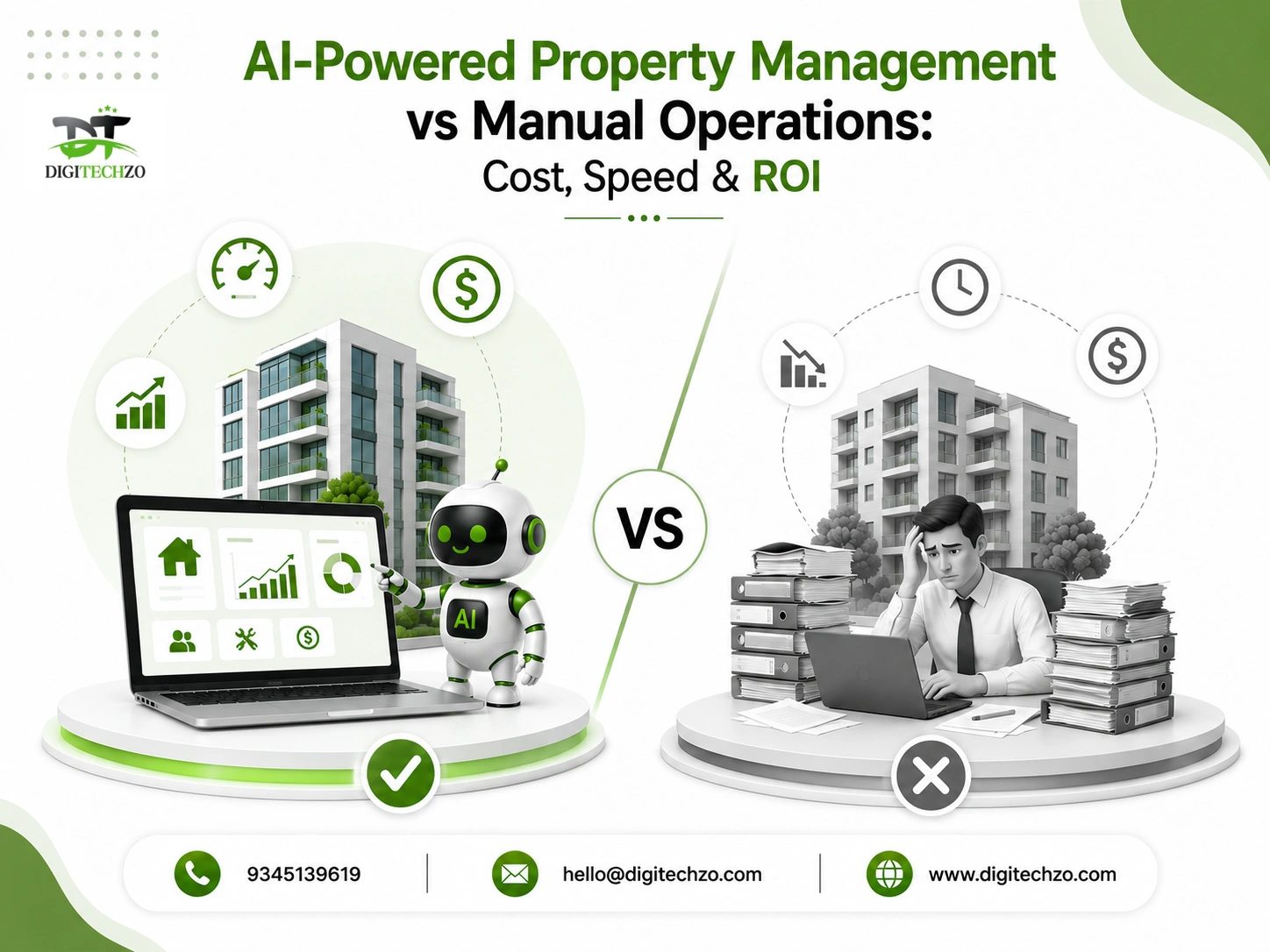
Introduction: The Comparison Most Companies Never Actually Run
Every property management company believes its manual processes are “working fine” — until someone actually sits down and calculates what those processes truly cost in staff hours, delayed collections, and missed maintenance windows. The comparison between manual operations and AI-powered property management rarely happens as a real, numbers-based exercise. It happens as a vague feeling that “we should probably look into new software eventually.”
That vagueness is exactly why so many companies stay stuck with manual processes far longer than they should. Without a clear framework comparing cost, speed, and ROI side by side, the decision to adopt AI-powered property management keeps getting deprioritized in favor of more urgent-feeling daily fires — fires that, ironically, manual processes are usually what’s causing.
This guide runs that comparison properly. Not vague claims about “efficiency,” but a direct breakdown of what manual operations actually cost versus what AI-powered property management delivers across the three metrics that actually matter to a business: cost, speed, and return on investment.
At Digitechzo, we’ve run this exact comparison for property management companies evaluating whether the switch is worth it — and the pattern holds consistently: the businesses that wait to run these numbers almost always find the gap is larger than they assumed. This article gives you the framework to run that comparison for your own operations, honestly, before making the call.
Quick Answer
AI-powered property management reduces administrative cost per unit, cuts response times from days to minutes, and typically delivers positive ROI within a few months by automating rent collection, maintenance routing, and reporting — tasks that consume a disproportionate share of staff time under manual operations.
Why This Comparison Rarely Gets Run Properly
Most cost comparisons between manual operations and AI-powered property management fail for one of two reasons: they compare software subscription cost against nothing (ignoring the hidden labor cost of manual processes), or they rely on vendor-provided efficiency claims without a clear methodology behind them.
A fair comparison requires isolating three specific dimensions — cost, speed, and ROI — and measuring each against your actual current operations, not industry averages alone. That’s the structure this article follows, because it’s the only version of this comparison that produces a decision you can actually stand behind.
Cost Comparison: Manual Operations vs AI-Powered Property Management
The Hidden Cost of Manual Operations
Manual property management costs rarely show up as a clean line item — they’re buried inside salaries. Consider what manual processes actually require:
- Staff time spent manually sending rent reminders and chasing late payments
- Coordinators reading, categorizing, and routing maintenance requests by hand
- Hours spent compiling owner and financial reports from spreadsheets each month
- Lost revenue from late payments that go uncaught until after the fact
- Higher turnover-related costs from inconsistent tenant communication
The Cost Structure of AI-Powered Property Management
AI-powered property management shifts these costs from ongoing labor to a largely fixed software cost, with labor required mainly for oversight and exception-handling rather than repetitive execution.
Featured Snippet Answer: The clearest cost difference between manual operations and AI-powered property management is that manual costs scale directly with portfolio size — more units require proportionally more staff hours — while AI-powered property management costs scale much more slowly, since automation absorbs additional volume without a matching labor increase.
H3: Example Cost Comparison
A company managing 200 units with manual processes might require three full-time coordinators handling rent collection, maintenance routing, and reporting combined. After adopting AI-powered property management, a similar operation is often maintained with two coordinators — with the reallocated capacity going toward tenant retention or business development rather than being eliminated entirely.
Speed Comparison: Response Times and Turnaround
Speed matters in property management because delays compound into bigger costs — a late maintenance response becomes a larger repair; a late rent reminder becomes a missed payment.
- Tenant inquiry response: Manual operations often mean hours or overnight delays; AI-powered property management responds to routine inquiries instantly, any time of day.
- Maintenance request routing: Manual categorization and vendor assignment can take hours depending on staff availability; automated routing happens in minutes.
- Rent reminder timing: Manual reminders are often sent inconsistently depending on staff workload; automated reminders trigger reliably on schedule every time.
- Reporting turnaround: Manual monthly reports can take days to compile; AI-powered property management generates real-time dashboards continuously.
This speed advantage isn’t just about convenience — it directly reduces the compounding costs that come from delayed action, whether that’s a maintenance issue worsening overnight or a late payment turning into a harder collections case.
ROI Comparison: How to Actually Calculate It
Most ROI conversations around AI-powered property management stay vague (“save time,” “increase efficiency”) without a concrete formula. Here’s a practical framework:
Step 1: Calculate current manual cost per unit Total monthly labor cost spent on rent collection, maintenance coordination, tenant communication, and reporting ÷ number of units managed.
Step 2: Estimate automation-driven labor reduction Based on which functions get automated (rent reminders, maintenance routing, reporting are the highest-impact starting points), estimate realistic hours saved per week.
Step 3: Factor in indirect savings Include reduced late payment losses, lower turnover from improved tenant communication, and avoided emergency maintenance costs from predictive flagging.
Step 4: Compare against software cost Subtract the AI-powered property management subscription cost from total savings (direct labor + indirect savings) to calculate net monthly ROI.
This framework matters because it captures the indirect savings competitors’ cost comparisons often ignore entirely — turnover reduction and avoided emergency repairs frequently represent a larger financial impact than the direct labor savings alone.
Side-by-Side Summary Table
| Metric | Manual Operations | AI-Powered Property Management |
|---|---|---|
| Cost scaling | Scales linearly with unit count | Scales sub-linearly; absorbs growth with less added labor |
| Tenant inquiry response | Hours to next business day | Instant, 24/7 |
| Maintenance routing speed | Hours, dependent on staff availability | Minutes, automated |
| Rent reminder consistency | Variable, dependent on staff workload | Reliable, automated on schedule |
| Reporting turnaround | Days to compile manually | Real-time, continuous |
| Late payment detection | After the fact | Predicted before due date |
| Maintenance issue detection | Reactive, after tenant complaint | Predictive, based on historical patterns |
Pros and Cons of Each Approach
Manual Operations
Pros:
- No new technology to learn or configure
- Full human judgment applied to every decision
- Familiar to long-tenured staff
Cons:
- Costs scale directly with growth, limiting margin expansion
- Slower response times across nearly every function
- Reactive by design — problems get caught after they happen
AI-Powered Property Management
Pros:
- Lower cost per unit as portfolios scale
- Significantly faster response and turnaround times
- Predictive capability catches problems before they escalate
Cons:
- Requires clean historical data for reliable predictions
- Initial setup and configuration take real time investment
- Still requires human oversight for exceptions and sensitive tenant situations
Real-World Use Case Scenarios
Scenario 1: Company Weighing Whether to Hire or Automate Facing growth, a company compares the fully loaded cost of hiring an additional coordinator against adopting AI-powered property management. The automation option typically absorbs the added volume at a lower ongoing cost, with the added benefit of predictive maintenance and churn flagging the new hire wouldn’t have provided anyway.
Scenario 2: Portfolio With High Late-Payment Rates A manual operation catching late payments only after they occur compares its collections losses against the projected reduction from AI-driven late-payment prediction — often finding the ROI case clear within the first few months.
Scenario 3: Company With Frequent Emergency Maintenance Costs By comparing historical emergency repair costs against the projected reduction from predictive maintenance flagging, a company can quantify exactly how much AI-powered property management would likely save annually.
When Manual Operations Still Make Sense
To be fair and balanced: manual operations aren’t automatically wrong for every business. They can still make sense when:
- The portfolio is very small (under roughly 15–20 units) where labor costs remain manageable
- The business has no near-term growth plans that would strain manual capacity
- Historical data is too limited or inconsistent for AI predictions to be reliable yet
In these cases, the cost of adopting and properly configuring AI-powered property management may not yet outweigh the benefit — though this calculus typically shifts quickly as the portfolio grows.
Common Mistakes When Comparing the Two
- Comparing software subscription cost against nothing, ignoring the hidden labor cost manual operations actually carry.
- Ignoring indirect savings like reduced turnover and avoided emergency repairs, which often exceed direct labor savings alone.
- Expecting immediate, dramatic ROI without accounting for the ramp-up period AI predictions need to reach full accuracy.
- Failing to calculate a real baseline before switching, making it impossible to prove or disprove ROI afterward.
- Assuming full automation replaces all staff rather than reallocating freed capacity toward growth and retention activities.
Expert Tips for Running Your Own Comparison
- Calculate your actual current cost per unit before evaluating vendors — this is the single most useful number in the entire comparison.
- Include indirect costs like turnover and emergency repairs in your baseline; they’re frequently larger than the direct labor cost alone.
- Pilot on your highest-cost function first — usually rent collection or maintenance routing — to validate real savings before expanding further.
- Track speed metrics explicitly, not just cost, since faster response times often prevent costs from accumulating in the first place.
- Revisit your ROI calculation quarterly after implementation to confirm savings are holding as the portfolio and market conditions change.
Frequently Asked Questions
Q1: Is AI-powered property management actually cheaper than manual operations?
In most cases, yes, particularly as portfolios grow — manual costs scale directly with unit count, while AI-powered property management absorbs additional volume without a proportional labor increase, lowering cost per unit over time.
Q2: How much faster is AI-powered property management compared to manual processes?
Response times for tenant inquiries and maintenance routing typically drop from hours to minutes, while reporting that once took days to compile manually becomes available in real time.
Q3: How is ROI calculated for AI-powered property management?
ROI is calculated by comparing total savings — direct labor reduction plus indirect savings from reduced turnover and avoided emergency repairs — against the software’s ongoing cost, typically evaluated over the first several months of use.
Q4: Does AI-powered property management eliminate the need for property management staff?
No. It typically reduces the proportion of time staff spend on repetitive administrative tasks, reallocating that time toward tenant retention, vendor relationships, and business growth rather than eliminating roles entirely.
Q5: When does manual property management still make more sense than AI-powered management?
Manual operations can still be reasonable for very small portfolios with no near-term growth plans, where labor costs remain low and the setup investment for automation may not yet be justified.
Conclusion: Run the Numbers Before You Decide
The comparison between manual operations and AI-powered property management isn’t really about which one sounds more modern — it’s about running an honest cost, speed, and ROI analysis against your actual portfolio. Once that comparison is run properly, accounting for both direct labor costs and indirect savings like reduced turnover and avoided emergency repairs, the case for AI-powered property management becomes measurable rather than theoretical.
The companies that wait to run this comparison typically discover the gap was larger — and more expensive — than they assumed. The ones that run it early make the switch with confidence, backed by real numbers instead of a vague sense that “we should probably upgrade eventually.”
If you haven’t run this comparison for your own portfolio yet, Digitechzo helps property management companies calculate real cost, speed, and ROI numbers before recommending any specific solution — not a sales pitch, an honest analysis.
Want your own cost, speed, and ROI comparison run against your actual operations? Reach out to Digitechzo for a free comparison audit and get the real numbers before you decide.
About The Author