
Picture a mid-size property business running on six different tools — one for leasing, one for maintenance tickets, a spreadsheet for financials, a separate app for tenant messages, and a shared inbox that nobody fully owns. Nothing talks to anything else. Every decision requires someone to manually stitch data together before they can even see the full picture.
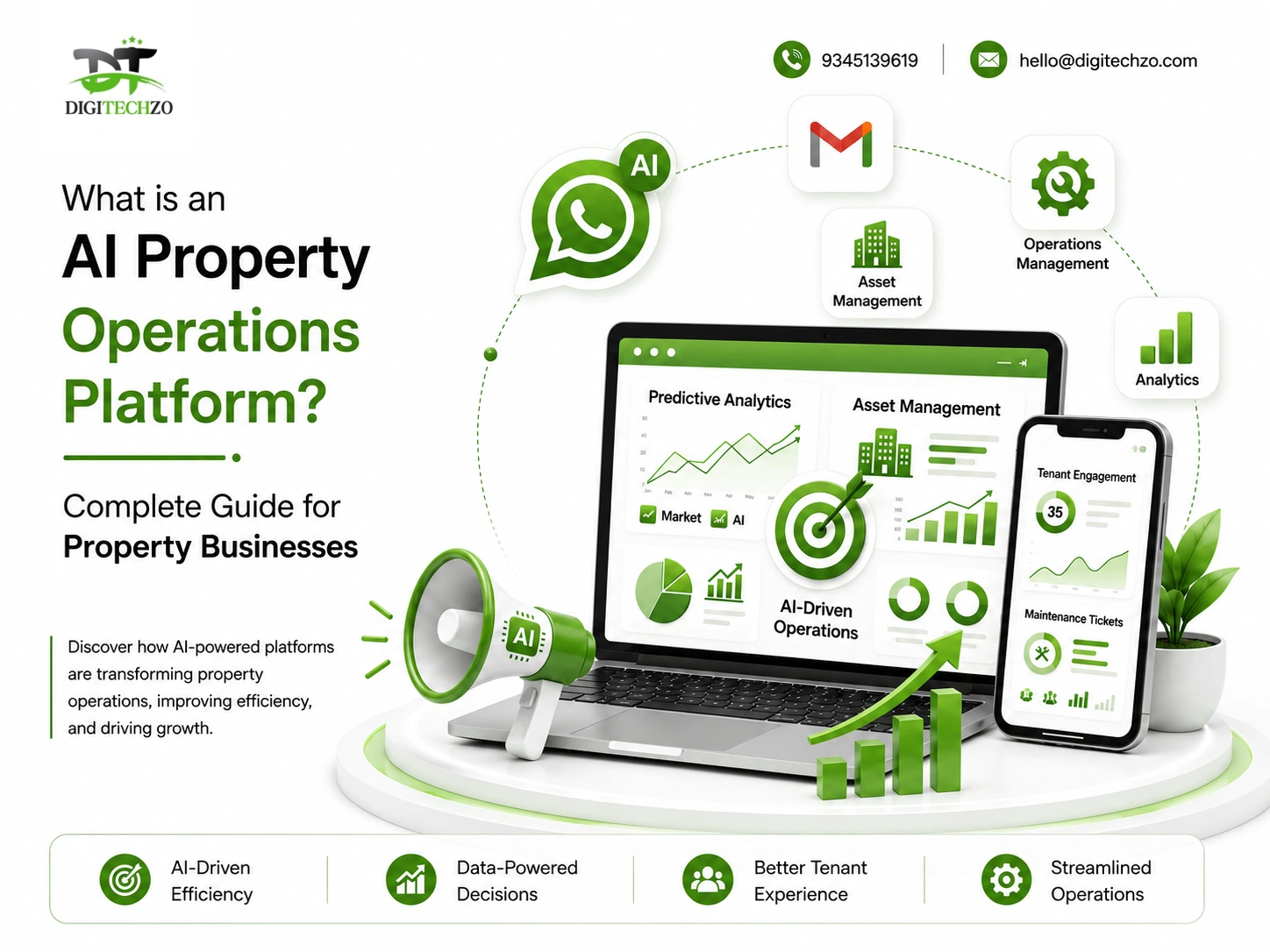
This is exactly the problem an AI property operations platform is built to solve. Instead of forcing your team to jump between disconnected tools, it unifies leasing, maintenance, financials, and tenant communication into one system — then layers AI on top to predict problems, automate routine decisions, and surface insights a human would take hours to find manually.
At Digitechzo, we work with real estate operators evaluating exactly this category of software, and we’ve seen firsthand how much operational drag disappears when the right platform replaces a patchwork of point solutions.
This guide explains what an AI property operations platform actually is, how it differs from basic property management software, what to look for before buying one, and the mistakes that trip up even experienced operators.
Quick Answer
An AI property operations platform is a unified system that combines leasing, maintenance, financial management, and tenant communication with AI-driven automation and predictive analytics — replacing multiple disconnected tools with one operational hub. It’s built for property businesses that have outgrown basic software and need centralized, intelligent decision-making across their entire portfolio.
What Is an AI Property Operations Platform?
An AI property operations platform is software that centralizes every operational function of running a property portfolio — leasing, maintenance, accounting, compliance, and communication — into a single system, then applies machine learning to automate decisions and predict outcomes across that entire workflow.
The key distinction is scope. Most property management tools handle a slice of the job — rent collection, or maintenance tickets, or applicant screening. An AI property operations platform is designed to be the operational backbone of the entire business, not a single-purpose tool.
Think of it less like an app and more like a central nervous system: every department feeds data into it, and the AI layer uses that combined data to make connections no single tool could see on its own. A maintenance pattern in one building might predict a lease renewal risk in another — connections only visible when the data lives in one place.
Why “Operations Platform” Is a Different Category
Vendors increasingly use “AI property operations platform” instead of “property management software” because the scope has genuinely expanded. Modern platforms now handle:
- Portfolio-wide financial forecasting, not just per-property accounting
- Cross-departmental workflow automation (leasing triggers maintenance prep, maintenance completion triggers tenant follow-up)
- Predictive resource allocation — deciding where staff and budget should go next, not just tracking where they went
AI Property Operations Platform vs. Traditional Property Management Software
| Factor | Traditional PM Software | AI Property Operations Platform |
|---|---|---|
| Scope | Single function (leasing, accounting, or maintenance) | Unified across all operational functions |
| Decision-making | Manual, based on static reports | AI-assisted, based on real-time cross-functional data |
| Data structure | Siloed per module | Centralized, shared data layer |
| Automation | Rule-based (if X, then Y) | Predictive (anticipates Y before X fully happens) |
| Best fit | Small portfolios, single-purpose needs | Multi-property businesses needing operational cohesion |
The practical difference shows up daily: in traditional software, a maintenance delay and a rent delinquency are two separate alerts in two separate systems. In an AI property operations platform, the system recognizes that tenants experiencing maintenance delays are statistically more likely to pay late — and flags the connection before it becomes a pattern.
Core Components of an AI Property Operations Platform
1. Unified Data Layer
Every module — leasing, accounting, maintenance, communication — writes to the same underlying data structure. This is what makes cross-functional AI predictions possible in the first place; without it, you just have several AI tools bolted together, not a true platform.
2. Predictive Maintenance and Asset Management
The system tracks equipment age, repair frequency, and vendor performance to forecast failures and recommend preventive maintenance schedules before something breaks.
3. Intelligent Financial Operations
Beyond basic bookkeeping, the platform forecasts cash flow, flags anomalous expenses, and models the financial impact of decisions like a rent increase or a capital improvement project.
4. AI-Driven Leasing and Tenant Screening
Applicant risk scoring, automated lease document generation, and renewal-likelihood prediction all live here, reducing vacancy periods and screening errors.
5. Conversational AI Across Channels
A tenant messaging on SMS, email, or a portal gets a consistent AI-assisted response, with context pulled from their full history — not a chatbot that starts from zero every conversation.
6. Workflow Automation Engine
This is the connective tissue: rules and AI models that trigger actions across modules automatically, like initiating a maintenance vendor request the moment a predictive model flags a likely HVAC failure.
Who Actually Needs One?
Not every property business needs a full AI property operations platform — and it’s worth being honest about that.
You likely need one if:
- You manage properties across multiple locations or asset types (residential + commercial)
- Your team currently uses 3+ disconnected tools for daily operations
- You’ve outgrown manual reporting and need portfolio-wide visibility
- Maintenance, leasing, and finance teams operate in silos and duplicate work
You probably don’t need one yet if:
- You manage fewer than 20-30 units single-handedly
- Your current single-purpose tool already covers your core pain point
- You don’t have the internal bandwidth to manage a platform migration right now
Key Benefits (With Real Scenarios)
Scenario 1 — Cross-property maintenance forecasting: A property business managing 8 buildings used the platform’s predictive maintenance module to identify that HVAC units installed in the same year across three properties were approaching a known failure window, allowing bulk preventive servicing instead of three separate emergency calls.
Scenario 2 — Leasing and finance connection: An operator noticed the platform’s renewal-prediction AI flagging a cluster of tenants unlikely to renew, correlated with a recent increase in maintenance response times in that building — insight that wouldn’t have surfaced from either department’s data in isolation.
Scenario 3 — Reduced admin overhead: A regional property manager consolidated five separate tools into one AI property operations platform and reported that staff spent significantly less time re-entering the same tenant data across systems, freeing up hours weekly for tenant-facing work instead of administrative duplication.
How to Evaluate an AI Property Operations Platform
Use this framework before signing any contract:
- Test the unified data claim directly. Ask the vendor to show a live example where data from one module (e.g., maintenance) actually influenced an AI prediction in another module (e.g., leasing). If they can’t demo this, it’s likely several separate tools marketed as one platform.
- Check integration depth, not just integration count. A long list of “integrations” means little if they only sync basic data one-way.
- Ask about data ownership and portability. You should be able to export your full operational history if you switch platforms later.
- Evaluate onboarding time realistically. True operations platforms take longer to implement than single-purpose tools — get a specific timeline, not a vague estimate.
- Confirm scalability pricing — understand exactly how costs change as you add units, buildings, or modules.
Pros and Cons
Pros:
- Eliminates data silos and duplicate manual entry
- Surfaces cross-functional insights single-purpose tools can’t
- Scales with portfolio growth without needing new tools for each function
- Reduces long-term software sprawl and vendor management overhead
Cons:
- Higher upfront cost and longer implementation timeline than single-purpose tools
- Requires genuine organizational buy-in across departments to deliver full value
- Switching costs are higher once your operational data lives inside one ecosystem
- Overkill for very small portfolios with simple, single-function needs
Common Mistakes When Adopting One
- Migrating everything at once instead of phasing modules in, which overwhelms teams and increases the risk of data errors during transition.
- Buying based on the AI label alone, without verifying the platform actually connects data across departments rather than just running separate AI features in parallel.
- Skipping change management. An AI property operations platform changes how departments interact, not just what software they open — teams need structured training on new cross-functional workflows.
- Underestimating data cleanup needs. Years of inconsistent data across old systems need to be reconciled before migration, or the AI models will learn from flawed inputs.
- Ignoring vendor roadmap transparency. Since this category is evolving fast, choosing a vendor without a clear development roadmap risks being locked into outdated capabilities.
Expert Tips for Implementation
- Start with your highest-friction department. Migrate the module causing the most daily pain first (often maintenance or leasing) to build internal trust before a full rollout.
- Assign a single internal owner for the platform transition — cross-functional tools fail most often when no one is accountable for adoption across departments.
- Set a 6-month review checkpoint to measure actual time saved and prediction accuracy against your baseline, not just vendor-reported benchmarks.
- Keep a manual override process for AI-driven decisions in leasing and screening, both for compliance reasons and to catch edge cases the model hasn’t seen yet.
- Document your current workflows before migrating — you can’t measure improvement from a unified platform if you never captured how disconnected your old process actually was.
Frequently Asked Questions
What is an AI property operations platform in simple terms?
It’s a single software system that combines leasing, maintenance, accounting, and tenant communication for a property business, using AI to automate decisions and predict issues across all of them together instead of handling each separately.
How is an AI property operations platform different from property management software?
Property management software typically handles one or two functions well, while an AI property operations platform unifies all operational functions on one data layer, enabling cross-functional AI predictions that isolated tools cannot produce.
Is an AI property operations platform only for large real estate companies?
No, though it’s most valuable for portfolios with multiple properties or departments experiencing coordination challenges; very small, single-property operators often don’t need the full scope yet.
How long does it take to implement an AI property operations platform?
Implementation timelines typically range from 6 to 16 weeks depending on portfolio size, data migration complexity, and how many modules are adopted at once, with phased rollouts generally taking longer but reducing operational disruption.
What’s the biggest sign a property business needs an AI property operations platform?
Recurring duplicate data entry across multiple disconnected tools, combined with departments unable to see how their work affects other teams, is the clearest signal it’s time to consolidate.
Final Thoughts
An AI property operations platform isn’t just a bigger version of property management software — it’s a fundamentally different approach to running a property business, built around unified data and cross-functional AI decision-making rather than isolated tools solving isolated problems.
The right time to adopt one is when your team is spending more time reconciling data between systems than actually managing properties. Get there too early and you’ll pay for capability you don’t use yet; wait too long and operational silos start costing you tenants, revenue, and staff hours you can’t get back.
If you’re trying to figure out whether your property business is ready for an AI property operations platform — or which one actually fits your portfolio’s complexity — Digitechzo’s advisory team can walk through your current stack and give you a clear, honest recommendation. Reach out for a free operations assessment.
About The Author