

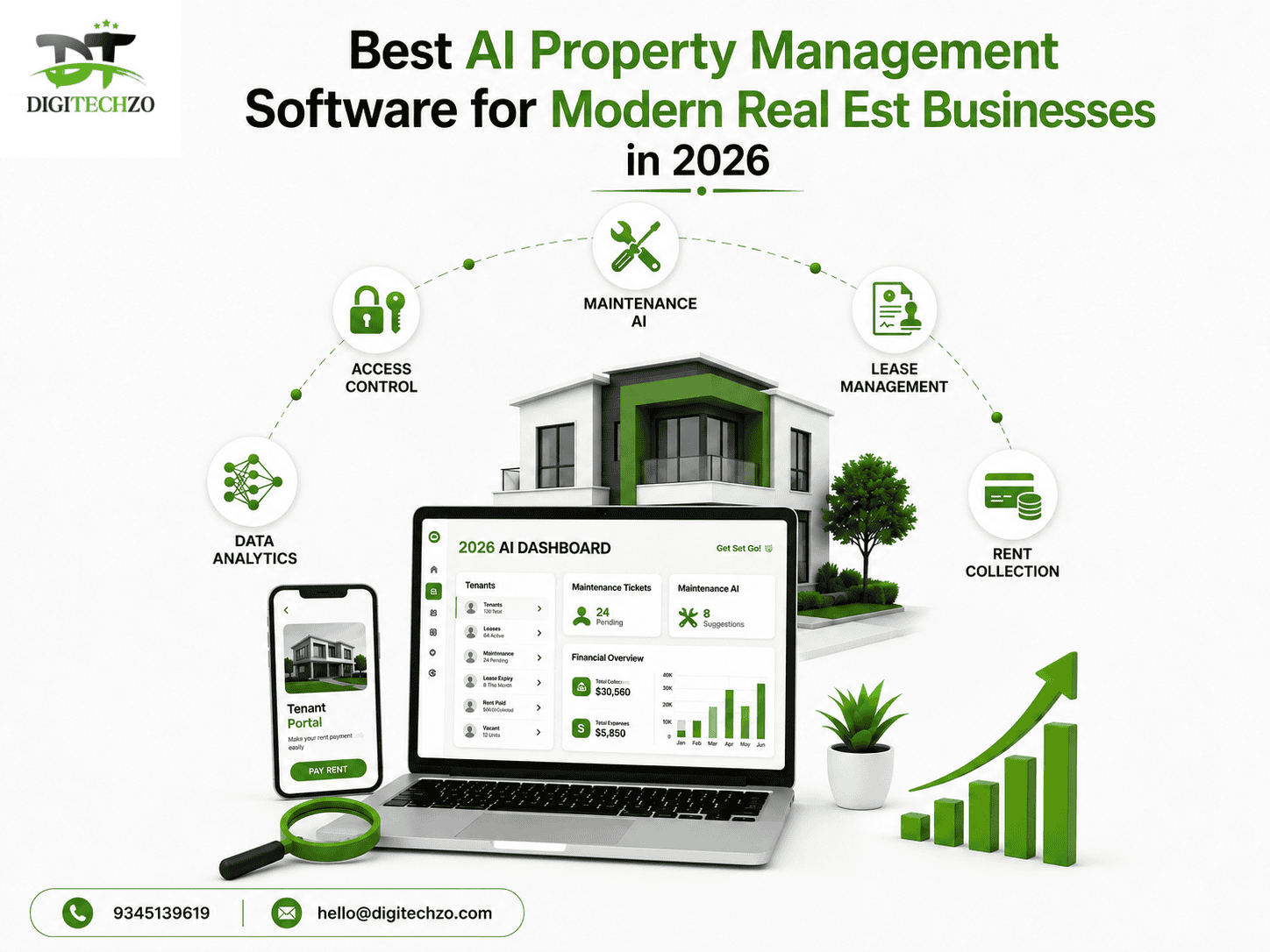
Every property manager knows the feeling: 2 AM, a burst pipe, three angry tenants, and a spreadsheet that hasn’t been updated since last Tuesday. If you’re still juggling maintenance requests over text, rent collection through a patchwork of apps, and vacancy forecasting based on gut instinct, you’re not managing properties — you’re just reacting to them.
That’s exactly the gap AI property management software is closing right now. Real estate businesses that adopted AI-driven platforms in the last two years report fewer late payments, faster maintenance turnaround, and significantly less time spent on manual admin work. This shift isn’t hype — it’s a structural change in how portfolios of any size get run.
At Digitechzo, we’ve spent years helping real estate businesses evaluate and implement the right proptech stack, and this guide reflects what we’ve actually seen work — not just what vendors claim in their pitch decks.
This article breaks down what AI property management software actually does, how to evaluate it, which platforms lead the market in 2026, the mistakes buyers commonly make, and how to pick the right one for your portfolio size and goals.
Quick Answer
The best AI property management software in 2026 combines automated rent collection, predictive maintenance, AI tenant screening, and smart communication tools into one platform. Top picks depend on portfolio size: AppFolio and Buildium lead for mid-size portfolios, Yardi Breeze and RealPage dominate enterprise, and DoorLoop and Rentvine are strong for growing landlords who want AI features without enterprise pricing. Choose based on unit count, integration needs, and how much automation you actually need versus what looks good in a demo.
What Is AI Property Management Software?
AI property management software is a category of proptech platforms that use machine learning, natural language processing, and predictive analytics to automate the day-to-day operations of managing rental properties. Unlike traditional property management software — which mostly digitizes paperwork — an AI property management software actively makes decisions, predictions, and recommendations.
In practice, this means the system doesn’t just log a maintenance ticket. It predicts which appliances are likely to fail based on age and usage patterns, prioritizes urgent requests automatically, and routes them to the right vendor without a human dispatcher.
Why Real Estate Businesses Are Switching to AI in 2026
Three forces are driving adoption right now:
Labor costs are rising faster than rents in many markets, pushing property managers to automate anything that doesn’t require a human judgment call.
Tenant expectations have shifted. Renters raised on instant-response apps expect the same from their landlord — a chatbot that answers at midnight beats a voicemail that gets returned in two days.
Portfolios are getting harder to manage manually. A manager overseeing 50+ units across multiple properties simply cannot track maintenance cycles, lease renewals, and payment patterns by memory or spreadsheet.
AI property management software addresses all three by shifting repetitive, time-sensitive tasks off human plates while keeping managers in control of exceptions and decisions.
Core Features to Look For
Not every platform labeled “AI-powered” actually delivers meaningful automation. Here’s what separates a genuinely useful AI property management software from a marketing buzzword:
1. Predictive Maintenance
The software should flag likely equipment failures (HVAC, water heaters, appliances) before they happen, based on age, usage, and historical repair data — not just log requests after something breaks.
2. Smart Rent Collection and Delinquency Prediction
Look for tools that predict which tenants are likely to pay late based on payment history patterns, and trigger proactive, personalized reminders before the due date rather than generic reminders after.
3. AI-Powered Tenant Screening
Modern systems score applicants using more than credit scores — factoring in rental history consistency, income stability signals, and fraud indicators in submitted documents.
4. Conversational AI for Tenant Communication
A chatbot that can answer lease questions, schedule maintenance visits, and escalate genuine emergencies to a human — available around the clock — is now table stakes for competitive AI property management software.
5. Automated Financial Reporting
Real-time dashboards that auto-categorize expenses, forecast cash flow, and flag anomalies (like a maintenance vendor overcharging) save hours every month during reconciliation.
6. Vacancy and Pricing Optimization
AI models that analyze local market data to recommend optimal rent pricing and predict vacancy risk help portfolios stay competitively priced without constant manual research.
Best AI Property Management Software in 2026 (Compared)
Here’s an honest comparison based on functionality, pricing tier, and ideal use case.
AppFolio
Best for: Mid-size to large portfolios (100+ units)
Pros:
– Strong AI-based leasing and maintenance automation
– Robust reporting and owner portals
– Scales well for multifamily and commercial mixes
Cons:
– Pricing can get expensive for smaller portfolios
– Steeper learning curve for new teams
Buildium
Best for: Small to mid-size residential portfolios
Pros:
– Intuitive interface, faster onboarding
– Solid automated rent reminders and e-signing
– Good value for the feature set
Cons:
– AI maintenance prediction is less advanced than enterprise competitors
Yardi Breeze / Yardi Voyager
Best for: Enterprise-level and commercial real estate
Pros:
– Deep AI analytics for large, mixed-use portfolios
– Strong compliance and accounting depth
Cons:
– Overkill and costly for small landlords
DoorLoop
Best for: Growing landlords wanting modern UI plus AI without enterprise cost
Pros:
– Fast-growing AI feature set (screening, communication automation)
– Transparent, accessible pricing
– Frequent feature updates
Cons:
– Fewer third-party integrations than legacy players
RealPage
Best for: Large multifamily operators
Pros:
– Advanced revenue management AI (dynamic pricing)
– Strong predictive analytics for occupancy
Cons:
– Complex implementation; best suited to dedicated ops teams
How to Choose the Right Platform for Your Portfolio
Choosing AI property management software isn’t about picking the “best” one in the abstract — it’s about matching capability to portfolio complexity. Here’s a practical framework we use with clients at Digitechzo:
1. Count your units honestly. Under 50 units rarely needs enterprise-grade AI; the ROI isn’t there yet.
2. Map your biggest time drain. If it’s maintenance chaos, prioritize predictive maintenance features. If it’s late rent, prioritize collection AI.
3. Check integration compatibility with your existing accounting software, bank feeds, and listing syndication tools.
4. Ask for real usage data in the demo — not just feature lists. Ask the vendor: “Show me an actual predictive maintenance alert from a live account.”
5. Factor in training time. The most powerful AI property management software is worthless if your team never adopts it properly.
Real-World Use Cases
Scenario 1 — Mid-size residential portfolio (120 units):** A regional property manager implemented AI-based delinquency prediction and cut late payments by identifying at-risk tenants two weeks before due dates, allowing earlier, softer outreach instead of after-the-fact collections calls.
Scenario 2 — Single-family rental investor (18 units):** A smaller investor used an AI property management software with automated tenant screening to reduce application review time from days to under an hour, while catching a fraudulent income document that manual review had missed in the past.
Scenario 3 — Commercial property group:** A commercial operator used AI vacancy forecasting to identify a submarket trending toward oversupply six months before competitors adjusted pricing, allowing proactive lease renewal incentives instead of reactive rent cuts.
Common Mistakes When Buying AI Property Management Software
- Choosing based on brand name alone, without testing whether the AI features actually apply to your property type (residential vs. commercial vs. mixed-use).
- Ignoring data migration complexity — moving years of tenant and financial history into a new AI property management software can take weeks if not planned properly.
- Underestimating team training needs, leading to expensive software sitting mostly unused after the first month.
- Not verifying data security practices, especially since these platforms handle sensitive tenant financial and identity data.
- Judging AI capability from marketing pages instead of live demos — many platforms label basic automation as “AI” without genuine predictive modeling behind it.
Expert Tips From the Field
- Run a 90-day pilot on one property or building before rolling AI property management software across your whole portfolio — this surfaces integration issues early.
- Keep a human-in-the-loop on tenant screening decisions. AI scoring should inform, not replace, final judgment, especially for fair housing compliance.
- Audit AI-generated maintenance predictions quarterly against actual repair outcomes to confirm the model is calibrated to your specific property types and climate.
- Negotiate pricing based on unit count tiers, not just sticker price — most vendors have flexibility that isn’t listed publicly.
- Use the communication AI logs as a training tool — reviewing chatbot transcripts monthly reveals recurring tenant pain points worth fixing structurally.
Frequently Asked Questions
Is AI property management software worth it for small landlords?
Yes, if you manage 10+ units and spend more than a few hours weekly on rent reminders, screening, or maintenance coordination. Below that, a simpler tool may deliver better ROI until your portfolio grows.
How much does AI property management software cost in 2026?
Pricing typically ranges from $1–$3 per unit per month for basic tiers to $5–$10+ per unit for advanced AI features like predictive maintenance and dynamic pricing, depending on the vendor and portfolio size.
Can AI property management software replace a property manager?
No. It automates repetitive, data-driven tasks but still requires human oversight for tenant relationships, legal compliance, and exception handling that AI cannot judge reliably.
Does AI property management software work for commercial real estate?
Yes, though features differ — commercial-focused platforms emphasize lease abstraction, CAM reconciliation, and vacancy forecasting more than residential-style tenant screening.
What’s the biggest risk of switching to AI property management software?
Poor data migration and inadequate staff training are the top reasons implementations fail, not the AI technology itself.
Final Verdict
The right AI property management software depends entirely on your portfolio size, property type, and which manual tasks are costing you the most time right now. Enterprise operators benefit most from Yardi and RealPage’s deep analytics; mid-size residential portfolios get strong value from AppFolio and Buildium; and growing landlords who want modern AI features without enterprise pricing should look closely at DoorLoop.
Whatever you choose, treat the selection process the way you’d treat any major operational investment — pilot it, verify the AI claims with real data, and make sure your team is trained to actually use it.
If you’re evaluating AI property management software for your portfolio and want a second opinion before you commit, Digitechzo‘s property tech advisory team can help you compare platforms against your specific unit count, budget, and growth plans — get in touch for a free portfolio assessment.
About The Author