
If you’ve ever watched a prediction market security freeze mid-event, lock out withdrawals during a volatile night, or get exploited through an oracle manipulation attack, you already know the stakes. Prediction markets sit at a strange intersection — real money, real-time data feeds, and often decentralized infrastructure — which makes them one of the more attractive targets in fintech today. A single security gap doesn’t just cost users their funds; it can wipe out a platform’s credibility overnight.
At Digitechzo, we’ve worked with fintech and Web3 teams building trading platforms, exchanges, and prediction market products, and one pattern shows up again and again: founders focus on UX and liquidity first, and treat security as a “phase two” problem. That order of priorities is exactly backwards, and it’s usually the reason platforms end up rebuilding their entire architecture after an incident.
This guide breaks down the exact security features a prediction market platform needs — not generic advice copied from a general fintech checklist, but the specific controls that matter for markets, oracles, settlement logic, and user funds.
Quick Answer
A secure prediction market platform needs multi-layered wallet protection, tamper-proof oracle and data feeds, smart contract audits (for on-chain platforms), real-time fraud monitoring, regulatory-grade KYC/AML, and transparent dispute resolution. Prediction market security isn’t one feature — it’s a stack of overlapping defenses across custody, data integrity, and platform infrastructure.
Why Prediction Market Security Is Different
Prediction markets aren’t just trading platforms — they’re forecasting engines that convert real-world outcomes into tradeable prices. That adds two attack surfaces most exchanges don’t have to worry about:
- Outcome resolution risk: Someone or something has to decide who won. If that process can be gamed, the entire market is compromised, regardless of how good the wallet security is.
- Information asymmetry exploitation: Because prices move on real-world events, bad actors have incentives to manipulate the source of truth (news feeds, sports data, election results) rather than just the platform itself.
This is why copying a generic exchange security checklist falls short. A prediction market can have flawless encryption and still get exploited through a corrupted data feed or a poorly designed dispute window.
Core Security Features Every Platform Needs
Here’s the baseline stack, before we go deeper into each layer:
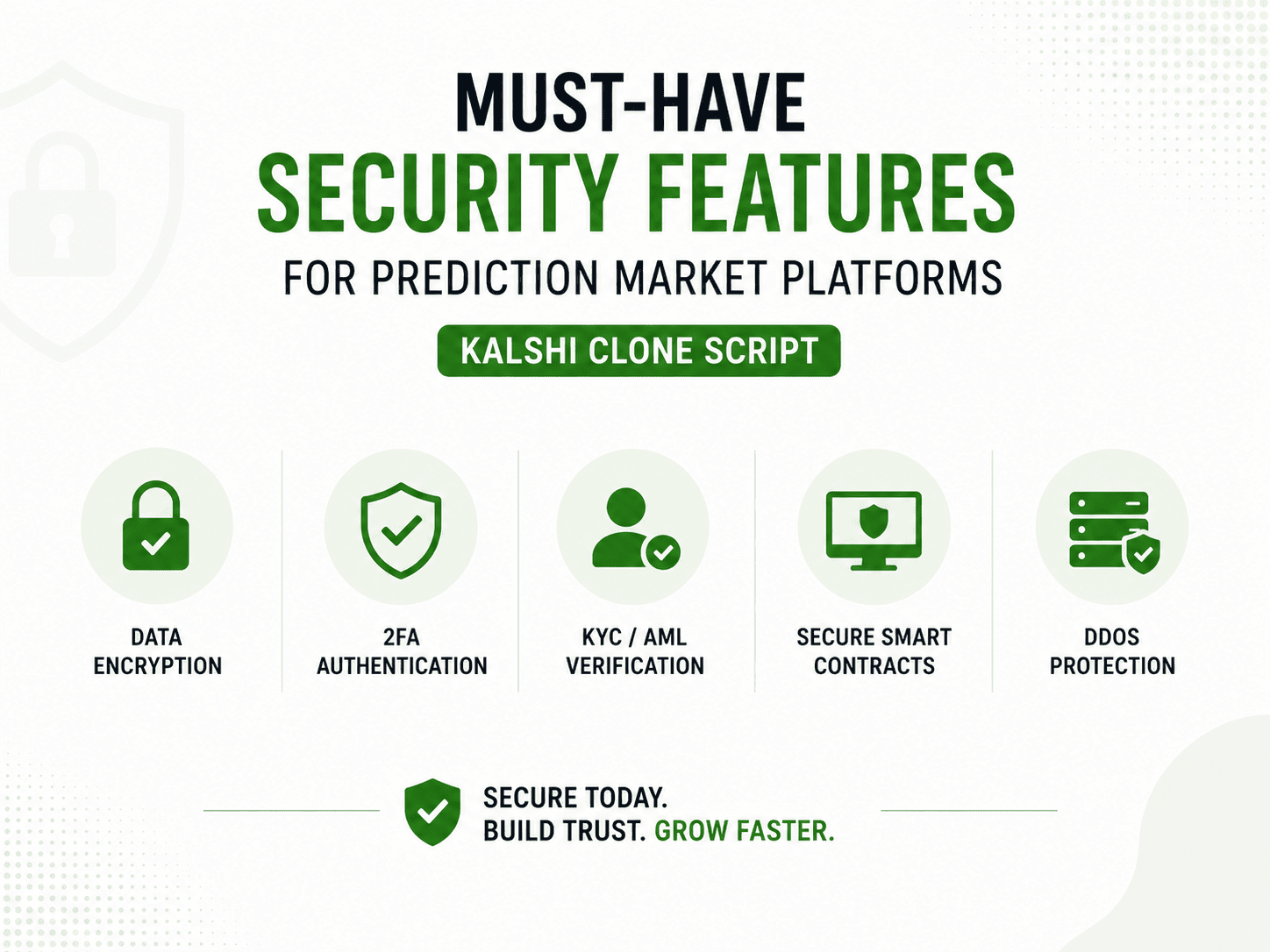
- End-to-end encryption for data in transit and at rest
- Multi-factor authentication (MFA) with support for hardware keys
- Role-based access control (RBAC) for internal teams and admins
- Cold storage for the majority of pooled funds
- Independent smart contract audits (for blockchain-based platforms)
- Real-time anomaly and fraud detection
- Transparent, auditable oracle sourcing
- Rate limiting and DDoS protection at the infrastructure level
- Immutable audit logs for every trade and resolution event
- Bug bounty programs with clear, published scope
Each of these deserves its own explanation, because “we have MFA” means very little without understanding how it’s implemented.
Oracle and Data Feed Security
This is the single most underrated risk in prediction markets, and it’s where Digitechzo spends the most time when auditing a client’s architecture.
An oracle is the bridge between the real world and the market’s smart contract or resolution engine. If a platform relies on a single data source, a single API, or a single human moderator to confirm outcomes, that’s a single point of failure — and attackers know it.
What good oracle security looks like:
- Multiple independent data sources cross-verified before settlement (e.g., three sports data providers instead of one)
- Decentralized oracle networks (like Chainlink-style architectures) for on-chain platforms, so no single node can manipulate the result
- Time-delayed resolution windows that allow disputes before funds are finalized
- Cryptographically signed data feeds so tampering is detectable
- Fallback resolution mechanisms if the primary oracle fails or reports conflicting data
Real-world example: In 2020, a well-known DeFi lending protocol lost millions when an attacker manipulated a single price oracle through a flash loan. Prediction markets face the same category of risk — except instead of manipulating a token price, an attacker manipulates the reported outcome of an event. The fix in both cases is identical: never trust one source.
Smart Contract & Settlement Security
If your platform runs on-chain (even partially), smart contract security isn’t optional — it’s existential.
What to Prioritize
- Third-party audits from firms with a public track record (not just an internal review)
- Formal verification for critical settlement logic, especially payout calculations
- Timelocks on admin functions so no single wallet can instantly change market rules or drain funds
- Upgradeability controls — if contracts are upgradeable, require multi-sig approval and a public delay window before changes go live
- Reentrancy and integer overflow protections, which remain some of the most exploited vulnerability classes in DeFi-adjacent products
H3: Off-Chain Settlement Considerations
If your platform is centralized (settlement happens off-chain, e.g., a database-driven exchange), you still need:
- Immutable, append-only transaction logs
- Dual-approval for manual payout overrides
- Reconciliation checks between the trading engine and the ledger every settlement cycle
User Fund & Wallet Protection
Users don’t read your whitepaper — they judge trust by whether their money is safe. This is where most platforms either win or lose credibility permanently.
Best practices:
- Keep 90%+ of user funds in cold storage, with only operational liquidity in hot wallets
- Use multi-signature wallets requiring 3-of-5 or similar thresholds for large withdrawals
- Implement withdrawal delays and limits for unusually large or first-time withdrawal requests
- Offer hardware key (FIDO2/U2F) support, not just SMS-based 2FA — SIM-swapping remains a common attack vector
- Provide session management tools so users can see and revoke active logins/devices
Compliance and Regulatory Safeguards
Prediction markets occupy a genuinely complex regulatory space — some jurisdictions treat them as derivatives trading, others closer to gambling, and enforcement is still evolving in many regions. Security and compliance overlap more than most teams realize.
- KYC/AML verification tiered by transaction volume, not just at sign-up
- Geofencing to restrict access from jurisdictions where the platform isn’t licensed to operate
- Transaction monitoring for structuring, layering, or other laundering patterns
- Licensing transparency — clearly stating which regulatory framework the platform operates under builds trust and reduces legal exposure
This isn’t just a legal checkbox. Platforms that skip this step often face abrupt shutdowns or asset freezes — which, from a user’s perspective, looks identical to a security failure.
Fraud Detection & Market Manipulation Prevention
Even with airtight infrastructure, markets can be gamed by coordinated user behavior.
- Wash trading detection — flagging accounts that trade against themselves or affiliated wallets to fake volume
- Insider trading monitoring — unusual position sizing right before a scheduled announcement is a major red flag
- Rate-limited order placement to prevent bot-driven spoofing
- Behavioral anomaly detection using ML models trained on historical trading patterns, not just static rules
Centralized vs Decentralized Platforms: A Security Comparison
| Security Factor | Centralized Platform | Decentralized (On-Chain) Platform |
|---|---|---|
| Custody Risk | Platform controls funds (higher trust required) | User-controlled wallets (lower custody risk) |
| Oracle Dependency | Can use internal moderators or licensed data feeds | Relies on decentralized oracle networks |
| Speed of Dispute Resolution | Faster (human review possible) | Slower (governed by contract logic/voting) |
| Regulatory Exposure | Higher — direct licensing requirements | Ambiguous, varies heavily by jurisdiction |
| Attack Surface | Server-side breaches, insider threats | Smart contract exploits, oracle manipulation |
| Transparency | Depends on internal audit disclosure | Publicly verifiable on-chain (if well-documented) |
Neither model is inherently “more secure.” Centralized platforms concentrate risk into infrastructure and internal controls; decentralized platforms distribute risk but introduce smart contract and oracle complexity. The right choice depends on your target users, regulatory strategy, and team’s technical maturity.
Common Mistakes
- Treating oracle security as an afterthought. Teams pour resources into wallet encryption while relying on a single unverified data source for settlement.
- Launching without an external smart contract audit because internal review “looked fine.” Internal teams miss what fresh eyes catch — this is well documented across DeFi exploit post-mortems.
- Using SMS-based 2FA as the only MFA option. SIM-swap attacks specifically target this weak point.
- No dispute resolution window. Instant, irreversible settlement sounds efficient but removes the ability to catch and correct manipulated outcomes.
- Ignoring insider risk. Admin wallets or moderator accounts with unchecked power are a bigger threat than most external hackers.
- Underestimating regulatory geofencing. Operating without jurisdiction-based restrictions invites both legal risk and reputational damage.
Expert Tips
- Run a “red team” simulation before launch. Hire an external team to actively try to manipulate a test market’s resolution — this surfaces oracle weaknesses that code audits alone won’t catch.
- Publish your incident response plan publicly. Trust isn’t built by claiming you’ll never get breached; it’s built by showing users exactly what happens if you do.
- Separate market creation privileges from settlement privileges. The account that creates a market should never be the same one that resolves it — this single separation prevents a huge class of insider manipulation.
- Set graduated withdrawal limits based on account age and behavior, not just KYC tier. New accounts making large, rapid withdrawals are a common fraud signal.
- Treat your bug bounty program as a living asset, not a launch-day PR item — update scope and rewards as your platform’s architecture evolves.
FAQs
What is the biggest security risk for prediction market platforms? Oracle manipulation is widely considered the biggest risk, because it targets the data source used to resolve outcomes rather than the platform’s technical infrastructure directly. A platform can have strong wallet security and still lose user trust if outcomes can be disputed or gamed.
Are decentralized prediction markets safer than centralized ones? Not automatically. Decentralized platforms reduce custody risk since users control their own funds, but they introduce smart contract and oracle risks. Centralized platforms reduce oracle complexity but concentrate custody and insider risk. Security depends on implementation, not just architecture type.
How do prediction markets prevent insider trading? Through behavioral monitoring (flagging unusual position sizes before scheduled events), separation of duties between market creators and resolvers, and transaction pattern analysis using machine learning models trained on historical trading data.
Do prediction market platforms need smart contract audits? Yes, if any part of the platform operates on-chain. Independent, third-party audits catch vulnerabilities — like reentrancy bugs or oracle manipulation vectors — that internal teams frequently miss due to familiarity bias with their own code.
What should users check before trusting a prediction market platform with their funds? Look for published audit reports, clear custody practices (cold vs hot wallet ratios), multi-signature withdrawal controls, transparent oracle sourcing, and a publicly stated dispute resolution process. If a platform can’t explain how it resolves disputed outcomes, that’s a red flag.
Conclusion
Security in prediction markets isn’t a single feature you bolt on before launch — it’s an architecture decision that touches custody, data integrity, compliance, and dispute resolution all at once. The platforms that earn long-term user trust are the ones that treat oracle security, fund custody, and fraud detection as equally critical, not as a checklist to complete after the product ships.
If you’re building or auditing a prediction market platform and want a second set of eyes on your security architecture — from oracle design to smart contract review — Digitechzo works with fintech and Web3 teams to close these gaps before they become headlines. Reach out to walk through your platform’s current risk posture and get a practical, prioritized roadmap forward.
About The Author