
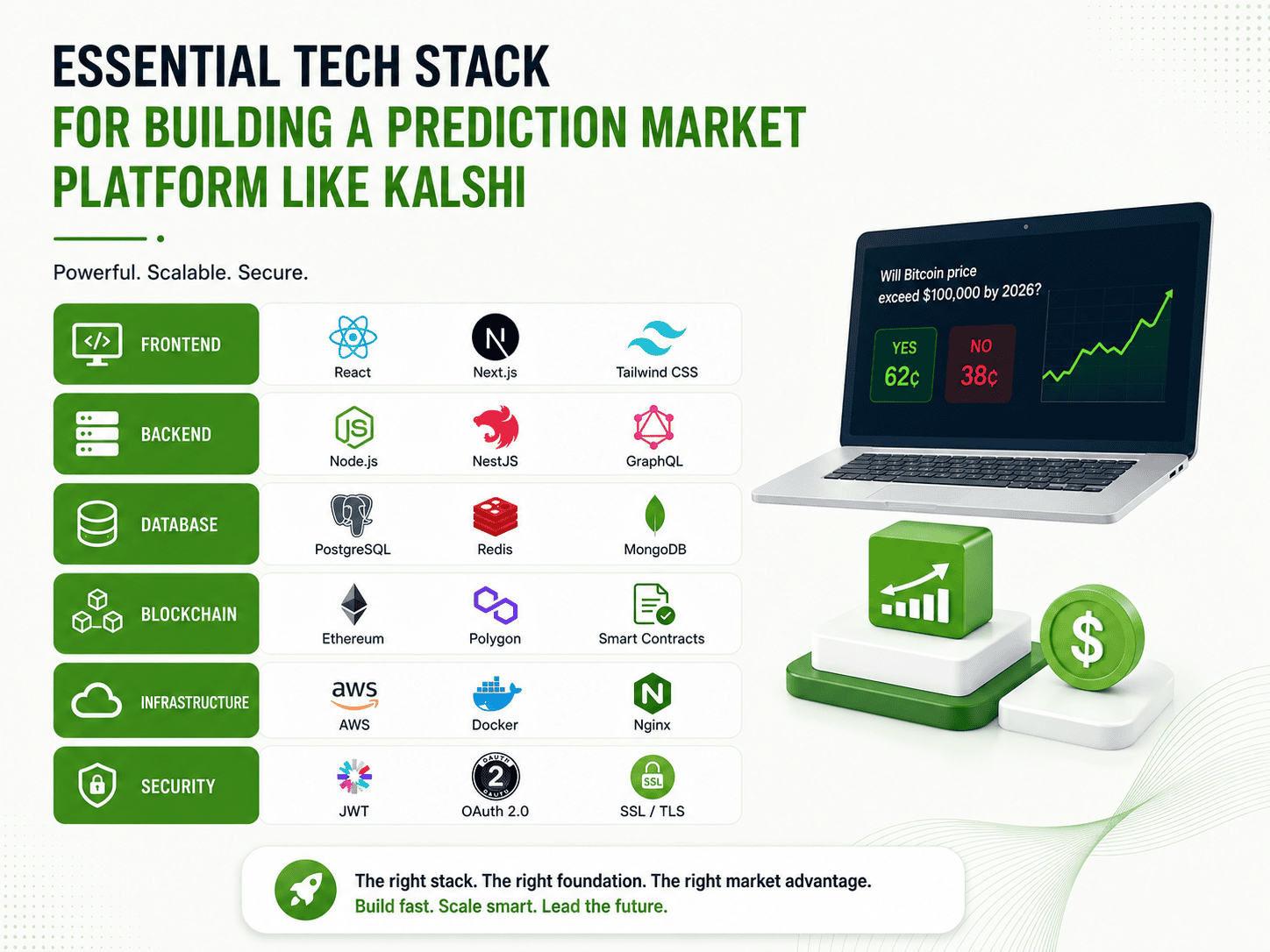
Prediction markets stopped being a niche experiment somewhere around 2025. Kalshi alone was moving roughly $2 billion in monthly trading volume by early 2026, and combined monthly turnover on Kalshi and Polymarket jumped from under $5 billion in September 2025 to nearly $24 billion by April 2026. That is not a fad curve — that is a market finding product-market fit in real time.
If you are a founder, CTO, or product lead exploring this space, you already know the hard part isn’t the idea. It’s the prediction market tech stack — the specific combination of matching engine, oracle system, compliance layer, and payment rails that decides whether your platform survives its first volatile news cycle or collapses under a liquidity crunch and a disputed market resolution.
At Digitechzo, we’ve spent time in the weeds of fintech and exchange-style architecture — matching engines, KYC pipelines, and real-time settlement systems — and this guide reflects what actually breaks in production, not just what looks good in a pitch deck. This is a practical, engineering-first breakdown of every layer you need, why it matters, and where most teams get it wrong.
Quick Answer
A production-ready prediction market platform needs seven core layers: a low-latency matching engine, a reliable oracle/data-resolution system, wallet and payment infrastructure, KYC/AML and compliance tooling, real-time market data delivery (WebSockets), risk and surveillance controls, and scalable cloud infrastructure. Skipping any one of these doesn’t just create a weaker product — it creates a platform that can’t legally operate or survive a disputed market.
What Is a Prediction Market Platform, Technically Speaking?
Strip away the marketing language and a prediction market is an exchange — structurally closer to a commodities exchange than a betting site. Users buy and sell contracts (usually “Yes/No” or multi-outcome) whose price reflects the market’s implied probability of a real-world event. When the event resolves, contracts settle at $1 or $0.
That single sentence hides enormous engineering complexity. You’re not building a quiz app — you’re building infrastructure that has to handle:
- Order matching under extreme volume spikes (think: election night or a Fed rate decision)
- Objective, disputable-proof resolution of real-world outcomes
- Custody of user funds with bank-grade or wallet-grade security
- Regulatory reporting obligations that vary by jurisdiction
Global prediction market trading volume reached roughly $44 billion across major platforms in 2025, with niche categories like economics-focused contracts growing about 905% year-over-year. That growth is exactly why the underlying stack has to be engineered like financial infrastructure, not a side project.
The Core Prediction Market Tech Stack, Layer by Layer
1. Matching Engine (The Heart of the Exchange)
The matching engine pairs buy and sell orders based on price-time priority, exactly like a stock exchange order book. It needs to process market orders, limit orders, partial fills, and cancellations with sub-second latency, even during a volume spike.
Practical insight: Most teams underestimate how bursty prediction market traffic is. Unlike equities, where volume is roughly steady through the day, prediction markets spike violently around news events — a debate, a jobs report, a court ruling. Your matching engine needs to be load-tested against 20–50x baseline traffic, not just average daily volume.
Common technology choices:
- Custom-built engines in Rust, Go, or C++ for ultra-low latency
- Managed exchange infrastructure providers for faster time-to-market
- On-chain CLOB (central limit order book) contracts for decentralized models, as used by Polymarket
2. Oracle & Resolution System
This is the layer most competitors gloss over — and it’s arguably the most important trust signal you can build. An oracle system determines the actual outcome of an event and feeds it back into the platform to settle contracts.
Kalshi reportedly resolved over 99% of its markets without dispute in 2025, largely because outcomes were tied to verifiable government and institutional data feeds rather than subjective judgment calls. That’s the standard to design toward.
H3: What a strong oracle architecture includes:
- Primary data feeds from authoritative sources (government agencies, exchanges, licensed data providers)
- A documented, public resolution methodology per market category
- A dispute window with human review escalation
- Redundant secondary sources for cross-verification on high-stakes markets
Weak resolution logic doesn’t just create bad PR — it directly widens spreads (sometimes 20–30%) because traders price in resolution risk. Trust, in this business, is infrastructure — not a policy page.
3. Wallet, Custody & Payment Rails
Depending on your model, this layer looks very different:
- Centralized/fiat model (Kalshi-style): Bank partnerships, ACH/wire rails, custodial fund segregation, FDIC-adjacent treatment of user balances.
- Crypto/non-custodial model (Polymarket-style): Embedded or external non-custodial wallets, USDC settlement, gas abstraction (smart accounts + paymasters) to reduce onboarding friction.
- Hybrid model: Non-custodial wallet plus an optional fiat on-ramp — increasingly the preferred approach for platforms trying to serve both crypto-native and mainstream users.
If you’re building for scale, design your wallet architecture so fiat rails can be bolted on later even if you launch crypto-only. Retrofitting custody logic after launch is one of the most expensive rebuilds a fintech team can undertake.
4. Real-Time Data & Market Feed Layer
Traders need live order books, price charts, and portfolio updates without refreshing the page. This means:
- WebSocket infrastructure for push-based price and order-book updates
- A time-series database (e.g., for tick-level price history)
- REST APIs for account, portfolio, and historical data
- Public market-data APIs if you want third parties or aggregators to integrate with you
5. Risk & Market Integrity Controls
Prediction markets are uniquely vulnerable to manipulation right before expiry, when a small trade can meaningfully move a probability that’s about to become “truth.” A serious platform needs:
- Position limits per user, per market
- Automated anomaly detection for wash trading and spoofing
- Circuit breakers for abnormal price moves
- Audit logging for every order and cancellation
6. Compliance & KYC/AML Layer
Covered in depth below — but structurally, this includes identity verification vendors, sanctions/watchlist screening, geofencing by jurisdiction, and transaction monitoring integrated directly into the trading flow, not bolted on afterward.
7. Cloud Infrastructure & DevOps
- Auto-scaling compute for traffic spikes around live events
- Multi-region redundancy for uptime during high-stakes markets (you cannot go down during an election night)
- Comprehensive observability (latency, order-fill rate, error tracking)
- Security: penetration testing, SOC 2-track controls, encrypted data at rest and in transit
Centralized vs. Decentralized Architecture
| Factor | Centralized (Kalshi-style) | Decentralized (Polymarket-style) |
|---|---|---|
| Regulatory path | CFTC-regulated exchange model in the U.S. | Smart-contract based, regulatory posture still evolving in some jurisdictions |
| Settlement | Internal ledger, bank-grade custody | On-chain conditional tokens, oracle-based resolution |
| Speed to market | Slower (licensing-heavy) | Faster technically, but jurisdictional access is inconsistent |
| Institutional trust | Higher, especially post-2026 institutional infrastructure build-out | Growing, but still building institutional rails |
| User onboarding | Bank-account style KYC | Wallet-based, can be near-instant |
| Best for | Teams targeting U.S. retail + institutional traders | Teams targeting crypto-native, global audiences |
Pros of centralized models: Clearer regulatory standing, easier institutional partnerships, familiar UX for mainstream traders. Cons: Heavier compliance overhead, slower geographic expansion, licensing costs.
Pros of decentralized models: Global reach, transparent on-chain settlement, lower custody risk for the platform. Cons: Regulatory ambiguity in key markets like the U.S., smart contract risk, harder fiat integration.
A growing number of serious operators are landing on hybrid architecture — centralized matching and UX with on-chain or verifiably transparent settlement — as the most defensible middle ground going into the next few years.
Build vs. Buy: Should You Build on Kalshi/Polymarket APIs or From Scratch?
This is the decision that determines your entire budget and timeline, and most teams don’t realize it’s even a choice.
Option A: Build on existing liquidity (API/SDK integration) Kalshi offers an official exchange API with REST, WebSocket, and FIX support plus Python and TypeScript SDKs. Polymarket exposes a CLOB API with official clients in TypeScript, Python, and Rust. This path lets you ship a product layer — a terminal, an aggregator, a niche vertical app — without building a matching engine or bootstrapping liquidity from zero. The tradeoff: you inherit the underlying platform’s rules, limits, and geographic restrictions.
Option B: Build on protocol primitives Frameworks like Gnosis Conditional Token Framework or other prediction-market protocols give you more control over market design without writing a matching engine from scratch, but you still own liquidity bootstrapping.
Option C: Full custom build Complete control over markets, fees, and product economics — but the highest cost and longest timeline, and you own 100% of the compliance and liquidity burden.
If your business model depends on owning the trading economics long-term, custom build is usually worth it. If you’re testing a vertical (sports, weather, niche finance) or building a trading terminal/analytics layer, integrating with existing liquidity is almost always the smarter first move.
The Compliance Layer Nobody Budgets Enough Time For
Regulatory classification is the single biggest risk variable in this industry right now. In the U.S., prediction markets sit at the center of an active jurisdictional fight between federal (CFTC) authority and state gaming regulators, and by mid-2026 that tension had intensified as platforms began building institutional infrastructure — clearing relationships, FCM memberships, and prime-broker access — that regulators and courts are actively scrutinizing.
Practical implications for your tech stack:
- Geofencing must be built into the core product, not added later — Kalshi, for example, blocks specific U.S. states and international jurisdictions at the platform level.
- KYC/AML should be a first-class system, not a plugin, if you plan to touch fiat rails or serve U.S. users.
- Design for jurisdictional flexibility. Market availability by region should be a configuration, not a hardcoded assumption, because the regulatory map is still moving.
If you take one thing from this section: treat “which users can legally access which markets” as a technical architecture question you solve at the data-model level, not a legal afterthought you patch in with a banner.
Common Mistakes When Building a Prediction Market Platform
- Treating the oracle as an afterthought. Teams pour resources into UI and trading UX, then bolt on a vague “admin resolves markets manually” system. This is where disputes, chargebacks, and reputational damage come from.
- Underestimating liquidity planning. A market with no depth is a market nobody trusts. Many platforms fail quietly simply because no one designed a liquidity seeding strategy before launch — market maker incentives, seed capital, or aggregator integration all need to be planned pre-launch, not reactively.
- Bolting compliance on after MVP. Retrofitting KYC/AML and geofencing into an already-built trading flow is dramatically more expensive than designing for it from day one.
- Ignoring surveillance until there’s a scandal. Manipulation near contract expiry is a known, predictable attack vector — not an edge case.
- Choosing architecture based on hype instead of target users. Going full decentralized because it’s trendy, when your actual audience wants a bank-account-style onboarding experience, creates friction that kills conversion.
- No load testing for event-driven spikes. Average daily traffic numbers are meaningless here; design and test for the 20-50x spike scenario.
Expert Tips for a Resilient Prediction Market Stack
- Design your data model around jurisdiction from day one. Every market, every user account, and every trade should carry jurisdiction metadata — it will save you months of rework later.
- Publish your resolution methodology per market category, not just per market. This builds trust at scale and reduces individual dispute volume.
- Separate your risk engine from your matching engine. Coupling them tightly makes it harder to add new integrity controls without touching core trading logic.
- Start with a narrower vertical if you’re resource-constrained. A focused category (sports, weather, macro data) with airtight resolution is more defensible than a broad, shallow market catalog.
- Instrument everything. Order latency, fill rates, and resolution time-to-dispute should all be dashboarded from week one — you cannot fix what you cannot measure.
- Plan your liquidity strategy before writing a line of matching-engine code. Whether that’s market maker agreements, aggregator integration, or seed capital, this determines whether day-one users see a usable order book.
Realistic Cost & Timeline Expectations
Costs vary enormously based on build path:
- Basic MVP using pre-built frameworks or existing exchange APIs: roughly $10,000–$50,000, focused on core trading functionality and a simple interface — ideal for testing product-market fit.
- Production-ready platform with custom matching engine, compliance integration, wallet infrastructure, and multi-market support: significantly higher, typically requiring a dedicated engineering team over 4–6 months for MVP and several additional months for advanced features like institutional APIs, AI-driven analytics, and security auditing.
- Full compliance-ready, scalable exchange: timeline frequently extends past 6 months once security audits, penetration testing, and regulatory review are factored in.
The fastest path to a market-ready product for most teams is building on top of existing liquidity through official APIs/SDKs — but that speed comes with inherited platform constraints, so weigh that tradeoff against your long-term ownership goals.
FAQs
What is the most important part of a prediction market tech stack?
The oracle/resolution system is the most important layer. It determines whether users trust your platform’s outcomes, and weak resolution logic directly widens spreads and increases dispute volume, even if your trading UI is excellent.
Should I build my prediction market platform on blockchain or use a centralized ledger?
It depends on your target audience and regulatory strategy. Centralized architecture (like Kalshi) suits platforms targeting U.S. retail and institutional traders under CFTC-style regulation. Decentralized architecture (like Polymarket) suits platforms prioritizing global, crypto-native access, though regulatory posture in key markets is still evolving.
Can I build a prediction market platform using Kalshi or Polymarket’s API instead of building my own exchange?
Yes. Both platforms offer official APIs and SDKs that let you build a product layer — such as a trading terminal, analytics tool, or niche vertical app — on top of their existing liquidity, without building a matching engine or bootstrapping order-book depth yourself.
How much does it cost to build a prediction market platform like Kalshi?
A basic MVP typically costs between $10,000 and $50,000 using existing frameworks or APIs. A fully custom, compliance-ready exchange with a proprietary matching engine costs substantially more and takes several months to over a year, depending on regulatory scope.
What compliance requirements apply to a prediction market platform?
At minimum: KYC/AML for fiat-touching platforms, jurisdictional geofencing, sanctions/watchlist screening, and transaction monitoring. U.S.-facing platforms also need to navigate the ongoing CFTC-versus-state-gaming-regulator jurisdictional landscape, which directly affects which markets and users you can legally serve.
Final Thoughts
Building a prediction market platform is fundamentally an exercise in financial-infrastructure engineering wearing a consumer-friendly interface. The winners in this space — Kalshi chief among them — didn’t win on flashy UX. They won because their architecture treated resolution integrity, liquidity design, and regulatory compliance as core product features, not afterthoughts bolted on before launch.
If you’re serious about building in this space, the smartest first step isn’t choosing a tech stack in isolation — it’s mapping your target jurisdiction, your liquidity strategy, and your resolution methodology before a single line of matching-engine code gets written.
At Digitechzo, this is the kind of architecture-first conversation we have with fintech and exchange-style founders before development ever starts. If you’re evaluating your build path — API integration, custom exchange, or hybrid — we’re happy to walk through what actually fits your compliance footprint and growth plan. Reach out to start that conversation.
About The Author