
Every founder exploring this space asks the same question in different words: “What’s this actually going to cost me?” And every vendor gives a different answer, because Prediction Market Platform Development Cost depends on variables most sales pages conveniently skip over.
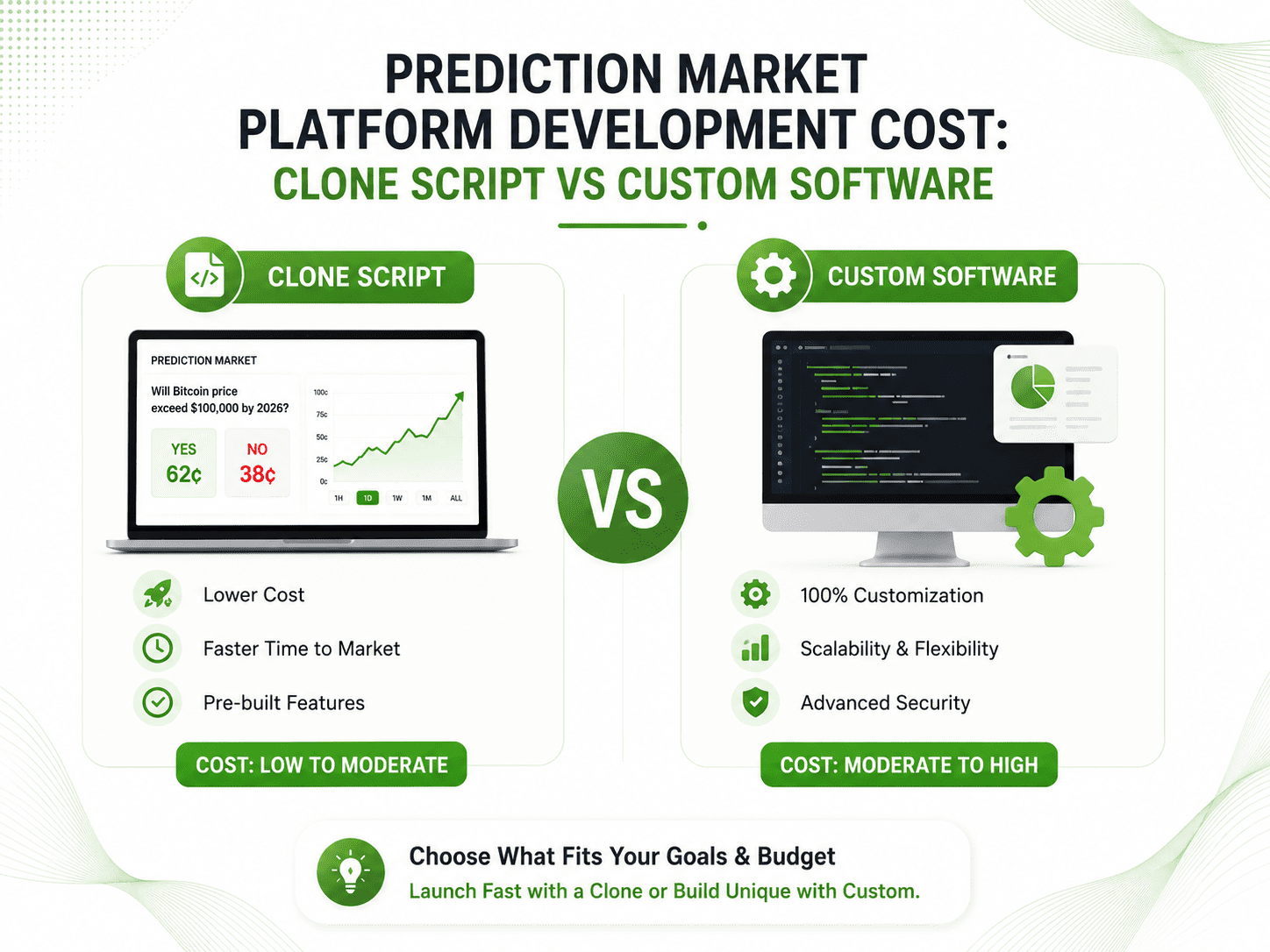
You’ve probably seen quotes ranging from $25,000 to $300,000 for what sounds like the same platform. That gap isn’t a pricing gimmick — it reflects two fundamentally different build paths: a clone script foundation versus fully custom software. Picking the wrong one for your stage either burns capital you didn’t need to spend, or locks you into infrastructure that can’t scale when you actually need it to.
This guide breaks down the real cost structure behind building a prediction market platform — line by line, path by path — so you can budget accurately instead of guessing. Teams like DigiTechzo, who build fintech and blockchain platforms for a living, walk founders through this exact cost conversation regularly, and the honest answer is almost always more nuanced than any single number a landing page can give you.
Quick Answer
A prediction market platform built on a clone script typically costs $25,000–$70,000 and launches in 8–12 weeks. Fully custom prediction market software ranges from $80,000–$300,000+, taking 4–8 months, depending on compliance scope, matching engine complexity, and supported jurisdictions. The right choice depends on whether you’re validating demand or building for long-term scale and ownership.
Why Development Cost Varies So Widely
Here’s what most cost guides won’t tell you upfront: the number you’re quoted depends almost entirely on which of three things you’re actually buying.
- A rebrand. A clone script with your logo and colors, minimal customization.
- A modular foundation. A clone script framework built to be extended and eventually migrated to custom infrastructure.
- A ground-up build. Fully custom prediction market software architected around your specific compliance and scaling needs.
These are three different products with three different price tags, and vague quotes get you a mismatch between what you paid for and what you actually needed. Understanding this distinction before requesting quotes is the single biggest lever you have over your final Prediction Market Platform Development Cost.
What Determines Prediction Market Platform Development Cost
At a high level, five components drive the bulk of your budget:
- Trading engine complexity — a basic order matching system versus a low-latency, high-throughput matching engine
- Compliance scope — single-jurisdiction basic KYC versus multi-region, audit-ready compliance infrastructure
- Payment infrastructure — fiat-only versus fiat plus crypto rails with reconciliation logic
- Platform reach — web-only versus native iOS and Android apps
- Data and analytics depth — basic charts versus real-time order book depth, historical data exports, and API access
Featured snippet answer: Prediction market platform development cost is primarily determined by trading engine complexity, compliance requirements, payment infrastructure, platform reach (web vs. mobile), and data/analytics depth — with clone scripts costing $25,000–$70,000 and custom builds ranging from $80,000–$300,000+.
Cost Breakdown Table
Here’s how the budget typically splits across core components, regardless of which build path you choose:
| Component | Clone Script Range | Custom Development Range |
|---|---|---|
| Core platform build (trading engine, UI) | $15,000 – $35,000 | $50,000 – $150,000 |
| KYC/AML integration | $3,000 – $8,000 | $8,000 – $20,000 |
| Payment gateway (fiat + crypto) | $2,000 – $6,000 | $6,000 – $18,000 |
| Mobile app development (iOS + Android) | $5,000 – $15,000 | $20,000 – $50,000 |
| Admin panel & analytics dashboard | Included in base build | $10,000 – $25,000 |
| Compliance/legal consulting | Often excluded | $10,000 – $30,000+ |
| QA, security testing & audits | $2,000 – $5,000 | $10,000 – $25,000 |
| Estimated Total | $25,000 – $70,000 | $80,000 – $300,000+ |
Clone Script vs Custom Development: Cost Comparison
Cost is only meaningful in context. Here’s how the two paths compare across the factors that actually affect your total investment and long-term value.
| Factor | Kalshi Clone Script | Custom Prediction Market Software |
|---|---|---|
| Upfront Cost | $25,000 – $70,000 | $80,000 – $300,000+ |
| Time to Market | 8–12 weeks | 4–8 months |
| Customization Depth | Limited to framework | Fully tailored |
| Compliance Flexibility | Basic, usually single-jurisdiction | Multi-jurisdiction ready |
| Scalability | Moderate, may need re-architecture | Built for scale from day one |
| Ownership | Often licensed, not fully owned | 100% IP ownership |
| Long-Term Maintenance Cost | Recurring vendor licensing fees | Full control, cost depends on internal roadmap |
| White-Label/B2B Potential | Limited | High, if architected for it |
| Best For | Validating demand, tight budgets | Scaling, multi-region, investor-ready platforms |
Pros and cons at a glance:
| Pros | Cons | |
|---|---|---|
| Clone Script | Fast, affordable, lower risk to test | Limited customization, possible licensing lock-in |
| Custom Software | Full ownership, built to scale, compliance-ready | Higher upfront cost, longer development timeline |
Factors Affecting Development Cost
Beyond the base build, these variables move your final number significantly:
- Number of supported markets/categories. Politics, sports, crypto, and economics each may need different data sourcing and settlement logic.
- Real-money vs. play-money launch. Real-money platforms require far more robust security, compliance, and payment infrastructure.
- Blockchain integration. A blockchain prediction market with on-chain settlement adds smart contract development and auditing costs.
- AI-driven features. An AI prediction market layer — dynamic pricing, fraud detection, market curation — adds engineering time but often pays for itself through better risk management and user retention.
- Team location and engagement model. Development costs vary significantly between agencies, freelancers, and in-house teams, and between geographic regions.
- White-label ambitions. Building for future white label prediction market platform licensing requires modular architecture from the start, which costs more upfront but avoids expensive rebuilds later.
Hidden Costs Most Companies Ignore
These are the costs that don’t show up in initial quotes but hit your budget within the first year:
- Ongoing licensing fees on clone scripts — many vendors charge annual or per-user renewal fees that compound over time.
- Payment processor underwriting delays — betting-adjacent businesses often face extended onboarding with banking partners, which costs time even without direct fees.
- Data infrastructure scaling costs — time-series market data grows fast, and poorly planned database architecture gets expensive to fix later.
- Third-party API costs that scale with volume — KYC providers, data feeds, and cloud hosting all increase in cost as your user base grows.
- Compliance consulting — frequently excluded from initial development quotes but essential before launching a real-money platform.
- Post-launch feature requests — clone scripts often charge premium rates for customizations beyond the original framework’s scope.
Expert insight: Ask any vendor directly what happens to your costs at 10x your current user volume. If they can’t answer clearly, that’s a sign the platform wasn’t architected with scale in mind — and that gap will eventually cost more than the difference between clone script and custom pricing today.
ROI Analysis
Cost only matters relative to return. Here’s how to think about ROI realistically for prediction market app development.
Revenue drivers that offset development cost:
- Trading fees (typically 1–5% per contract trade)
- Withdrawal fees
- Premium subscription tiers for advanced data/analytics
- Market maker spreads on platform-provided liquidity
- Data licensing to research firms once volume is meaningful
- White-label licensing to other operators, the highest single-deal revenue potential
A practical ROI framework:
- Estimate realistic monthly trading volume based on your target category and user base size.
- Apply your planned fee percentage to get baseline monthly revenue.
- Compare that against your monthly operating costs (infrastructure, compliance, support, payment processing).
- Calculate your break-even point against total development cost.
Example: A platform launched on a $50,000 clone script build, generating $8,000/month in net trading fee revenue after operating costs, reaches break-even in roughly 6–7 months. A $150,000 custom build generating $20,000/month net revenue — because of better liquidity design and additional revenue streams — reaches break-even in about the same timeframe, despite the higher upfront cost, because the custom platform supports more monetization layers from day one.
This is the calculation most founders skip, and it’s the one that actually determines whether the cheaper option is really the better deal.
Real Business Use Cases
Use Case 1: The Bootstrapped Validator A two-person team with $35,000 in funding needs to test demand for a niche event trading platform focused on regional sports outcomes. A clone script gets them live in 10 weeks, and they use real trading data to decide whether a Series A pitch is worth pursuing.
Use Case 2: The Multi-Region Fintech A funded startup planning to operate across the US and EU, each with different compliance requirements, invests in custom prediction market platform development from the start, because retrofitting multi-jurisdiction compliance onto a rigid framework later would cost more than building it correctly upfront.
Use Case 3: The AI-Enhanced Operator A team building an AI prediction market targeting economic forecasting integrates machine learning models for dynamic pricing and market curation — a feature set that requires custom architecture, since most clone scripts don’t support this level of integration without significant rework.
Common Mistakes
- Comparing quotes without comparing scope. A $30,000 quote and a $30,000 quote can represent very different deliverables — always request a detailed line-item breakdown.
- Ignoring long-term licensing costs on clone scripts. The cheapest upfront option isn’t always the cheapest over 2–3 years.
- Skipping compliance budgeting entirely. Real-money platforms without proper compliance investment face legal risk that dwarfs any development cost savings.
- Over-building before validating demand. Spending $200,000 on custom infrastructure before confirming trader interest is a common and expensive mistake.
- Choosing a vendor based on price alone, without evaluating whether their architecture can actually scale with your growth plans.
Expert Tips
- Request a cost breakdown, not just a total number. A vendor unwilling to itemize costs is a red flag about how they scope projects.
- Budget for compliance separately, even if a vendor bundles it in. Understanding true compliance cost helps you plan for multi-jurisdiction expansion later.
- Treat clone script investment as Phase 1, not the final architecture. Plan your budget assuming a future migration to custom infrastructure if you succeed.
- Prioritize matching engine and liquidity design over UI polish when allocating budget — this is what actually retains active traders.
- Get a second opinion from a development partner that builds both clone scripts and custom platforms. Vendors who only offer one path have an inherent bias in your direction, whether or not it fits your actual stage.
Frequently Asked Questions
1. What is the average cost to build a prediction market platform?
A clone script-based platform typically costs $25,000–$70,000, while fully custom prediction market software ranges from $80,000 to $300,000 or more, depending on compliance scope, trading engine complexity, and supported platforms.
2. Is a Kalshi clone script cheaper than custom prediction market software?
Yes, a Kalshi clone script is generally 50–70% cheaper upfront than custom development, but it often carries ongoing licensing fees and limited scalability, which can narrow the long-term cost gap.
3. What factors most affect prediction market platform development cost?
biggest cost drivers are trading engine complexity, compliance and KYC/AML requirements, payment infrastructure (fiat vs. crypto), mobile app development, and whether the platform needs to support multiple jurisdictions or market categories.
4. How long does it take to build a prediction market platform, and does timeline affect cost?
Clone script builds typically take 8–12 weeks, while custom development takes 4–8 months. Longer timelines generally correlate with higher costs due to increased engineering hours, but they also typically deliver more scalable, compliant infrastructure.
5. Are there hidden costs in prediction market platform development?
Yes. Common hidden costs include ongoing clone script licensing fees, payment processor underwriting delays, compliance consulting (often excluded from initial quotes), and data infrastructure scaling costs as trading volume grows.
Conclusion
There’s no single correct answer to Prediction Market Platform Development Cost — only the answer that matches your current stage, compliance needs, and growth ambitions. A clone script gets you to market fast and cheap when you’re validating demand. Custom software costs more upfront but removes the scalability ceiling you’ll eventually hit if your platform succeeds.
The founders who budget well are the ones who plan for both phases from the start, rather than treating this as a one-time decision made in isolation.
DigiTechzo has helped founders scope both paths honestly — clone script MVPs built to validate quickly, and fully custom prediction market platforms engineered for multi-region scale — with cost breakdowns that reflect what you’re actually building, not a generic package price.
Want an accurate, itemized cost estimate for your specific prediction market platform? Book a free consultation with DigiTechzo’s fintech development team and get a realistic budget before you commit to a build.
About The Author