

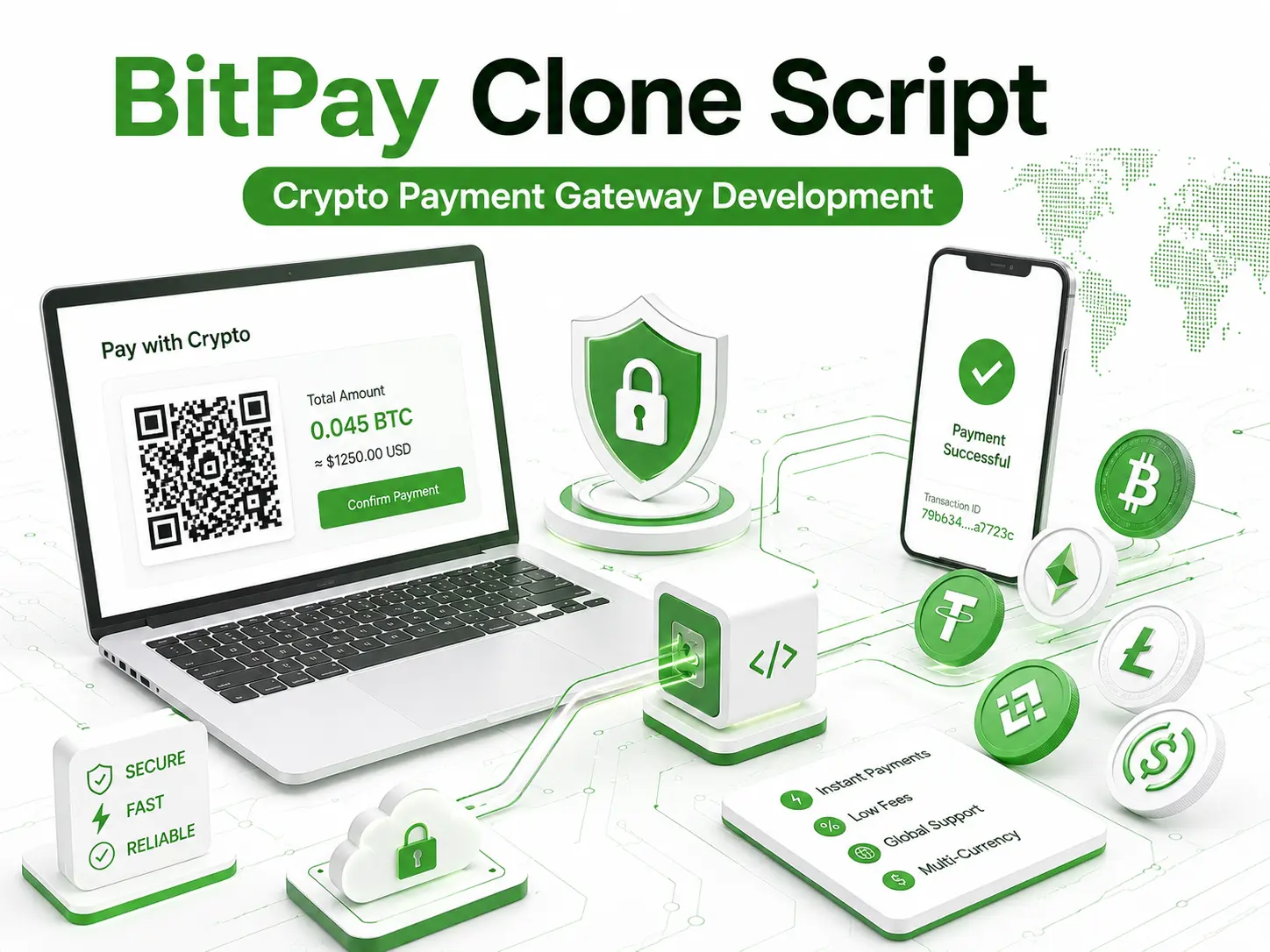
BitPay Clone Script – Crypto Payment Gateway Development
Every day, thousands of businesses lose customers at the checkout stage — not because of bad products, but because of outdated payment systems. In 2024, the global crypto payment gateway market was valued at over $1.5 billion and is projected to grow at a CAGR of 20%+ through 2030. Yet most businesses are still fumbling with clunky integrations, high transaction fees, and weeks-long development cycles.
Here is the truth that most development agencies won’t tell you: you don’t need to build a crypto payment gateway from scratch. A BitPay Clone Script gives you a battle-tested, feature-complete foundation that compresses months of blockchain development into days of deployment.
At DigiTechzo, we’ve helped fintech startups, crypto exchanges, and e-commerce platforms launch enterprise-grade crypto payment gateways using custom clone scripts. This guide draws from that hands-on experience to give you a no-fluff, technical breakdown of what a BitPay Clone Script actually is, how it works, what it costs, and how to choose the right development partner.
|
What Is a BitPay Clone Script?
A BitPay Clone Script is a pre-built, white-label software solution that mirrors the functionality of BitPay — one of the world’s most trusted cryptocurrency payment processors. It provides a complete backend and frontend infrastructure that lets you accept, process, convert, and settle cryptocurrency payments for merchants and end users.
Unlike a simple payment plugin, a BitPay Clone Script includes:
- A multi-currency crypto payment engine (Bitcoin, Ethereum, USDT, Litecoin, and more)
- A merchant dashboard for invoice management and transaction history
- Real-time fiat conversion with integrated exchange rate APIs
- API and plugin integrations for WooCommerce, Shopify, Magento, and custom platforms
- Admin panel for business operations, fee management, and user control
- KYC/AML compliance modules for regulatory adherence
The ‘clone’ in the name does not mean a carbon copy. Reputable providers like Digitechzo build these scripts to be fully customizable — your branding, your feature set, your business rules. Think of it as a highly capable skeleton that you flesh out into your own product.
Why Is BitPay the Reference Model?
BitPay processes billions of dollars in crypto transactions annually and has set the industry standard for merchant-facing crypto payment tools. Their product architecture — from the invoice flow to settlement logic — is the benchmark that businesses want to replicate. A BitPay Clone Script gives you that proven architecture without the years of R&D.
How a Crypto Payment Gateway Works (Technical Breakdown)
Understanding the underlying flow helps you make better product decisions. Here is how a crypto payment gateway processes a transaction end-to-end:
1.Customer initiates checkout and selects ‘Pay with Crypto’.
2.The gateway generates a unique payment invoice with a wallet address and amount in the selected cryptocurrency.
3.A QR code or payment link is presented to the customer with a countdown timer (typically 15 minutes).
4.The customer sends the exact amount from their wallet. The gateway listens to the blockchain for incoming transactions.
5.On confirmation (1-6 blockchain confirmations depending on the coin), the payment is marked complete.
6.The gateway either holds the crypto or converts it to fiat at the current exchange rate and credits the merchant’s account.
7.Settlement occurs on a daily or weekly cycle, depending on the merchant’s preferences.
Key Technical Components
|
Component |
Function |
|
Blockchain Node / API |
Monitors wallet addresses for incoming transactions across supported networks |
|
Rate Engine |
Fetches real-time exchange rates from aggregators like CoinGecko, Binance API |
|
Invoice Generator |
Creates unique, time-bound payment requests tied to specific addresses |
|
Settlement Module |
Converts crypto to fiat and routes funds to merchant bank or crypto wallet |
|
KYC/AML Engine |
Verifies user identity and screens transactions for compliance |
|
Admin Panel |
Manages merchants, fees, payout cycles, and dispute resolution |
Core Features of a BitPay Clone Script
Not all BitPay Clone Scripts are created equal. Here are the features you must demand from any provider — and what separates a professional-grade script from a budget knockoff.
Merchant-Facing Features
Multi-cryptocurrency support: BTC, ETH, LTC, XRP, USDT, BNB, and custom tokens
Instant fiat conversion to USD, EUR, GBP, INR, and other currencies
Branded merchant dashboard with real-time analytics
API keys and webhook support for seamless platform integrations
Invoicing and payment link generation
WooCommerce, Shopify, Magento, OpenCart plugin support
Email and SMS notifications for payment events
Admin-Facing Features
Super admin dashboard with full business visibility
Fee configuration (flat fee, percentage fee, or hybrid)
Merchant onboarding and approval workflows
Transaction monitoring and dispute management
Payout cycle configuration and settlement reporting
Multi-language and multi-currency admin interface
Security & Compliance Features
Two-factor authentication (2FA) for all accounts
End-to-end SSL/TLS encryption
KYC integration (Onfido, Jumio, or custom providers)
AML transaction screening
Cold wallet and hot wallet architecture
IP whitelisting and DDoS protection
Audit logs and access control
Advanced / Premium Features
Recurring billing and subscription payment support
Multi-wallet and HD wallet generation
Partial payment handling
Refund and overpayment management
Cross-chain swap integration (optional)
White-label mobile app (iOS & Android)
BitPay Clone Script vs. Building From Scratch
One of the most common questions we get at Digitechzo is: ‘Should I use a clone script or build my payment gateway from scratch?’ The answer depends on your timeline, budget, and strategic goals — but the data strongly favors the clone script approach for most businesses.
|
Factor |
Clone Script vs. From Scratch |
|
Development Time |
Clone Script: 2–6 weeks | From Scratch: 6–18 months |
|
Cost |
Clone Script: $5,000–$30,000 | From Scratch: $100,000–$500,000+ |
|
Technical Risk |
Clone Script: Low (battle-tested code) | From Scratch: High (untested) |
|
Customization |
Clone Script: High (full source code) | From Scratch: Unlimited (but costly) |
|
Compliance |
Clone Script: Pre-built modules | From Scratch: Must build from zero |
|
Time to Market |
Clone Script: Weeks | From Scratch: 12+ months typically |
|
Maintenance |
Clone Script: Provider support available | From Scratch: Full in-house burden |
The only scenario where building from scratch makes clear sense is if you have highly proprietary blockchain infrastructure requirements, a dedicated team of blockchain engineers, and a budget exceeding $500K. For 95% of businesses entering the crypto payment space, a well-built clone script is the smarter and faster path.
Use Cases & Business Models
A BitPay Clone Script is not a one-size-fits-all product. Here are the most commercially viable use cases:
E-Commerce & Retail
Online stores can integrate a crypto payment gateway to accept Bitcoin and altcoins alongside traditional payment methods. This opens access to the global crypto-holding consumer base — estimated at over 420 million people worldwide.
Freelance & Service Platforms
Platforms serving international clients struggle with cross-border payment fees and currency restrictions. A crypto gateway eliminates middlemen, reduces fees to near-zero, and settles in hours instead of days.
Crypto Exchanges & Wallets
Exchanges can integrate a white-label payment gateway to allow users to pay merchants directly from their exchange wallets — a massive UX improvement and a stickiness driver.
Gaming & NFT Marketplaces
In-game purchases and NFT transactions require fast, low-fee payment rails. A BitPay Clone Script adapted for gaming can handle micro-transactions at scale.
SaaS & Subscription Businesses
Recurring billing in crypto is still underserved. A properly built clone script with subscription support gives SaaS founders a competitive edge in the Web3 community.
Financial Services & Remittance
Remittance companies can drastically cut transaction costs by routing payments through crypto rails and settling in fiat at the destination — a model that can undercut traditional wire transfer fees by 80%+.
How to Choose the Right BitPay Clone Script Provider
The market is flooded with vendors selling cheap clone scripts. Here is how to evaluate them like a professional:
Source Code Ownership
Always insist on full, unencoded source code delivery. Some vendors deliver encrypted or nulled scripts that lock you into dependency. You must own 100% of the code.
Blockchain Architecture Quality
Ask whether they use direct node integration or third-party APIs for blockchain monitoring. Direct node integration (running your own BTC, ETH nodes) gives you reliability and independence. API-based approaches are cheaper but create a single point of failure.
Security Audit Trail
Request proof of a third-party security audit on the codebase. Professional providers will have at minimum a penetration test report. Handling other people’s money demands this baseline.
Customization Depth
Ask for a demo where they change branding, add a new cryptocurrency, and modify fee structures in real time. If they hesitate, the script is likely template-locked.
Post-Launch Support
Crypto networks upgrade constantly (Ethereum’s EIPs, Bitcoin’s Taproot, etc.). Ensure your provider commits to software updates, bug fixes, and network upgrade compatibility — ideally for at least 12 months post-launch.
Compliance Modules
Depending on your geography, KYC/AML is not optional — it is a legal requirement. Verify the script includes or can integrate with compliant identity verification providers.
Pros & Cons of Using a BitPay Clone Script
Pros
- Dramatically reduced time to market — launch in weeks, not months
- Cost-effective compared to custom development
- Battle-tested architecture reduces technical risk
- Full white-label capability — your brand, your product
- Pre-built compliance and security modules
- Multi-currency and multi-blockchain support out of the box
- Easier to attract early investors with a working product
Cons
- Quality varies widely between vendors — due diligence is critical
- Some scripts use outdated libraries or insecure dependency chains
- Very niche or proprietary features may still require custom development
- Shared codebase may mean competitors have similar feature sets initially
- Post-launch customization complexity depends on code quality
Common Mistakes to Avoid
After reviewing dozens of crypto payment gateway projects, these are the mistakes that cause the most damage:
Mistake #1: Choosing on Price Alone
A $500 BitPay clone from a freelance marketplace is almost certainly a security disaster waiting to happen. When your platform handles real crypto transactions, a single vulnerability can result in six-figure losses. Budget appropriately.
Mistake #2: Ignoring Regulatory Requirements
Many founders launch first and think about compliance later. In crypto payments, this is backwards. MSB (Money Services Business) licensing in the US, EMI licensing in the EU, and similar frameworks in other regions require compliance infrastructure to be baked in from day one.
Mistake #3: Skipping Load Testing
Your payment gateway needs to handle traffic spikes — think a viral product launch or a crypto market rally driving user activity. Test your infrastructure for 10x expected traffic before going live.
Mistake #4: Using Custodial Wallets Without Proper Architecture
If your platform holds customer funds, you are a custodian — with significant legal and security obligations. Many operators get this wrong by using a single hot wallet for everything. The correct architecture uses a combination of HD wallets (one address per transaction) and cold storage for reserves.
Mistake #5: Neglecting the Merchant UX
The best crypto payment gateway is one that merchants actually use. If the dashboard is confusing, the API docs are thin, or the onboarding flow is broken, merchants will abandon you for a competitor. Invest in UX as seriously as you invest in blockchain infrastructure.
Expert Tips for a Successful Launch
|
|
|
|
|
Frequently Asked Questions (FAQs)
Q1: What is a BitPay Clone Script and how does it work?
A BitPay Clone Script is a white-label crypto payment gateway software that replicates the core functionality of BitPay’s platform. It works by generating unique payment addresses for each transaction, monitoring the blockchain for incoming payments, confirming transactions, and either holding the crypto or converting it to fiat before crediting the merchant. Businesses deploy it under their own brand to offer crypto payment processing to merchants.
Q2: How long does it take to launch a crypto payment gateway with a clone script?
With a professional BitPay Clone Script, most businesses can go from purchase to live deployment in 2 to 6 weeks. This includes customization, third-party integrations (KYC, payment plugins), server setup, testing, and launch. Custom development of the same product from scratch typically takes 6 to 18 months.
Q3: How much does a BitPay Clone Script cost?
Pricing varies widely based on the provider and feature set. Entry-level scripts from freelance marketplaces start around $500–$2,000 but carry significant quality and security risks. Professional-grade scripts with full source code, security audits, and support range from $5,000 to $30,000. Factor in server infrastructure, KYC API costs, and ongoing maintenance when budgeting.
Q4: Is a BitPay Clone Script legal?
The script itself is legal software. However, operating a crypto payment gateway may require regulatory licensing depending on your jurisdiction — such as MSB (Money Services Business) registration in the US, EMI licensing in the EU, or equivalent frameworks elsewhere. Always consult a legal advisor before launching. A reputable provider will include compliance modules but cannot provide legal advice.
Q5: Can a BitPay Clone Script support custom cryptocurrencies and tokens?
Yes, professional BitPay Clone Scripts are designed to support custom ERC-20, BEP-20, and other standard tokens with minimal development effort. Adding a custom cryptocurrency typically requires integration of the relevant blockchain node or API and configuration of the wallet generation logic. Your development partner should be able to add new token support as a standard feature.
Conclusion: Build Fast, Launch Smart
The crypto payment industry is not waiting for late movers. Businesses that deploy robust payment infrastructure today are building the merchant relationships and brand trust that will compound for years. A BitPay Clone Script is not a shortcut — it is the intelligent, proven path that lets you compete with established players from day one.
The key is choosing the right development partner. At Digitechzo, we build custom BitPay Clone Scripts that go beyond the template — deeply integrated, security-audited, compliance-ready, and built for scale. Our blockchain team has delivered crypto payment gateways for fintech startups, exchanges, and enterprise clients across the US, EU, and Southeast Asia.
If you are ready to launch your own crypto payment gateway, here is what your next step should look like:
Schedule a free technical consultation to scope your exact requirements
Get a custom feature breakdown and project timeline
Review a live demo of our BitPay Clone Script platform
Receive a transparent, itemized cost estimate — no hidden fees
About The Author