
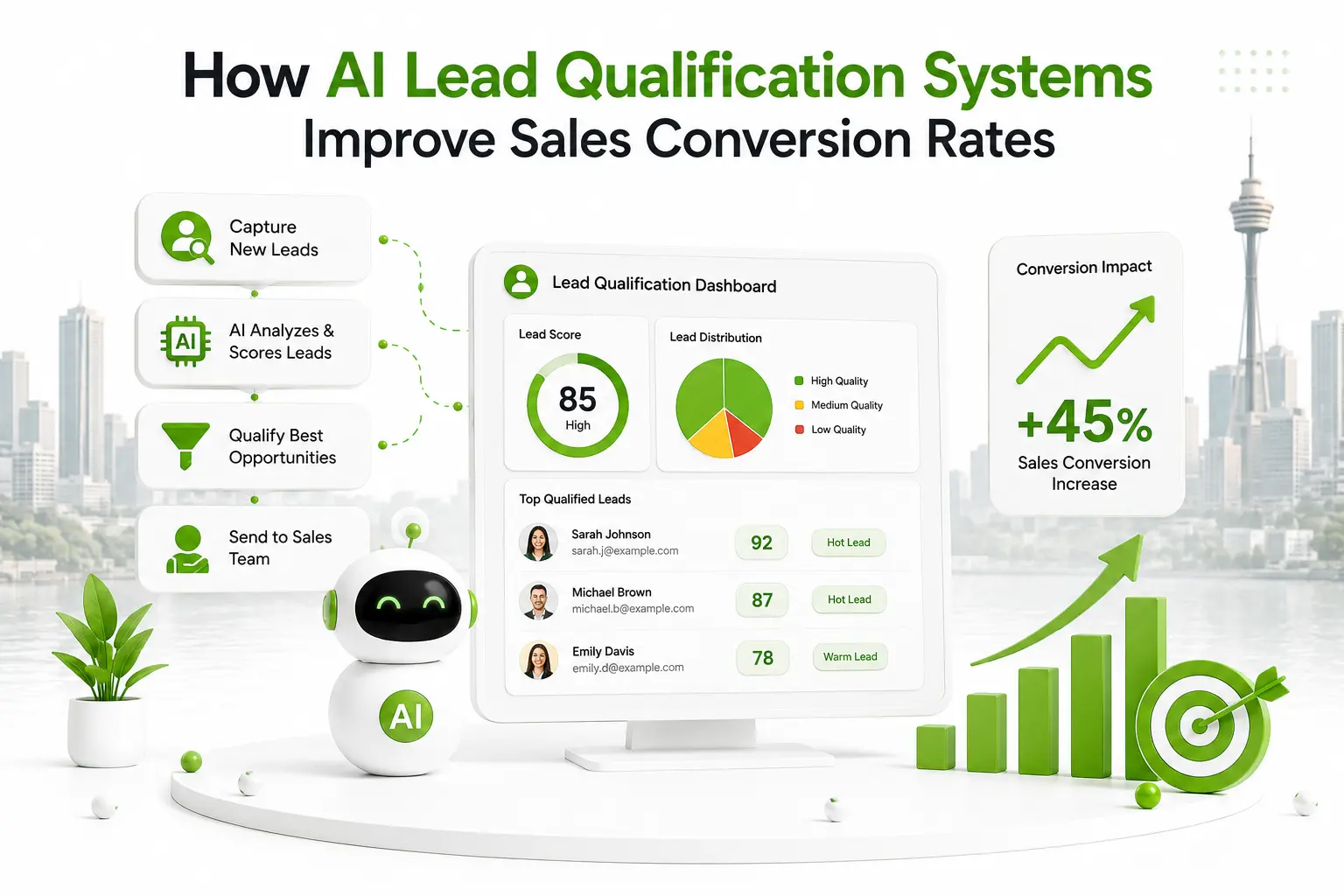
How AI Lead Qualification Systems Improve Sales Conversion Rates
Your sales team is drowning in leads — but closing fewer deals than ever. Sound familiar?
It’s one of the most frustrating paradoxes in modern sales: more pipeline, more activity, more tools — and yet conversion rates stay stubbornly flat. The culprit, more often than not, isn’t your product or your pitch. It’s the leads your reps are chasing. An AI lead qualification system fixes this at the source by using machine learning to identify which leads are genuinely worth pursuing — before a single human second is spent on them.
At DigiTechzo, we’ve implemented AI qualification frameworks for B2B and B2C sales teams across industries. What we’ve seen consistently: businesses that deploy intelligent lead scoring cut their sales cycle by 30–50% and increase conversion rates by 20–40% within the first two quarters. This guide breaks down exactly how — and how to replicate those results for your team.
|
What Is an AI Lead Qualification System?
An AI lead qualification system is a technology layer — typically integrated with your CRM and marketing automation platform — that automatically evaluates every inbound lead against hundreds of behavioral, firmographic, and intent signals to assign a predictive score reflecting their likelihood to convert.
Unlike static lead scoring models that rely on simple rules (“+10 points if they opened an email, -5 if they’re from a small company”), AI qualification systems continuously learn from your actual conversion data. Every closed-won and closed-lost deal trains the model to become more accurate over time.
The Three Core Functions
- Lead Scoring — Assigning a dynamic, predictive score to each lead based on real-time data
- Lead Routing — Automatically directing qualified leads to the right rep, team, or nurture sequence
- Lead Prioritization — Surfacing the highest-value leads to reps at the optimal moment to engage
Together, these three functions transform your lead pipeline from a chaotic inbox into a precision-ranked queue where reps always know exactly who to call next — and why.
Why Traditional Lead Qualification Fails
Most sales organizations still qualify leads using some variation of BANT (Budget, Authority, Need, Timeline) — a framework developed at IBM in the 1950s. It was innovative then. Today, it’s a liability.
The Core Problems with Manual Qualification
- It’s subjective — Two reps evaluating the same lead often reach different conclusions
- It’s slow — Manual qualification adds days or weeks of delay before first contact
- It’s incomplete — Reps can only evaluate what they can see; AI processes hundreds of signals simultaneously
- It doesn’t scale — As lead volume grows, qualification quality inevitably degrades
- It wastes top talent — Your best closers spend hours chasing leads who were never going to buy
|
How AI Lead Qualification Works: The Full Mechanism
Understanding the mechanics separates businesses that implement AI qualification effectively from those who buy software and wonder why conversion rates didn’t move. Here’s the complete picture:
Step 1: Multi-Signal Data Ingestion
The AI system pulls data from every available source simultaneously: website behavior (pages visited, time on site, content consumed), email engagement (opens, clicks, reply patterns), CRM history (previous interactions, deal stages), firmographic data (company size, industry, tech stack), and third-party intent data (what the prospect is researching across the web).
Step 2: Feature Engineering and Pattern Recognition
The machine learning model identifies which combinations of signals correlate most strongly with conversion in your specific business. This is where AI surpasses human judgment — it detects non-obvious patterns. For example: leads from a specific industry who visit your pricing page twice within 48 hours after downloading a case study convert at 4x the baseline rate. No human reviewer would catch that pattern across thousands of leads; the AI does it automatically.
Step 3: Dynamic Score Assignment
Each lead receives a continuously updated score — not a static number assigned at intake. As the lead engages with more content, visits the website again, or gets forwarded to colleagues, the score updates in real time. This means a lead who was a 42 yesterday and is a 78 today gets surfaced to reps immediately, at the moment their intent is highest.
Step 4: Intelligent Routing and Prioritization
Leads above defined score thresholds are automatically routed to the appropriate rep or team based on territory, specialty, or capacity. Leads below threshold enter nurture sequences designed to increase their score over time. Leads with negative signals (wrong company size, competitor employees, students) are filtered out entirely.
Step 5: Continuous Model Learning
Every outcome — won, lost, stalled — feeds back into the model. AI qualification systems improve with every sales cycle, making them exponentially more accurate over 6–12 months than they are at deployment.
Key Features of a High-Performance AI Lead Qualification System
Predictive Lead Scoring
The foundation of any AI qualification system. Look for models trained on your own historical conversion data rather than generic industry benchmarks. Proprietary training data produces dramatically more accurate scores for your specific ICP (Ideal Customer Profile).
Intent Data Integration
Best-in-class systems ingest third-party intent data — signals that a prospect is actively researching solutions in your category on external sites, review platforms, and industry publications. This surfaces in-market buyers before they’ve even visited your website.
Natural Language Processing for Inbound Leads
For leads that arrive via contact forms, chat, or email, NLP engines analyze the text of their inquiry to extract intent signals, urgency indicators, and qualification criteria — automatically. A message saying “We’re evaluating solutions for our 200-person sales team and need something deployed by Q1” scores very differently than “Just curious about pricing.”
Conversational AI Qualification
Advanced systems deploy AI chatbots or email sequences that actively qualify leads through conversation — asking the MEDDIC or BANT questions your reps would ask, capturing responses, and updating lead scores accordingly. This qualification happens 24/7, before any human is involved.
CRM and MAP Native Integration
Scores and qualification data must flow seamlessly into your CRM (Salesforce, HubSpot, Pipedrive) and marketing automation platform (Marketo, Pardot, ActiveCampaign) — not live in a separate tool that reps have to check independently.
Real-World Use Cases and Results
B2B SaaS Company — Reducing Time-to-First-Contact
A 50-person B2B SaaS company was generating 2,000+ monthly trial signups but converting only 3.2% to paid. Their SDR team was calling every signup sequentially — spending equal time on enterprise prospects and students using a work email. After implementing AI qualification: the top 15% of leads by score converted at 18.4%, SDRs’ productive call time increased by 60%, and overall paid conversion rose from 3.2% to 6.1% within one quarter.
Financial Services Firm — ICP Precision
A regional wealth management firm was wasting advisor time on leads who weren’t investable (below their minimum asset threshold). AI qualification, trained on three years of CRM data, learned to identify high-net-worth prospects from behavioral signals alone — website content consumed, referral source, geographic area — before any advisor contact. Advisor time spent on qualified prospects increased from 34% to 71% of total selling hours.
E-Commerce Brand — Recapturing Cart Abandoners
A DTC brand used AI qualification to segment abandoned cart leads by purchase probability rather than treating them all equally. High-intent abandoners (multiple site visits, added to cart multiple times, engaged with email) received immediate personal outreach. Low-intent abandoners entered a discount email sequence. Revenue from the cart recovery program increased 2.3x without increasing outreach volume.
AI Lead Qualification Systems vs. Traditional Scoring: Side-by-Side
|
Dimension |
Traditional Scoring |
AI Qualification |
|
Data inputs |
5–10 manual signals |
100s of behavioral + firmographic + intent signals |
|
Score updates |
Static at intake |
Real-time, continuous |
|
Accuracy |
Degrades over time |
Improves with every sales cycle |
|
Scale |
Breaks above ~500 leads/month |
Handles unlimited volume |
|
Setup time |
1–2 weeks |
4–8 weeks (training + integration) |
|
Subjective bias |
High — reflects who built the rules |
Low — driven by actual conversion data |
|
ICP detection |
Predefined by marketing |
Self-learned from won deals |
|
Cost of errors |
High — reps waste time on bad leads |
Low — errors caught before rep engagement |
How to Implement an AI Lead Qualification System
Implementation quality determines whether you see 2x or 0.2x the results. Here is the framework we use at Digitechzo for every client deployment:
Audit Your CRM Data — AI models are only as good as their training data. You need at minimum 500–1,000 historical deals (won and lost) with consistent field completion. Clean and normalize data before model training.
Define Your Ideal Customer Profile (ICP) Explicitly — Document the firmographic, behavioral, and technographic attributes of your best customers. This gives the AI a starting framework before it learns from outcomes.
Choose Your Platform — Native AI scoring in HubSpot or Salesforce Einstein works well for SMB. Mid-market and enterprise teams should evaluate dedicated tools like MadKudu, 6sense, Demandbase, or Clearbit Reveal for deeper intent data and model customization.
Integrate Intent Data Sources — Connect third-party intent providers (Bombora, G2 Buyer Intent, TechTarget Priority Engine) to give the AI visibility into out-of-site buyer activity.
Set Routing Rules and Thresholds — Define score bands: what score triggers immediate SDR outreach vs. nurture vs. disqualification. Build in human override capability for edge cases.
Run a Parallel Pilot — For the first 60 days, run AI qualification alongside your existing process. Compare outcomes to validate model accuracy before full cutover.
Train Your Sales Team — Reps need to understand what the score means and trust it. Showing them the specific signals that drove a high score (“they visited pricing 3x and attended a webinar”) builds confidence faster than abstract numbers.
Establish a Review Cadence — Review model performance quarterly. Retrain with new closed deal data. Adjust ICP criteria as your market evolves.
Common Mistakes That Kill AI Qualification ROI
Mistake #1: Training on Dirty CRM Data
Garbage in, garbage out — and AI amplifies this more than any previous technology. If your historical deals have inconsistent fields, missing data, or logging errors, your model will learn the wrong patterns. A data audit before implementation is non-negotiable.
Mistake #2: Setting Static Score Thresholds and Never Revisiting Them
A threshold that made sense at model launch becomes outdated as your market shifts, your ICP evolves, or your product expands. Quarterly reviews of threshold performance — not just model accuracy — are essential.
Mistake #3: Ignoring the Sales Team in Implementation
If reps don’t trust the score, they’ll ignore it and revert to their own judgment — making the investment pointless. Involve top performers in the pilot phase, show them the data behind the scores, and make it easy to provide feedback when the model gets it wrong.
Mistake #4: Using Only First-Party Data
Your website data tells you who visited and what they read. But intent data tells you who is actively evaluating your category right now — even if they haven’t found you yet. Systems that integrate third-party intent dramatically outperform those that only analyze owned data.
Mistake #5: Treating Qualification as a One-Time Setup
AI qualification is not a “set it and forget it” system. It requires ongoing training, threshold tuning, and ICP updates. Companies that deploy and forget see accuracy degrade within 6–12 months as their market evolves but their model doesn’t.
Expert Tips for Maximum Conversion Lift
|
Frequently Asked Questions
Q: What is an AI lead qualification system and how does it work?
A: An AI lead qualification system uses machine learning to analyze hundreds of behavioral, firmographic, and intent signals from each lead — then assigns a predictive score reflecting their likelihood to convert. Unlike manual scoring models, it continuously learns from your actual closed-won and closed-lost deals, improving accuracy over time. The system automatically routes high-scoring leads to sales reps and low-scoring leads to nurture sequences, ensuring reps only spend time on prospects most likely to buy.
Q: How much can an AI lead qualification system improve conversion rates?
A: Results vary by industry and baseline, but businesses that deploy AI qualification systems typically see a 20–40% improvement in lead-to-opportunity conversion rates and a 30–50% reduction in sales cycle length within 2–3 quarters of full deployment. The largest gains come from eliminating wasted rep time on unqualified leads and ensuring high-intent leads are contacted within minutes of reaching peak engagement.
Q: What data does an AI lead qualification system need to work?
A: At minimum, an AI qualification system needs 500–1,000 historical deals with consistent CRM data (won, lost, company size, industry, source) plus website behavioral data and email engagement history. Higher-performing systems also integrate third-party intent data from providers like Bombora or 6sense, which reveals when prospects are actively researching your category across the web — before they’ve visited your site.
Q: Which CRM platforms integrate with AI lead qualification tools?
A: Most enterprise AI qualification platforms integrate natively with Salesforce, HubSpot, Pipedrive, and Microsoft Dynamics. Dedicated tools like MadKudu, 6sense, and Clearbit integrate via API with virtually any CRM. Native AI scoring is also available built-in to Salesforce Einstein and HubSpot’s predictive lead scoring features for teams that prefer to minimize their tool stack.
Q: Is AI lead qualification only for large enterprise sales teams?
A: No — AI qualification delivers strong ROI for teams of all sizes, but the implementation approach differs. Small teams (under 10 reps) typically get the best results using built-in AI scoring in HubSpot or Pipedrive, which requires minimal setup and works well with smaller data volumes. Mid-market and enterprise teams with higher lead volumes and more complex ICPs benefit from dedicated platforms like MadKudu or 6sense that offer deeper model customization and multi-source intent data.
Conclusion: Qualification Is Where Sales Wars Are Won
The best sales team in the world can’t compensate for a pipeline full of the wrong leads. Conversion rates are won or lost before a single call is made — in the qualification layer that determines who gets a rep’s time and who doesn’t.
AI lead qualification systems fix this at the source. They replace guesswork and bias with precision intelligence, give your reps an unfair advantage in knowing who to call and when, and continuously improve as they learn from your specific market and buyer behavior.
The businesses outgrowing their competitors in 2025 aren’t necessarily running better pitches or offering better prices. They’re running smarter pipelines — where every hour of selling time is spent on leads the data has already validated as worth pursuing.
About The Author