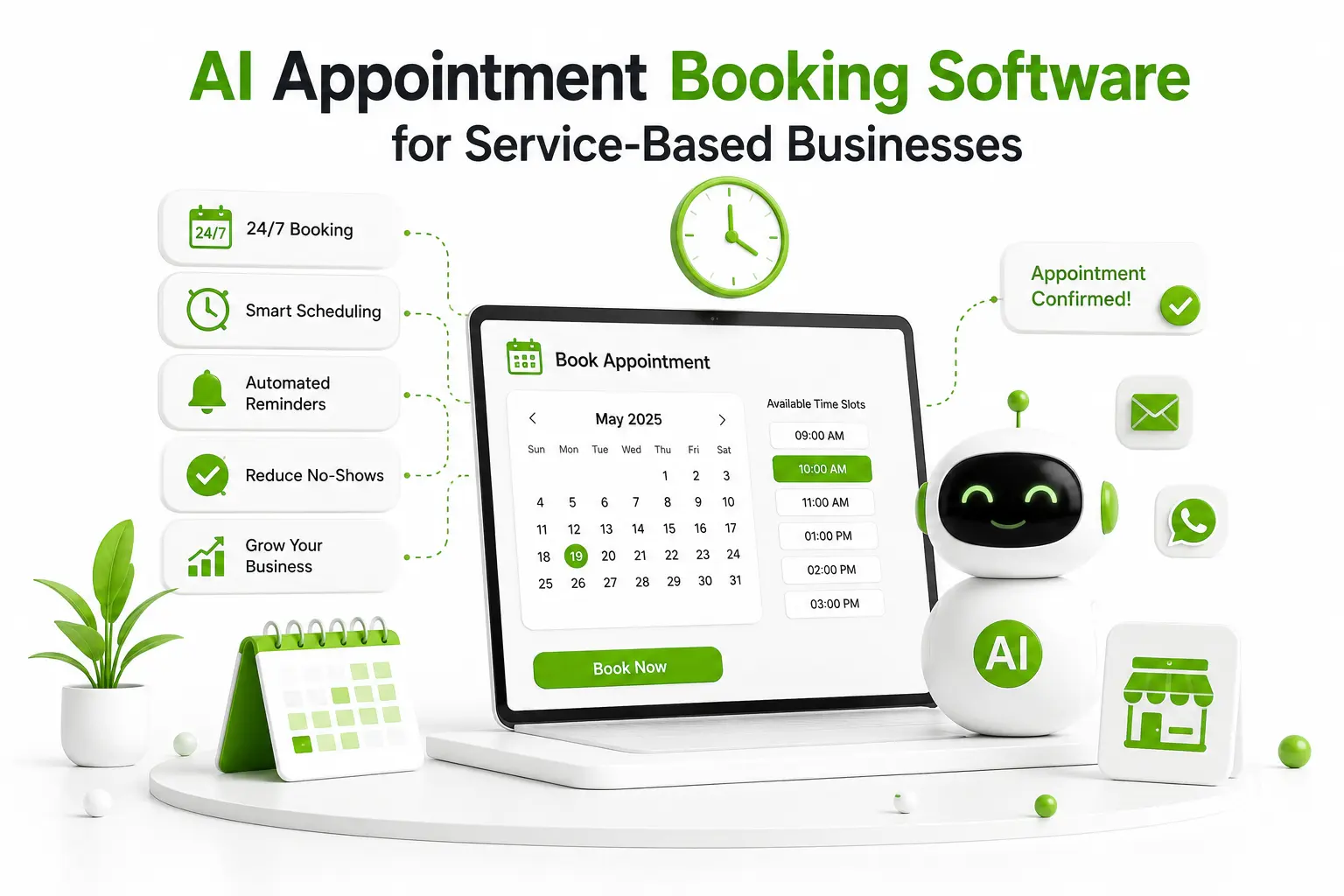
AI Appointment Booking Software for Service-Based Businesses: The Complete 2025 Guide
Picture this: it’s 11 PM and a potential client wants to book your service. Your phone is off, your inbox is silent, and that lead quietly moves on to a competitor who had a “Book Now” button on their website.
This scenario plays out thousands of times a day for salons, clinics, consultants, fitness studios, and every other service business that still relies on phone calls and manual scheduling. The fix isn’t hiring a receptionist around the clock — it’s deploying AI appointment booking software that works 24/7, never misses a beat, and actively reduces your no-show rate.
At DigiTechzo, we’ve spent years helping service-based businesses implement intelligent scheduling systems that cut admin time by up to 80% and recover revenue that was previously lost to missed calls and scheduling friction. This guide distills everything we’ve learned — plus what the data says — into one comprehensive resource.
Whether you’re evaluating your first AI booking tool or looking to upgrade a clunky scheduling system, this guide covers everything you need to make a confident, high-ROI decision.
|
What Is AI Appointment Booking Software?
AI appointment booking software is a scheduling platform that uses artificial intelligence — including machine learning, natural language processing (NLP), and predictive analytics — to automate the end-to-end process of booking, managing, and following up on client appointments.
Unlike traditional scheduling tools that simply let clients pick a time slot, AI-powered systems actively learn from behavior, predict cancellation risk, optimize staff availability, and even handle rescheduling conversations autonomously through chatbots or SMS.
How It Differs from Traditional Booking Tools
|
Feature |
Traditional vs. AI-Powered |
|
Scheduling |
Manual time slot selection vs. AI-suggested optimal times |
|
Reminders |
Fixed email/SMS vs. adaptive reminders based on no-show risk |
|
Rescheduling |
Client must call or email vs. automated chatbot rescheduling |
|
Staff Allocation |
Manual assignment vs. AI-optimized routing |
|
Insights |
Basic reports vs. predictive analytics and demand forecasting |
|
Availability |
Business hours only vs. 24/7 self-service booking |
Why Service Businesses Need AI Scheduling in 2025
The numbers tell an urgent story. According to industry research, the average service business loses 10–15% of its annual revenue to no-shows and late cancellations. For a clinic seeing 50 patients per week at $150 per visit, that’s over $58,000 in lost revenue annually — from scheduling friction alone.
Meanwhile, consumer expectations have shifted dramatically. Studies consistently show that over 60% of appointment bookings now happen outside business hours, and more than 70% of clients prefer self-service scheduling over calling.
The 5 Core Problems AI Booking Software Solves
- After-hours booking loss — Clients book when it’s convenient for them, not you
- No-show revenue drain — Predictive reminders and deposits reduce cancellations
- Admin time sink — Staff spend hours per week on manual scheduling tasks
- Double-booking errors — AI enforces real-time calendar logic across staff and locations
- Poor client experience — Friction in booking leads to abandonment and lost loyalty
|
Core Features to Look For in AI Appointment Booking Software
Not all scheduling platforms market themselves as “AI” are equally intelligent. Here’s what separates genuinely smart booking systems from tools that just slapped the word “AI” on a calendar widget.
Must-Have AI Features
- Natural Language Booking — Clients book via conversational chatbot, SMS, or voice without forms
- Smart Scheduling Suggestions — AI recommends times based on staff performance data and client history
- Predictive No-Show Alerts — Flags high-risk appointments so staff can intervene proactively
- Automated Waitlist Management — Fills cancellations instantly with waitlisted clients
- Adaptive Reminders — Adjusts reminder frequency and channel based on individual client behavior
- Self-Rescheduling — Clients reschedule autonomously; AI fills the opened slot immediately
Operational Features That Drive ROI
- Multi-location and multi-staff calendar management
- Online payment and deposit collection at booking
- Custom intake forms and pre-appointment questionnaires
- Two-way calendar sync (Google, Outlook, Apple)
- Reporting dashboard with booking trends and revenue attribution
- HIPAA or GDPR compliance modes for regulated industries
Integration Ecosystem
The best AI booking systems act as a hub, not an island. Essential integrations include your CRM, EMR/EHR (for healthcare), video conferencing (Zoom, Teams), payment gateways (Stripe, Square), and marketing platforms (Mailchimp, HubSpot).
Top AI Appointment Booking Software Compared (2025)
Here is a no-fluff breakdown of the leading platforms, based on feature depth, real-world performance, and value for service businesses.
Platform Comparison at a Glance
|
Platform |
Best For / Key Differentiator |
|
Calendly |
Consultants & B2B: slick UX, robust integrations, team scheduling |
|
Acuity Scheduling |
Salons & wellness: intake forms, packages, memberships built-in |
|
Square Appointments |
Retail + service hybrids: POS integration, free solo plan |
|
Jane App |
Allied health clinics: HIPAA-compliant, insurance billing, charting |
|
Booksy |
Beauty & barbershops: marketplace discovery + booking in one |
|
Reclaim.ai |
Professionals: AI auto-schedules tasks + meetings around priorities |
|
Tidio |
E-commerce + service: AI chatbot handles bookings + customer queries |
|
HubSpot Meetings |
Sales teams: CRM-native, deal pipeline integration |
Deep Dive: When to Choose Each
Acuity Scheduling is the workhorse for wellness and beauty businesses. Its intake form logic, package tracking, and gift certificate features make it the top choice for studios managing memberships. The AI reminders engine has measurably reduced no-shows for many service providers using it.
Jane App dominates healthcare scheduling because it’s one of the few tools natively built with clinical workflows in mind — integrated charting, billing, and HIPAA compliance that other platforms tack on as afterthoughts.
Reclaim.ai takes a different approach entirely: instead of just managing client bookings, it uses AI to protect and optimize your own time — blocking focus time, scheduling around your energy patterns, and preventing meeting overload. Ideal for solo professionals and consultants.
Industry-Specific Use Cases
Healthcare & Medical Clinics
A multi-provider family clinic in Austin implemented AI scheduling to replace phone-based booking. Within 90 days: 24/7 self-service bookings accounted for 41% of all appointments, no-show rates dropped from 18% to 9%, and front desk call volume fell by 55%. The AI’s predictive reminder system targeted patients with a history of missed appointments with personalized multi-channel reminders — the single highest-impact feature.
Salons, Spas & Beauty Studios
Beauty businesses benefit enormously from AI booking because of the complexity involved — multiple service durations, staff skill specializations, product prep time, and turn-around time between clients. AI scheduling engines handle this constraint logic automatically, optimizing the day’s calendar for maximum chair utilization while preventing double-booking errors that frustrate stylists.
Fitness Studios & Personal Trainers
Class-based businesses use AI to manage waitlists dynamically. When a client cancels a popular 7 AM spin class, the AI immediately notifies the next five people on the waitlist and fills the slot — often within minutes. For trainers, AI scheduling integrates with wearable data and client fitness logs to suggest optimal session timing.
Professional Services (Consultants, Lawyers, Accountants)
For knowledge workers, the biggest scheduling challenge is protecting deep work time while remaining accessible. AI tools like Reclaim.ai and Calendly’s smart scheduling enforce buffer time, avoid back-to-back meetings, and route different meeting types to specific availability windows — automatically.
How AI Appointment Booking Software Reduces No-Shows
No-show reduction is where AI scheduling delivers its most measurable and immediate ROI. Here is the full mechanism:
- Risk Scoring at Booking — AI analyzes historical patterns to assign each new booking a no-show probability score based on time of day, client history, appointment type, and lead time.
- Adaptive Reminder Sequences — High-risk bookings receive earlier and more frequent reminders, via the channel each client responds to best (SMS, email, or push notification).
- Frictionless Rescheduling — Instead of just reminding, the reminder message includes a one-tap rescheduling option. Clients who can’t make it reschedule instead of ghosting.
- Deposit Requirements — AI systems can automatically enforce deposit collection for clients flagged as high-risk or for premium/long-duration appointments.
- Waitlist Auto-Fill — If a cancellation does occur, the slot is filled within minutes from a live waitlist, recovering the revenue that would otherwise be lost.
|
Integration Capabilities: What Actually Matters
A booking tool that doesn’t talk to your other systems creates data silos and manual reconciliation work that defeats the purpose. Before choosing a platform, map these integration requirements:
Tier 1 — Critical Integrations
- Calendar (Google, Outlook, Apple iCal) — Real-time two-way sync is non-negotiable
- Payment gateway (Stripe, Square, PayPal) — Collect deposits and full payments at booking
- CRM (HubSpot, Salesforce, Zoho) — Sync client records, booking history, and lifetime value
Tier 2 — High-Value Integrations
- Video conferencing (Zoom, Google Meet, Teams) — Auto-generate meeting links for virtual appointments
- Email marketing (Mailchimp, Klaviyo) — Trigger post-appointment follow-up sequences automatically
- Review platforms (Google, Yelp) — Send review requests at optimal post-visit timing
Tier 3 — Industry-Specific
- EMR/EHR (Epic, Jane, SimplePractice) — For healthcare providers
- POS systems (Square, Lightspeed) — For retail + service hybrid businesses
- Accounting (QuickBooks, Xero) — For automated revenue reconciliation
Common Mistakes When Choosing AI Booking Software
After helping dozens of service businesses implement scheduling systems, these are the mistakes we see repeatedly at Digitechzo:
Mistake #1: Choosing Based on Price Alone
The cheapest tool almost always lacks the AI features that deliver ROI. A $15/month scheduler with no predictive reminders will cost you more in no-shows than a $60/month platform that reduces them by 40%. Calculate the cost of your current no-show rate before evaluating pricing.
Mistake #2: Ignoring the Client Experience
Businesses often evaluate scheduling software from the admin side only. But if the booking flow has too many steps, requires account creation, or isn’t mobile-optimized, clients abandon it — negating the entire investment. Always test the client-facing flow on mobile before committing.
Mistake #3: Skipping the Integration Audit
Buying a booking tool that doesn’t integrate with your CRM or EMR creates data silos and manual work. Map your current tech stack before evaluating platforms, and confirm integrations work natively (not just via Zapier workarounds).
Mistake #4: Under-Configuring AI Features
Most businesses set up their booking software and never touch the AI settings. Smart reminder logic, no-show risk thresholds, and waitlist automation require initial configuration and ongoing tuning. Allocate time in your implementation plan for this.
Mistake #5: No Staff Training Plan
Even the most intuitive scheduling system fails without staff adoption. If your team doesn’t trust or understand the tool, they’ll work around it — booking appointments manually and undermining the system’s accuracy.
Expert Tips for Maximum ROI from AI Booking Software
|
Frequently Asked Questions
Q: What is the best AI appointment booking software for small businesses?
A: For most small service businesses, Acuity Scheduling or Square Appointments offer the best balance of AI features, ease of use, and price. Acuity excels for wellness and beauty businesses with complex service menus, while Square is ideal for businesses that need integrated POS and payment processing. Both offer robust automated reminder systems that meaningfully reduce no-shows.
Q: How does AI appointment booking software reduce no-shows?
A: AI booking platforms reduce no-shows through three mechanisms: (1) predictive risk scoring that identifies high-risk appointments and triggers proactive outreach; (2) adaptive reminder sequences that adjust timing, frequency, and channel based on client behavior patterns; and (3) frictionless rescheduling options embedded directly in reminder messages, so clients who can’t attend reschedule rather than simply not showing up.
Q: Is AI appointment booking software HIPAA compliant?
A: Not all platforms are. If you operate in healthcare, you must select a platform that explicitly offers a HIPAA-compliant mode and will sign a Business Associate Agreement (BAA). Platforms with strong HIPAA compliance include Jane App, SimplePractice, and Kareo. Always request and review the BAA before implementing any booking system that handles protected health information.
Q: Can AI booking software handle multiple locations and staff members?
A: Yes — multi-location and multi-staff scheduling is a core feature of enterprise-tier AI booking platforms. Systems like Acuity, Jane, and Calendly Teams allow you to manage separate calendars per location, route bookings to the right staff based on service type and availability, and view consolidated reporting across all sites from a single dashboard.
Q: How long does it take to implement AI appointment booking software?
A: A basic implementation — setting up services, staff calendars, and a booking page — takes 2–4 hours for most platforms. A full implementation including CRM integration, custom intake forms, payment setup, reminder configuration, and staff training typically takes 1–2 weeks. Complex multi-location rollouts with EMR integration may take 4–8 weeks with proper data migration and testing.
Conclusion: Stop Losing Revenue to Scheduling Friction
AI appointment booking software isn’t a luxury for large enterprise clinics and franchise studios. In 2025, it’s the baseline infrastructure for any service business serious about client experience and revenue optimization.
The math is simple: if you’re seeing 30+ appointments per week, a 10% reduction in no-shows through AI-powered reminders likely pays for your booking software subscription many times over — in the first month alone. Add 24/7 booking capture, automated waitlist fill, and admin time savings, and the ROI becomes undeniable.
The businesses winning in service industries right now have removed every possible point of friction between a potential client and a confirmed appointment. AI scheduling is the most direct, measurable way to do that.
About The Author