
AI Automation Company Sydney
A Sydney accounting firm was spending 22 hours a week on manual invoice processing. A local logistics company employed three people whose entire job was copy-pasting data between systems. A healthcare clinic’s admin team spent more time on appointment reminders than on patients. These aren’t edge cases — they’re the everyday reality for hundreds of Sydney businesses that haven’t yet worked with an AI automation company in Sydney to replace repetitive, low-value work with intelligent, scalable systems.
If you’re reading this, you’re probably at an inflection point. You know your business has inefficiencies. You’ve heard about AI automation but you’re not sure which processes to automate first, what it costs, or whether local Sydney providers can actually deliver. This guide answers every one of those questions — with real numbers, real use cases, and no hype.
At Digitechzo, we work with Australian businesses across Sydney’s CBD, Parramatta, North Shore, and surrounding regions to build AI automation systems that reduce operational costs and free teams to do the work that actually grows a business.
Quick Answer
“AI automation companies in Sydney help businesses eliminate repetitive manual tasks using technologies like RPA (Robotic Process Automation), AI-powered workflows, and intelligent document processing. Sydney businesses that implement AI automation typically see a 30–60% reduction in processing costs, 4–8x faster turnaround on routine tasks, and ROI within 6–12 months of deployment. The best candidates for automation are businesses with high-volume, rule-based processes in admin, finance, operations, and customer service.”
What Does an AI Automation Company in Sydney Actually Do?
An AI automation company in Sydney designs, builds, and deploys systems that replace or augment human effort in repetitive, rule-based, or data-intensive business processes. They sit at the intersection of business operations consulting and software engineering — their job is not just to install tools but to understand your workflows, identify automation opportunities, and implement solutions that integrate with your existing systems.
Core Services Offered
- Process discovery and automation audit — mapping which tasks are high-ROI candidates
- Robotic Process Automation (RPA) — bots that interact with software the way a human would
- AI-powered document processing — extracting, classifying, and routing documents automatically
- Intelligent workflow automation — multi-step processes with decision logic and exceptions handling
- Chatbot and virtual assistant deployment — for customer service, internal helpdesks, and onboarding
- Data pipeline automation — moving and transforming data between systems without manual effort
- Ongoing monitoring, optimisation, and support
How They Differ from Generic IT Consultants
Traditional IT consultants implement software. AI automation specialists redesign processes first, then apply technology. The distinction matters because poorly designed automation just accelerates bad processes. A genuine AI automation company will spend 20–30% of a project’s time on process analysis before writing a single line of code or configuring a single workflow.
The Sydney Business Landscape: Who Is Automating and Why Now?

Sydney is Australia’s largest business hub, home to over 500,000 SMEs and the regional headquarters of hundreds of multinational companies. Labour costs in Sydney are among the highest in the Asia-Pacific region — the average full-time employee costs a Sydney business approximately $85,000–$120,000 per year including superannuation, leave, and overhead.
| 40–60%
of tasks in a typical Sydney office role are automatable with current AI technology (McKinsey Global Institute estimate) |
Three pressures are accelerating AI adoption in Sydney right now:
- Labour shortages — particularly in administrative, data entry, and back-office roles
- Rising wages — Sydney salary inflation has outpaced productivity gains in admin functions for the past five years
- Cloud maturity — SaaS platforms like Xero, MYOB, Salesforce, and ServiceNow now expose APIs that make integration-based automation practical for mid-market businesses
Which Sydney Sectors Are Leading Adoption?
Based on current implementation patterns, these sectors are investing most heavily in AI automation in Sydney:
| Sector | Primary Automation Use Case | Typical ROI Timeline |
| Professional Services | Invoice processing, compliance reporting, document review | 6–9 months |
| Healthcare & Allied Health | Appointment booking, patient comms, billing | 4–8 months |
| Real Estate & Property | Lease management, maintenance requests, tenant comms | 5–10 months |
| Logistics & Warehousing | Freight tracking, POD processing, carrier comms | 3–6 months |
| Financial Services | KYC/AML checks, loan processing, reconciliation | 8–14 months |
| Retail & E-Commerce | Order management, returns processing, customer support | 4–7 months |
Top Processes Sydney Businesses Are Automating with AI
Finance and Accounts Payable
Accounts payable automation is consistently the highest-ROI starting point for Sydney businesses. AI-powered document processing reads supplier invoices — regardless of format — extracts line items, matches them to purchase orders, flags exceptions, and routes for approval. What previously required a part-time accounts payable officer can be handled by an automated workflow at 1/10th of the cost.
- Average manual cost per invoice: $12–$18 in Sydney (labour, error correction, filing)
- Automated cost per invoice: $0.50–$2.00
- Processing time: from 3–5 days to 2–4 hours
Customer Onboarding and KYC
Financial services, insurance brokers, and professional service firms face a significant compliance burden around client onboarding. AI automation extracts identity documents, validates against AML/KYC databases, scores risk profiles, and pre-populates CRM and compliance systems — reducing a 3–5 day manual process to under 4 hours in many cases.
HR and Employee Onboarding
Sydney HR departments spend disproportionate time on paperwork: contracts, system access requests, equipment provisioning, payroll setup, and induction scheduling. Automated onboarding workflows trigger from an accepted offer letter and complete 80% of back-office HR tasks without human input.
Customer Service and Support Triage
AI-powered triage systems classify incoming support tickets or emails, extract intent and urgency, route to the appropriate team, and — for common queries — resolve without human involvement. Sydney businesses using AI triage typically reduce first-response time from hours to minutes and cut tier-1 support volume by 40–60%.
Data Entry and System Synchronisation
Legacy system integrations are one of Sydney’s most common — and most expensive — automation targets. Many businesses still have staff manually re-entering data between their CRM, ERP, accounting software, and industry-specific platforms. RPA bots eliminate this entirely, working 24/7 without errors at a fixed infrastructure cost.
AI Automation Technologies Explained: RPA, LLMs, and Intelligent Workflows
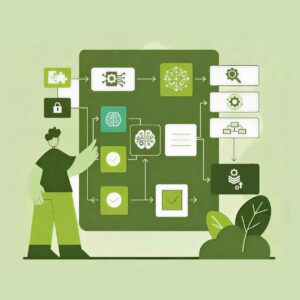
Not all automation is created equal. Understanding the technology layers helps you have more productive conversations with potential AI automation partners — and avoid vendors who dress up simple rule-based scripts as “AI.”
Robotic Process Automation (RPA)
RPA bots interact with software through the UI layer — clicking, typing, copying, pasting — exactly as a human would. Tools like UiPath, Automation Anywhere, and Microsoft Power Automate are the market leaders. RPA is ideal for processes that involve legacy systems without APIs, and for processes that don’t require understanding of content — just moving it.
| Best for: High-volume, structured, rule-based processes. Data migration, system sync, form filling, screen scraping from legacy portals. |
Intelligent Document Processing (IDP)
IDP uses a combination of OCR (optical character recognition), computer vision, and machine learning to extract structured data from unstructured documents — invoices, contracts, forms, medical records, shipping documents. Modern IDP systems achieve 95–99% extraction accuracy with continuous learning from human corrections.
| Best for: Invoice processing, contract analysis, insurance claims, permit applications, compliance documentation. |
Large Language Models (LLMs) in Automation
LLMs like GPT-4 and Claude are being integrated into automation workflows to handle tasks that require language understanding: summarising documents, drafting responses, classifying emails, answering policy questions, and generating reports from structured data. The key architectural pattern is Retrieval-Augmented Generation (RAG) — grounding the LLM’s outputs in your business’s own documents and data.
| Best for: Email triage and drafting, internal knowledge bases, contract summarisation, customer communication generation, meeting notes to action items. |
Orchestrated Intelligent Workflows
Modern automation rarely relies on a single technology. Best-in-class implementations orchestrate multiple systems: an IDP layer reads a document, an RPA bot enters data into a legacy system, an LLM generates a response draft, and a rules engine routes the case for human review if confidence is below threshold. Platforms like Microsoft Power Platform, Make (Integromat), and n8n serve as the orchestration layer for many Sydney deployments.
What Does AI Automation Cost in Sydney?
Pricing transparency is one area where the AI automation industry in Sydney consistently fails buyers. Here is an honest framework based on real project economics:
Project-Based Engagements
| Project Scope | Typical Investment (AUD) | Timeline |
| Single process automation (RPA bot) | $8,000–$25,000 | 4–8 weeks |
| Department-level automation (3–5 processes) | $35,000–$80,000 | 3–5 months |
| Enterprise automation programme | $100,000–$400,000+ | 6–18 months |
| AI-powered document processing setup | $15,000–$45,000 | 6–10 weeks |
| Custom LLM workflow integration | $20,000–$60,000 | 8–14 weeks |
Managed Service / Ongoing Retainer
Many Sydney businesses engage AI automation companies on an ongoing managed service basis post-implementation. This covers bot maintenance, error monitoring, scaling, and continuous improvement. Expect $2,000–$8,000/month for a managed automation programme depending on complexity and volume.
The ROI Calculation You Should Run
Before engaging any vendor, calculate your baseline manual cost using this formula:
| Annual Automation Saving = (Hours per week on process × 52 × fully-loaded hourly cost) × error reduction factor Example: 15 hrs/week × 52 × $55/hr = $42,900/year saved on labour alone — before factoring in faster processing, reduced errors, and 24/7 availability. |
Most well-scoped automation projects in Sydney achieve full cost recovery within 6–12 months. The ongoing annual saving thereafter is largely net margin improvement.
Choosing the Right AI Automation Company in Sydney
What to Evaluate — Beyond the Sales Deck
- Process expertise, not just technology expertise — can they map your workflows and identify automation opportunities before pitching a solution?
- Integration experience with your existing stack — Xero, MYOB, Salesforce, SAP, ServiceNow, Microsoft 365, Google Workspace
- Local vs offshore delivery model — onshore Sydney teams cost more but offer timezone alignment, compliance understanding, and accountability
- Post-deployment support model — who do you call at 8am when a bot breaks before a compliance deadline?
- Reference clients in your industry — request a 15-minute call with a current Sydney client, not just a written case study
Questions to Ask in the Discovery Call
- “Walk me through a recent project from process audit to go-live. What broke and how did you fix it?”
- “How do you handle exceptions — processes your bots can’t complete?”
- “What’s your change management approach? How do you get our team on board?”
- “What’s included in your support SLA post-deployment?”
- “How do you measure and report ROI?”
Red Flags to Watch For
- They propose a solution before understanding your processes — vendors who skip discovery are selling technology, not solving your problem
- “Fully automated” promises — every real-world automation has exception handling requirements; anyone promising 100% automation without nuance doesn’t understand your processes
- No mention of change management — employee resistance is one of the top causes of failed automation rollouts in Sydney businesses
- Pricing that sounds too good — a $3,000 quote for an “AI automation project” is either an offshore script with no support or a template that won’t fit your actual processes
| Digitechzo’s approach: Every engagement begins with a 2-week process discovery sprint before any automation is built. We map your existing workflows, calculate automation potential, and present a prioritised roadmap — so you invest in the automations with the highest guaranteed return first. |
Real-World Results: Sydney Industry Use Cases

Professional Services Firm — Invoice Processing Automation
A mid-sized Sydney accounting firm processing 800+ supplier invoices per month implemented AI-powered invoice processing integrated with Xero. Prior to automation, two part-time staff spent a combined 18 hours per week on invoice receipt, data entry, approval routing, and filing. After automation, the same volume is processed in under 4 hours of human review time per week — an 80% reduction in manual effort — with error rates dropping from 3.2% to 0.1%.
Healthcare Clinic Network — Patient Communication Automation
A network of allied health clinics across Sydney’s Northern Beaches and Inner West automated their appointment reminder, rebooking, and waitlist management workflows. The previous system relied on reception staff spending 2+ hours daily on phone calls and manual SMS. The automated system reduced no-show rates by 28% and freed reception staff to focus on in-clinic patient experience — improving both revenue and patient satisfaction scores.
Logistics Company — Freight Documentation Processing
A Sydney-based freight forwarder handling 200+ shipments per week was manually processing delivery confirmations, proof-of-delivery documents, and carrier rate sheets. An IDP-plus-RPA solution was deployed to extract, validate, and file documents automatically and update their TMS (Transport Management System). Processing time per shipment dropped from 12 minutes to under 90 seconds, and the team was redeployed to higher-value customer relationship activities.
Property Management Company — Maintenance Request Triage
A Parramatta-based property management firm managing 1,200 residential properties automated their maintenance request intake workflow. Incoming requests via email and web form are now classified by urgency and trade type using an LLM-powered triage system, automatically assigned to the correct contractor, and tracked through to completion — with tenant updates sent automatically at each stage. Portfolio manager capacity increased by 35% without additional headcount.
Common Mistakes Sydney Businesses Make with AI Automation
Mistake #1: Automating a Broken Process
Automation amplifies whatever process it replaces — including its flaws. A data entry process with inconsistent input formats, unclear ownership, and no quality checks will produce faster, more consistent errors when automated. Fix the process first; automate second. Reputable AI automation partners will push back on requests to automate processes that need redesign.
Mistake #2: Starting With the Wrong Process
The highest-visibility process is rarely the highest-ROI automation target. A finance director who wants to automate board reporting (complex, low-frequency) will see slower returns than automating accounts payable (simple, high-frequency). Prioritise by volume × time × error rate, not by executive interest.
Mistake #3: Neglecting Change Management
Employees in Sydney organisations often perceive automation as a threat to their roles. Without proactive communication about how automation changes job scope — not eliminates jobs — you risk passive resistance, poor adoption, and employees finding workarounds. The most technically successful automation projects fail because the team doesn’t use them.
Mistake #4: Underbudgeting for Maintenance
Automated workflows break when upstream systems change — software updates, UI changes, new document formats, API deprecations. Budget 15–25% of initial project cost annually for maintenance. Vendors who don’t mention this in their proposals are leaving you with a hidden future cost.
Mistake #5: Treating Automation as a One-Off Project
The businesses extracting the most value from AI automation treat it as an ongoing programme, not a one-time IT project. They continuously identify new automation candidates, measure outcomes of deployed automations, and iterate. A single invoice bot is a tactic; a systematic automation programme is a competitive advantage.
Expert Tips for a Successful Automation Rollout in Sydney
Tip 1: Run a Process Audit Before Talking to Vendors
Map your ten most time-consuming recurring tasks. For each one, note: weekly hours consumed, number of staff involved, error frequency, and which systems are touched. This baseline data lets you evaluate vendor proposals objectively — and prevents being upsold on automation solutions you don’t need.
Tip 2: Choose One High-Value, Low-Risk Process First
Your first automation should be high enough ROI to justify the project cost and demonstrate value to the business, but low enough risk that a failed run doesn’t stop your operations. Accounts payable, employee onboarding, and report generation are classic first automation targets for this reason.
Tip 3: Involve End Users in the Design Process
The people who currently do the manual work know its nuances better than anyone. Involve them in process mapping sessions. They will identify exception scenarios your vendor won’t think to ask about, and their involvement in design dramatically improves adoption post-deployment.
Tip 4: Define Success Metrics Before You Start
Agree on measurable success criteria at project kick-off: processing time reduction, error rate, cost per transaction, or staff hours saved. Without pre-agreed metrics, it’s impossible to evaluate whether an automation project delivered value — and vendors have no accountability.
Tip 5: Plan for the Humans, Not Just the Technology
Automation changes job descriptions. Some tasks disappear; new tasks emerge (reviewing AI outputs, managing exceptions, training models). Proactively plan for how automated capacity will be redeployed — whether that’s headcount reallocation, service expansion, or not backfilling attrition. This makes automation a workforce strategy decision, not just a technology purchase.
Frequently Asked Questions
How much does AI automation cost for a small Sydney business?
For a single, well-defined process — such as invoice processing or data entry automation — expect to invest $8,000–$25,000 AUD for a Sydney-based implementation. Ongoing managed service typically adds $2,000–$4,000/month. Most small business automations achieve full ROI within 6–10 months based on labour savings alone.
Is AI automation suitable for small and medium businesses in Sydney, or only large enterprises?
AI automation delivers strong ROI at SME scale. In fact, SMEs with 10–50 staff often see faster percentage returns because their processes are simpler to automate and the labour cost of manual tasks represents a higher proportion of their total cost base. Cloud-based automation platforms have eliminated the need for expensive on-premise infrastructure that previously made automation enterprise-only.
Which Sydney industries benefit most from AI automation?
Professional services (accounting, legal, consulting), healthcare and allied health, logistics and freight, property management, and financial services consistently show the strongest ROI from AI automation in Sydney. However, any business with repetitive, high-volume back-office processes is a viable candidate regardless of industry.
Will AI automation replace jobs in my Sydney business?
AI automation typically changes job roles rather than eliminating them. Staff who previously performed manual data entry or document processing are redeployed to higher-value activities — client relationship management, exception handling, quality control, and business development. Most Sydney businesses that automate don’t reduce headcount; they grow capacity without adding headcount. Clear communication of this distinction is essential in managing your team through an automation rollout.
How long does an AI automation project take in Sydney?
A single process automation typically takes 4–10 weeks from process audit to go-live. Department-level automation programmes run 3–6 months. Timeline depends heavily on the complexity of the process, the number of systems integrated, and the availability of your internal team for design sessions and UAT (user acceptance testing).
Conclusion: The Right Time to Automate Is Before Your Competitors Do
AI automation is no longer a technology experiment — it’s a business operations strategy that Sydney’s most competitive companies are deploying right now. The businesses waiting for the technology to mature are falling further behind the businesses that started 12 months ago.
The calculus is straightforward: Sydney labour costs are high, talent is scarce, and the volume of repetitive back-office work in most businesses is substantial. Every week you spend paying staff to move data between systems, process invoices manually, or send appointment reminders by hand is a week your competitors are compounding their automation advantage.
The entry point is lower than most Sydney business owners think. A well-scoped first automation — accounts payable, customer onboarding, or data synchronisation — can pay for itself in under six months and permanently change the economics of that process. The question isn’t whether to automate. It’s which process to start with.
| Ready to Reduce Costs with AI Automation?
Digitechzo helps Sydney businesses identify, design, and deploy AI automation solutions that deliver measurable ROI. We start with your processes — not a product pitch. → Book a Free Process Automation Audit with Digitechzo In 60 minutes, we’ll map your highest-ROI automation opportunities and give you an honest cost-benefit assessment — no obligation, no sales pressure. |
Digitechzo is an AI automation and digital transformation company serving businesses across Sydney, Melbourne, and Brisbane. Our team specialises in RPA, intelligent document processing, LLM-powered workflows, and systems integration for mid-market Australian businesses.