
Most founders and executives assume that expertise alone will earn them recognition. It won’t. Every industry today is flooded with “experts” posting generic advice, recycling the same five LinkedIn hooks, and calling it thought leadership. The result? Genuine expertise gets buried under noise, and the people who actually deserve authority status remain invisible to the exact buyers searching for them.
This is the gap a thought leadership services is built to close. It’s not about being loud — it’s about being credible, consistent, and impossible to ignore in your niche.
At Digitechzo, What is a Thought Leadership Services?
A thought leadership services is a structured, done-for-you (or done-with-you) program that positions an individual or company as a trusted authority in their field. Rather than generic marketing, it focuses on original insight, data-backed opinions, and consistent visibility across the channels your audience already trusts — LinkedIn, industry publications, podcasts, webinars, and search.
Unlike a one-off PR campaign or a batch of blog posts, thought leadership is cumulative. Each piece of content, interview, or public appearance builds on the last, compounding your credibility over time. That compounding effect is exactly why it works so well as a long-term lead generation channel — people buy from people they perceive as authorities, not from anonymous companies., we’ve worked with founders, consultants, and B2B leaders who had deep expertise but zero visibility, and helped them turn that expertise into a recognized personal or brand authority that actually generates inbound leads. This guide breaks down exactly what a thought leadership services does, how it works, what to look for in a provider, and how to avoid the mistakes that quietly kill most personal branding efforts.
Quick Answer
A thought leadership services helps individuals or brands build recognized authority in their industry through strategic content, media placements, speaking opportunities, and personal branding — turning expertise into visibility, trust, and qualified leads. The best services combine content strategy, ghostwriting, PR, and data-backed positioning rather than just posting on social media.
What Is a Thought Leaderships Service?
A thought leadership services is a structured, done-for-you (or done-with-you) program that positions an individual or company as a trusted authority in their field. Rather than generic marketing, it focuses on original insight, data-backed opinions, and consistent visibility across the channels your audience already trusts — LinkedIn, industry publications, podcasts, webinars, and search.
Unlike a one-off PR campaign or a batch of blog posts, thought leadership is cumulative. Each piece of content, interview, or public appearance builds on the last, compounding your credibility over time. That compounding effect is exactly why it works so well as a long-term lead generation channel — people buy from people they perceive as authorities, not from anonymous companies.
Core Idea Behind Thought Leadership
The premise is simple: buyers trust people before they trust brands.A 2023 Edelman Trust Barometer report found that a large majority of B2B decision-makers say thought leadership content directly influenced a purchasing decision — yet most companies still under-invest in it because the ROI isn’t as immediately visible as paid ads.
Why Thought Leadership Matters More Than Ever
Search behavior has changed. Buyers no longer just Google “best software for X” — they look for people they recognize discussing that category. AI-driven search results (like Google’s AI Overviews) increasingly surface content from recognized authors and cited experts over anonymous brand pages.
Three shifts are driving this:
- Trust has moved from brands to individuals. People follow founders, not logos.
- Search engines reward E-E-A-T. Google explicitly favors content demonstrating real experience and expertise.
- Buying cycles are longer and more research-heavy. Prospects consume 8–12 pieces of content before ever talking to sales — and they remember names, not company taglines.
If your competitors have a recognizable voice in your space and you don’t, you’re invisible at the exact moment prospects are forming their opinion of who to trust.
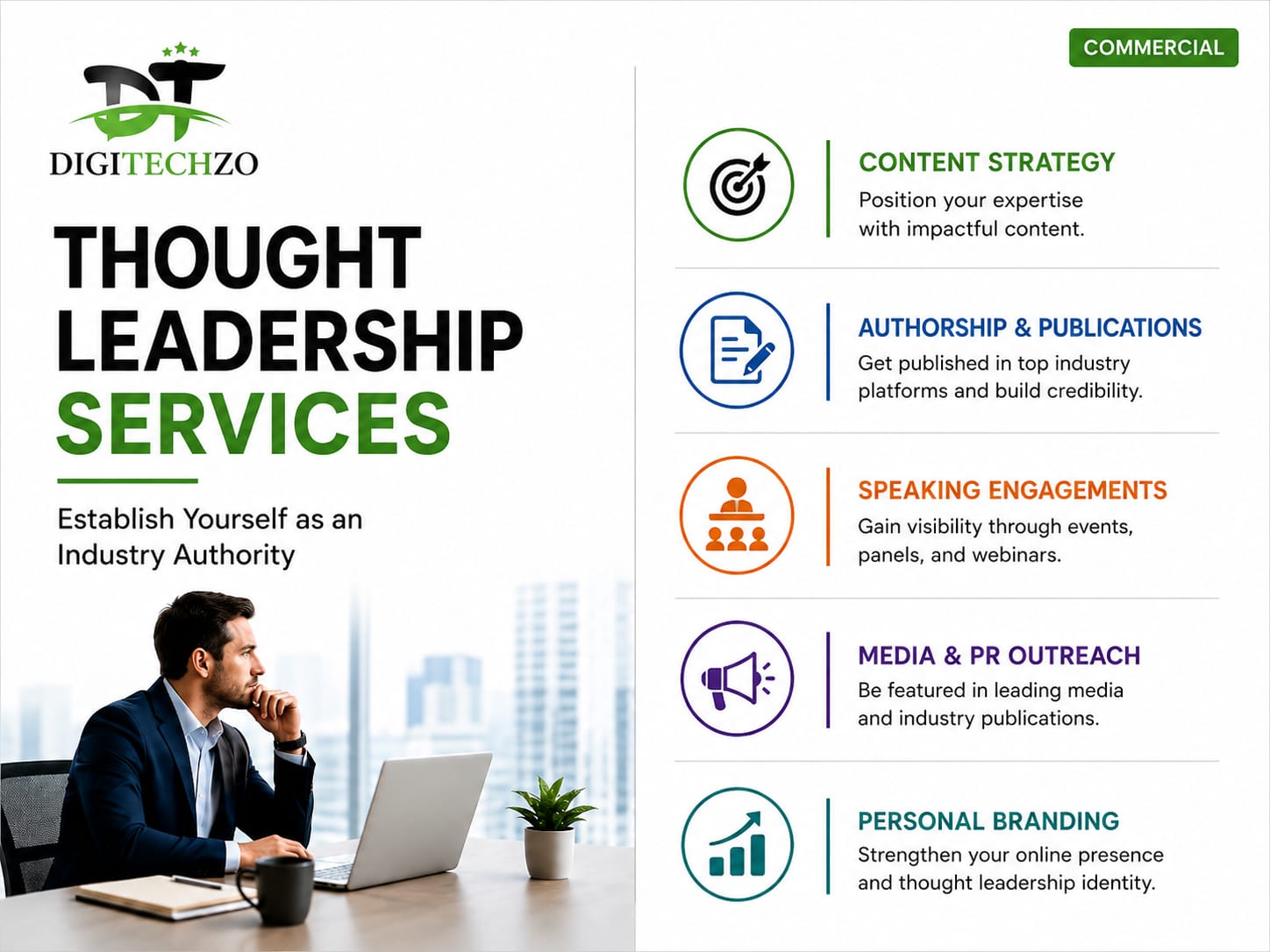
What a Thought Leadership Services Actually Includes
A genuine thought leadership services is broader than “we’ll write your LinkedIn posts.” Here’s what’s typically bundled:
- Positioning & Narrative Strategy
Defining your unique point of view — the specific angle, contrarian take, or framework that differentiates you from every other “expert” in your space. - Content Creation & Ghostwriting
Long-form articles, LinkedIn posts, opinion pieces, and newsletters written in your voice, based on your real experiences and insights (not generic AI-generated fluff). - Media & PR Placement
Getting you featured in industry publications, podcasts, panels, and press mentions to build third-party credibility — which carries more weight than self-published content alone. - Speaking & Community Visibility
Securing speaking slots at conferences, webinars, or industry roundtables where your ideal audience already gathers. - SEO Optimised Authority Content
Publishing structured, keyword-optimized articles under your byline that rank in search and reinforce your expertise to both readers and search engines. - Analytics & Positioning Refinement
Tracking engagement, share-of-voice, and inbound lead quality to continuously refine the narrative and channels that convert.
The Thought Leadership Framework We Use
Through work with multiple B2B clients, we’ve found a repeatable four-stage framework works best
- Audit— Identify existing expertise, past wins, and unique perspectives worth amplifying.
- Angle — Develop a specific, ownable point of view (not generic advice everyone already says).
- Amplify — Distribute that angle across owned content, PR, and community channels consistently.
- Attribute — Track which content and platforms actually drive inbound conversations, and double down there.
Most people skip step 2 entirely — they publish content with no distinct angle, which is why it never breaks through.
Real-World Example: From Invisible Expert to Industry Voice
Consider a fractional CFO with 15 years of experience but almost no online visibility. Through a structured thought leadership push — a distinct point of view on cash-flow forecasting for startups, weekly LinkedIn breakdowns of real (anonymized) client scenarios, and two podcast guest appearances — inbound consultation requests increased noticeably within a few months, without any paid advertising spend.
The lesson: expertise didn’t change. Visibility and framing did.
Pros and Cons of Investing in Thought Leadership
Pros:
- Builds long-term, compounding trust and visibility
- Generates warmer, higher-intent inbound leads
- Improves credibility for sales, hiring, and partnerships simultaneously
- Strengthens SEO through E-E-A-T signals and backlink
Cons:
- Results take months, not days — it’s not a quick-win channel
- Requires genuine input and time from the expert/founder
- Harder to measure with simple last-click attribution
- Low-effort execution (generic posts) produces little to no results.
How to Choose the Right Thought Leadership Services
Not all providers are equal. Look for:
– Proof of ghostwriting that sounds human, not templated AI copy
– A clear positioning process, not just a content calendar
– Media and PR relationships , not just social scheduling
– Case studies or examples of authority built for past clients
– A defined measurement approach — share of voice, inbound leads, engagement quality
Common mistakes in thought leadership
- Copying competitors’ angles instead of developing an original point of view
- Posting inconsistently, killing the compounding effect that makes authority-building work.
- Focusing on virality over credibility — chasing likes instead of qualified attention
- Outsourcing without input — ghostwritten content with no real experience behind it reads hollow
- Ignoring distribution — publishing great content nobody sees because there’s no PR or amplification layer.
Expert tips for building authority faster
– Anchor every piece of content in a real experience or specific data point— specificity beats generic advice every time
– Publish a strong opinion occasionally; agreeable content rarely gets remembered
– Repurpose one strong idea across five formats (article, LinkedIn post, podcast talking point, webinar slide, newsletter) instead of creating five separate ideas
– Track who engages, not just how many — a few decision-makers commenting matters more than hundreds of passive likes
– Revisit your positioning every quarter; markets and competitive angles shift.
FAQs
How long does it take to build a personal brand as a business owner?
A: Most founders see meaningful inbound traction within 4-6 months of consistent posting (3x/week minimum), though visible market recognition typically takes 12-18 months of sustained effort.
How long does it take to see results from thought leadership?
Most brands start seeing meaningful engagement and inbound interest within 3–6 months of consistent execution, with compounding results building over 12+ months.
Is thought leadership only for founders and executives?
No. It works for consultants, subject-matter experts, sales leaders, and even technical specialists who want to be recognized as go-to voices in their niche.
How is thought leadership different from personal branding?
Personal branding is broader and can include lifestyle or general presence; thought leadership specifically focuses on demonstrating expertise and original insight within a professional domain.
Can thought leadership actually generate leads?
Yes. Because it builds trust before a sales conversation even happens, thought leadership content typically produces warmer, higher-intent leads compared to cold outbound or generic ads.
Final thought
Expertise without visibility is a wasted asset. A well-executed thought leadership services doesn’t just get you seen — it gets you trusted, remembered, and chosen before your competitors even enter the conversation.
About The Author