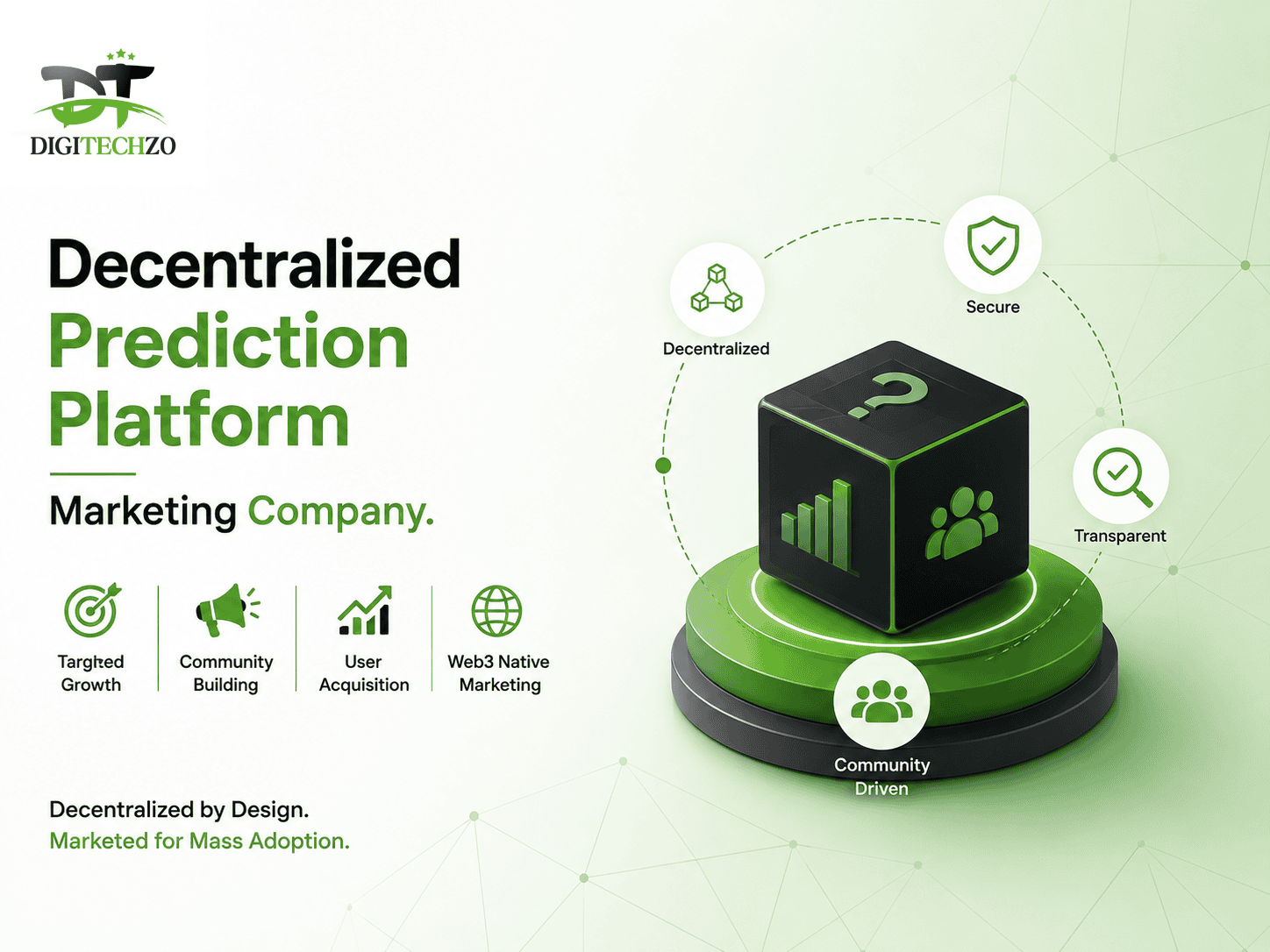
Here’s the paradox every decentralized prediction platform runs into: the thing that makes your product technically superior — no central authority, permissionless market creation, on-chain resolution — is also the thing that makes it harder to market. “Decentralized” doesn’t sell itself. Users don’t wake up wanting decentralization; they wake up wanting fair odds, fast payouts, and markets they can trust. Marketing has to translate the architecture into a reason to care.
That translation job is exactly what a specialized prediction platform marketing company exists to do — communicating decentralization as a trust advantage rather than a technical footnote, while still running the acquisition and retention playbook every marketplace needs. At Digitechzo, we’ve spent time in the trenches figuring out how to position decentralized architecture as a selling point instead of jargon, and this guide lays out the full framework, including subtopics most competitor content skips entirely — like oracle-source marketing, governance-token messaging risk, and cross-chain positioning.
Quick Answer
A decentralized prediction platform marketing company translates technical decentralization (permissionless markets, on-chain resolution, DAO governance) into trust-based messaging that drives trader acquisition, while managing the unique compliance and community-governance challenges that centralized competitors don’t face.
Why Decentralization Is a Marketing Challenge, Not Just a Feature
Most decentralized prediction platforms make the same mistake early on: they market the architecture instead of the outcome. Landing pages lead with “permissionless, on-chain, non-custodial” — language that means a lot to a developer and almost nothing to a trader deciding whether to deposit funds.
The real marketing challenge is translation:
- “Permissionless market creation” needs to become “anyone can turn their prediction into a tradeable market in minutes”
- “On-chain resolution via decentralized oracles” needs to become “no single party can rig how a market resolves”
- “DAO governance” needs to become “disputes get resolved by the community, not a black-box support team”
A prediction platform marketing company with real experience in this category knows the job isn’t explaining the tech stack — it’s making decentralization legible as a reason to trust the platform with real money.
What Makes Decentralized Prediction Platforms Different to Market
Oracle Trust Is the New Brand Trust
In a centralized prediction market, users trust a company. In a decentralized one, users need to trust an oracle mechanism — a concept most retail users have never had to evaluate before. Marketing has to do the education work that centralized competitors skip entirely.
Governance Adds a Second Audience
Decentralized platforms often have a governance token and active DAO. This means marketing serves two audiences with different motivations: traders who want good odds and fast resolution, and token holders/governance participants who care about protocol direction, treasury, and fee structures. Blending these messages carelessly confuses both groups.
Cross-Chain and Multi-Chain Positioning
Many decentralized platforms operate across multiple chains to access different liquidity pools. This creates a real marketing subtopic competitors often ignore: explaining why a market lives on a particular chain, and reassuring users that bridging or chain-switching doesn’t add risk to their funds.
Regulatory Narrative Is More Complex
Decentralization is sometimes framed (rightly or wrongly) as a way to avoid regulatory scrutiny. A credible marketing company won’t lean into that framing — it invites more risk than it avoids. Instead, messaging should focus on transparency and community governance as trust features, not evasion tactics.
Core Services a Prediction Platform Marketing Company Provides
Positioning & Messaging Architecture
Translating technical differentiators (oracle design, dispute resolution, permissionless markets) into plain-language trust signals that convert visitors into depositors.
Trader Acquisition Campaigns
- KOL and crypto-analyst partnerships anchored to specific live markets
- Community programs across Discord/Telegram/X segmented by trader vs. governance participant
- Referral and incentive design gated behind real trading activity, not wallet connects
Governance & Token-Holder Communication
Separate content tracks for protocol updates, treasury reports, and governance votes — kept distinct from trader-facing acquisition content so messaging doesn’t blur together.
Trust & Transparency Content
- Public oracle-source explainers
- Dispute resolution walkthroughs with real (anonymized) examples
- Audit history and smart contract security summaries presented in accessible language
SEO & Organic Authority Building
Long-form educational content around “how decentralized prediction markets resolve,” comparison content against centralized alternatives, and glossary-style content that captures long-tail, high-intent search traffic from users doing due diligence before depositing funds.
Example scenario: A decentralized platform using a multi-oracle resolution system had strong tech but users kept asking the same question in support channels: “who decides who’s right?” Instead of another FAQ page, the fix was a public “How a Market Resolves” explainer video and blog series walking through a real disputed market from creation to final payout. Support tickets on resolution disputes dropped noticeably, and the content became one of the highest-converting organic landing pages on the site — because it answered the actual trust question in the visitor’s head before they ever reached out.
Positioning Decentralization as a Trust Advantage
| Technical Feature | Weak Messaging | Strong Messaging |
|---|---|---|
| Permissionless market creation | “Fully permissionless protocol” | “Anyone can launch a market in minutes — no gatekeepers” |
| Decentralized oracle resolution | “On-chain oracle-based resolution” | “No single party can manipulate the outcome” |
| DAO governance | “Governed by DAO vote” | “Disputes are settled by the community, not hidden support tickets” |
| Non-custodial funds | “Non-custodial architecture” | “Your funds never sit in our wallet — you’re always in control” |
This reframing is the single highest-leverage marketing lever a decentralized platform has, and it’s the subtopic most competitor blog content skips in favor of generic “why Web3 matters” filler.
Decentralized vs. Centralized Prediction Platforms: A Marketing Comparison
| Factor | Centralized Platform | Decentralized Platform |
|---|---|---|
| Trust source | Company reputation | Oracle design + governance transparency |
| Dispute resolution messaging | Support team decision | Community/DAO-driven, needs education |
| Regulatory positioning | Often licensed/regulated framing | Transparency-first framing, avoid evasion narrative |
| Audience complexity | Single audience (traders) | Dual audience (traders + governance participants) |
| Content opportunity | Product features | Trust/education content (oracle, disputes, audits) |
Pros & Cons of Marketing a Decentralized Platform
Pros
- Genuine differentiation story (no single point of failure) that’s hard for centralized competitors to copy
- Strong long-tail SEO opportunity around trust and transparency topics competitors under-serve
Cons
- Requires more educational content investment before conversion
- Two-audience messaging (traders + governance) is easy to get wrong and confuse both groups
Governance & DAO Marketing Considerations
Getting this wrong is one of the fastest ways to erode trust with power users. A few working principles:
- Never blend trader acquisition messaging with governance-token promotion. It reads as using trust-building content to pump a token, and sophisticated users notice immediately.
- Publish governance updates on a predictable cadence, even when there’s nothing dramatic to report — silence between governance updates breeds speculation.
- Make dispute outcomes public and searchable. This becomes some of the highest-trust content on the entire site, and it’s genuinely hard for competitors to fake.
- Keep token-price talk separate from platform-trust talk. Conflating “our token is doing well” with “our markets resolve fairly” damages credibility on both fronts if the token underperforms.
Common Mistakes Decentralized Platforms Make
- Leading marketing copy with architecture instead of outcomes. Users don’t care that it’s “on-chain” — they care that it’s fair and fast.
- Ignoring the oracle-trust education gap. Assuming users understand how resolution works, when most have never encountered the concept before.
- Framing decentralization as a way to dodge regulation. This invites scrutiny rather than avoiding it.
- Mixing governance-token hype with trader-facing trust content. Confuses both audiences and damages credibility.
- Under-investing in dispute-resolution content until a dispute goes public. By then, you’re playing defense instead of building trust proactively.
- Copying centralized platform marketing wholesale. Centralized platforms can market on “brand trust” alone; decentralized platforms need to earn trust through transparency content instead.
Expert Tips for Sustainable Growth
- Build a permanent “Trust Center” page covering oracle sources, dispute history, and audit reports — treat it as a core conversion asset, not a footnote.
- Create explainer content around your specific oracle mechanism, not generic “how oracles work” content — specificity builds more credibility than general education.
- Segment your community channels early between trader discussion and governance discussion so neither audience feels talked over.
- Turn resolved disputes into content, anonymized where necessary — real examples build far more trust than abstract policy statements.
- Publish comparison content against centralized competitors honestly, acknowledging trade-offs (e.g., slightly slower resolution in exchange for no single point of failure) rather than overselling.
- Track conversion specifically from trust/education content, not just from acquisition campaigns — this reveals which explainer content is actually doing conversion work versus just generating pageviews.
FAQs
What does a decentralized prediction platform marketing company actually do?
It translates technical differentiators like permissionless market creation, oracle-based resolution, and DAO governance into plain-language trust messaging that drives trader acquisition, while managing the added complexity of serving both traders and governance participants.
Why is marketing harder for decentralized prediction platforms than centralized ones?
Because trust has to be earned through transparency and education about oracle mechanisms and dispute resolution, rather than relying on a company brand name the way centralized platforms can.
Should decentralized prediction platforms market their governance token alongside trading features?
No — blending token promotion with trader-facing trust content confuses both audiences and can damage credibility if the token underperforms while the platform itself is functioning well.
What content works best for building trust in a decentralized prediction platform?
Public, specific explainers of your oracle mechanism and dispute resolution process, along with anonymized real dispute examples, consistently convert better than generic decentralization messaging.
Is SEO effective for decentralized prediction platforms specifically?
Yes, particularly long-tail content answering due-diligence questions users search before depositing funds — comparison guides, oracle explainers, and dispute-resolution walkthroughs tend to convert unusually well because they target high-intent, trust-seeking searchers.
Final Thoughts
Decentralization is a genuine competitive advantage — but only if your marketing translates it into something a trader actually feels before they deposit funds. That requires treating oracle trust, governance clarity, and dispute transparency as core marketing assets, not technical footnotes buried in your docs.
If you’re building a decentralized prediction platform and need marketing that turns your architecture into an actual trust advantage instead of jargon, that’s exactly the work Digitechzo does with decentralized forecasting and prediction platforms.
Ready to turn your platform’s decentralization into a real growth advantage? Reach out to Digitechzo for a positioning and growth audit built specifically for decentralized prediction platforms.
About The Author