Most NFT marketplaces don’t fail because the product is bad. They fail because nobody can find them.
You launched a marketplace with a clean UI, low gas fees, maybe even a killer creator royalty structure — and traffic still trickles in at a rate that wouldn’t fill a Discord server, let alone drive trading volume. Meanwhile, a competitor with a mediocre interface sits on page one for “buy NFT art” and “best NFT marketplace for [niche],” quietly compounding organic traffic month over month while you’re stuck bidding on expensive paid ads that stop converting the second you turn off the budget.
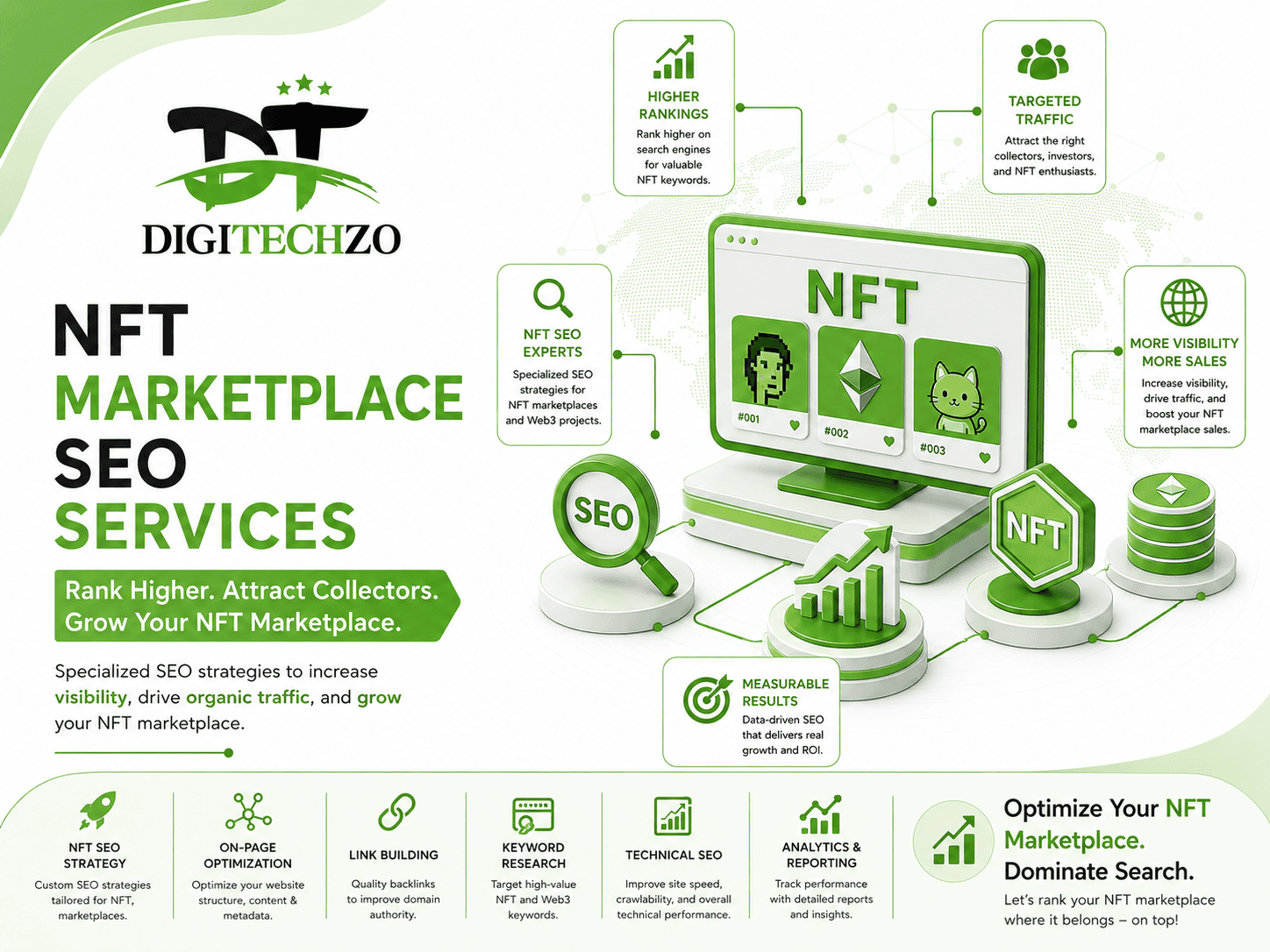
That’s the gap NFT Marketplace SEO Services exist to close — a specialized discipline that blends technical SEO, Web3 domain knowledge, and content strategy built specifically for how crypto-native buyers actually search, evaluate, and transact.
At Digitechzo, we’ve spent the last several projects working inside marketplaces, NFT drop launches, and Web3 platforms where the biggest lever wasn’t more paid spend — it was fixing indexation issues, structuring collection pages correctly, and building content that answered the exact questions collectors were typing into Google before they ever connected a wallet. This guide distills that experience into a practical playbook you can use whether you’re hiring an agency or building the strategy in-house.
Quick Answer
NFT Marketplace SEO Services combine technical SEO (crawlability, schema, Core Web Vitals for JS-heavy dApps), on-page optimization for collection/token pages, and content marketing around high-intent keywords to help NFT platforms rank organically and attract buyers, sellers, and creators without relying solely on paid ads or influencer spend. The biggest wins usually come from fixing indexation of dynamically rendered pages and building topical authority around niche NFT categories.
What NFT Marketplace SEO Actually Means
NFT Marketplace SEO isn’t generic e-commerce SEO with “crypto” swapped in. It’s a hybrid discipline because NFT marketplaces have three characteristics that break most standard SEO playbooks:
- They’re built on JavaScript frameworks (React, Next.js, Vue) that often render collection and token data client-side, which search engines can struggle to crawl and index without proper server-side rendering or dynamic rendering fallbacks.
- Inventory changes constantly. New drops, delisted tokens, floor price shifts — the catalog is more volatile than a typical retail store.
- Search intent is split between three very different audiences: buyers researching a collection, creators researching where to mint, and speculators researching price/rarity data.
Good NFT marketplace SEO services treat these as three separate funnels with overlapping technical infrastructure — not one generic “get more traffic” campaign.
Why NFT Marketplaces Struggle With SEO
Before fixing anything, it helps to understand why this niche is harder than average:
- Trust deficit. Google and users alike are cautious about crypto-adjacent sites due to years of scam marketplaces and rug pulls. E-E-A-T signals matter more here than in almost any other vertical.
- Thin collection pages. Thousands of auto-generated token pages with near-identical templated text look like doorway pages to search engines.
- High competition on head terms. Terms like “NFT marketplace” are dominated by OpenSea, Blur, and Magic Eden — sites with years of backlinks and brand search volume most challengers can’t out-muscle directly.
- Volatile backlink profiles. Crypto PR and guest posting are full of low-quality, spammy link networks that can do more harm than good.
Core Components of NFT Marketplace SEO Services
A proper service engagement typically includes:
1. Technical SEO Audit and Fixes
Crawlability, indexation, rendering strategy, site speed, mobile usability, and Core Web Vitals — all evaluated against how your specific tech stack (Next.js, Moralis, third web, custom smart contract front-ends) actually renders content.
2. Information Architecture
How collections, categories, and individual tokens are structured and internally linked. Poor architecture is one of the single biggest reasons marketplace pages never get indexed at scale.
3. On-Page Optimization
Title tags, meta descriptions, header structure, and unique descriptive content for category and collection pages — written to satisfy both search engines and skeptical collectors deciding whether to trust the platform.
4. Content Marketing
Blog content, buying guides, collection spotlights, and educational resources that capture top-of-funnel and mid-funnel search demand before someone is ready to transact.
5. Off-Page Authority Building
Digital PR, credible crypto media placements, and community-driven backlinks (Web3 communities link very differently than traditional industries — Discord, Mirror.xyz, and X threads often carry more referral value than a typical guest post).
6. Schema and Structured Data
Product, FAQ, and breadcrumb schema adapted for NFT listings to improve rich result eligibility and featured snippet chances.
SEO for Marketplaces vs. Individual NFT Projects
| Factor | NFT Marketplace | Individual NFT Project/Collection |
|---|---|---|
| Page volume | Thousands to millions of pages | Usually one landing page + roadmap |
| Primary intent | Comparison, discovery, transactional | Brand/navigational, community-driven |
| Biggest SEO lever | Technical indexation at scale | Content and PR around the mint |
| Timeline to results | 4–8 months (more pages to rank) | Can spike quickly around mint date, then flatten |
| Risk of thin content | High (templated token pages) | Low (single curated page) |
Understanding which category you fall into changes the entire strategy — marketplaces need infrastructure-first SEO, while individual projects need momentum-first SEO.
Keyword Strategy for NFT Marketplaces
Effective keyword research for this niche goes beyond “NFT marketplace” and “buy NFTs.” A layered approach works better:
- Category-intent keywords: “best NFT marketplace for photography,” “low gas fee NFT marketplace,” “NFT marketplace for gaming assets”
- Comparison keywords: “OpenSea vs [competitor],” “NFT marketplace with lowest fees”
- Educational/top-of-funnel keywords: “how to sell NFT art,” “NFT royalties explained”
- Creator-side keywords: “how to mint NFT for free,” “best platform for NFT artists”
- Long-tail transactional keywords: “buy [specific collection] NFT,” “[chain name] NFT marketplace”
The mistake most teams make is chasing only the highest-volume head terms. In practice, the long-tail creator- and category-intent terms convert better and are realistically winnable within 6–12 months.
Technical SEO Checklist for Web3 Platforms
- [ ] Confirm collection/token pages are server-side rendered or pre-rendered, not purely client-side
- [ ] Submit and monitor an updated XML sitemap that reflects active listings only
- [ ] Set canonical tags correctly across paginated and filtered collection views
- [ ] Audit Core Web Vitals specifically on wallet-connect and marketplace pages, which often load heavy JS
- [ ] Implement structured data (Product, Offer, BreadcrumbList, FAQ Page)
- [ ] Fix duplicate content across near-identical token description templates
- [ ] Ensure delisted/sold-out NFTs return proper status codes instead of soft 404s
- [ ] Verify mobile rendering of wallet connection flows doesn’t block crawlers
Content Strategy That Actually Converts Collectors
Content for NFT marketplaces works best when it mirrors the actual decision journey:
- Discovery stage: “What is [niche] NFT art,” trend explainers, market reports
- Evaluation stage: Collection spotlights, creator interviews, comparison guides
- Transaction stage: How-to-buy guides, wallet setup tutorials, gas fee explainers specific to your platform’s chain
Example scenario: A gaming-focused NFT marketplace we’ve worked alongside saw its strongest organic growth not from “NFT marketplace” content, but from a series of guides explaining how in-game asset NFTs work on their specific chain. That content ranked for dozens of long-tail questions and pulled in buyers who were already primed to transact — a much higher-intent visitor than someone landing on a generic homepage.
Common Mistakes
- Treating token pages as an afterthought. Auto-generated pages with zero unique content rarely get indexed, let alone rank.
- Ignoring page speed on wallet-connect flows. A slow-loading connect wallet button tanks both conversion and Core Web Vitals scores.
- Buying low-quality crypto backlinks. Spammy link networks common in this niche can trigger manual actions or algorithmic devaluation.
- Publishing content with no expert voice. Generic “what is an NFT” posts with no original insight rarely outrank established players and do little for E-E-A-T.
- Skipping internal linking between collections and blog content. This is one of the fastest, cheapest wins available and is frequently ignored.
Expert Tips
- Prioritize indexation over volume — 500 properly indexed, unique collection pages will outperform 50,000 templated ones sitting in Google’s crawl queue.
- Use real trading data (floor price trends, volume history) inside content where possible; data-backed content earns more organic backlinks in this space than opinion pieces.
- Build topical clusters around specific NFT categories (art, gaming, music, utility/membership NFTs) rather than trying to rank broadly on day one.
- Treat Discord and X community engagement as part of your link-earning strategy, not a separate marketing silo — Web3 audiences link differently than traditional industries.
- Monitor for AI-generated boilerplate across collection descriptions; search engines increasingly deprioritize templated, low-effort text at scale.
How to Choose an NFT Marketplace SEO Agency
Look for a partner who can show:
- Direct experience with JavaScript-heavy or headless front-ends, not just WordPress SEO
- A clear point of view on schema and indexation strategy for large, dynamic catalogs
- Case studies or examples involving crypto, fintech, or otherwise regulated/trust-sensitive niches
- A content team that can write with actual subject-matter depth, not templated crypto listicles
- Transparent reporting tied to organic traffic, indexed pages, and conversion — not vanity metrics
This is the exact framework our team at Digitechzo applies when scoping NFT and Web3 marketplace engagements — technical foundation first, then content and authority layered on top.
FAQs
Q:What is NFT Marketplace SEO?
NFT Marketplace SEO is the practice of optimizing an NFT trading platform’s technical structure, on-page content, and off-page authority so it ranks organically in search engines for buyer, seller, and creator-related queries.
Q:How long does it take to see results from NFT marketplace SEO?
Most platforms start seeing meaningful organic traffic gains within 4–8 months, depending on how many pages need indexing and how competitive the target keywords are.
Q:Do NFT marketplaces need different SEO than regular e-commerce sites?
Yes. NFT marketplaces typically run on JavaScript-heavy frameworks with volatile inventory and split search intent across buyers, sellers, and creators, which requires a more technical, rendering-aware SEO approach.
Q:Can SEO actually drive NFT sales, or just traffic?
When targeted correctly at comparison and transactional keywords, SEO traffic converts because it captures users who are already actively researching a purchase decision, unlike cold paid traffic or social impressions.
Q:Is backlink building safe for NFT and crypto sites?
It can be, but only through credible crypto media, community engagement, and digital PR. Low-quality paid link networks common in this niche carry real risk of penalties.
Final thought
NFT marketplace SEO isn’t about chasing a single keyword to the top of Google — it’s about building a platform search engines can actually crawl, trust, and want to surface to buyers who are ready to transact. The marketplaces winning organic traffic today aren’t necessarily the biggest names; they’re the ones that fixed their indexation, built genuinely useful content, and earned authority the right way.
If you’re evaluating whether your marketplace’s SEO foundation is solid — or if you’re starting from scratch — it’s worth getting a second set of eyes on the technical side before investing heavily in content or PR. That’s the kind of audit our team at Digitechzo typically starts with for Web3 clients, and it’s usually where the biggest quick wins are hiding.
Want a free technical SEO audit of your NFT marketplace? Reach out to Digitechzo and we’ll show you exactly where you’re losing indexable pages and organic traffic — before you spend another dollar on ads.
About The Author