
Most companies don’t fail because their product is bad. They fail because they launch it into the market with no real strategy — guessing at pricing, guessing at channels, guessing at who’s actually going to buy.
If you’re searching for a GTM consulting company, chances are you’ve already felt this pain. Maybe your last product launch underperformed. Maybe your sales and marketing teams are pulling in different directions. Maybe you’re about to enter a new market or vertical and you don’t want to burn six months (and six figures) finding out the hard way what doesn’t work.
At Digitechzo, we’ve sat on both sides of this problem — building go-to-market systems from scratch for early-stage startups and rebuilding broken GTM motions for scaling companies that grew faster than their strategy could keep up with. This guide is built from that experience. It’s not a generic “what is GTM” explainer — it’s a practical breakdown of what a real GTM consulting engagement should look like, how to evaluate one, and what separates the consultants who actually move revenue from the ones who just deliver a deck.
Quick Answer
A GTM consulting company helps businesses design, validate, and execute the strategy behind how they bring a product to market — covering positioning, pricing, channel selection, and sales enablement. The right partner combines strategic frameworks with hands-on execution support, and is measured by pipeline and revenue outcomes, not just deliverables.
What Does a GTM Consulting Company Actually Do?
A GTM (go-to-market) consulting company helps a business figure out — and then execute — exactly how a product or service should reach its target customers profitably and repeatably.
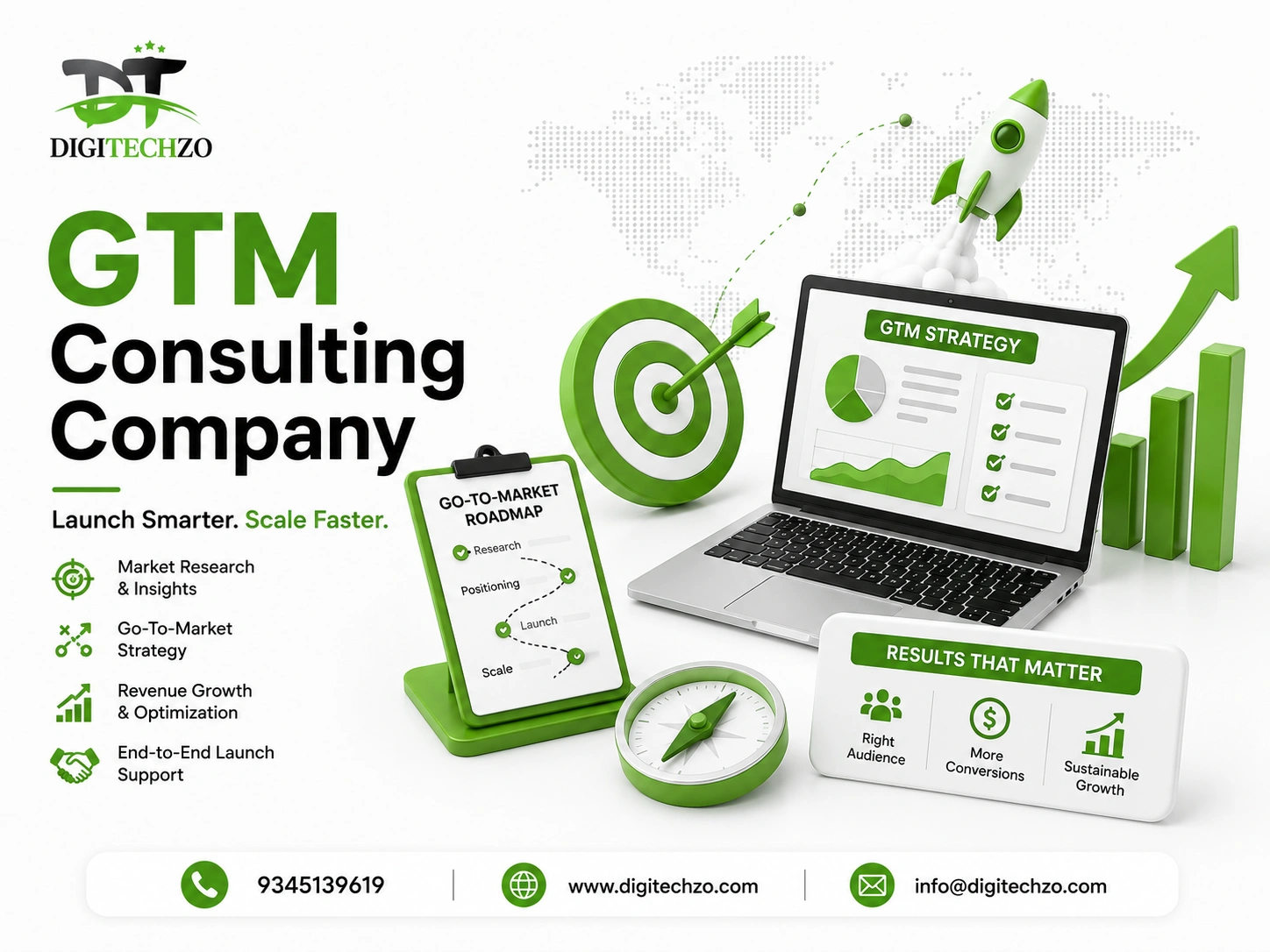
This typically spans four core pillars:
- Market & buyer research — understanding who actually buys, why, and what triggers the purchase decision.
- Positioning & messaging — defining how the product is framed against alternatives (including “doing nothing,” which is often the real competitor).
- Channel & pricing strategy — deciding whether the business should lead with sales-led, product-led, or partner-led motions, and how pricing supports that.
- Execution enablement — building the sales playbooks, marketing assets, and internal processes that make the strategy actually usable by the team.
The critical distinction: a good GTM consulting company doesn’t just hand over a strategy document. It stays close enough to execution that the strategy gets tested against real market feedback and adjusted — because most GTM plans are wrong in some way on day one, and the value is in how fast you correct course.
Signs You Need GTM Consulting (Not Just More Marketing)
Many companies mistake a GTM problem for a marketing problem, which leads to hiring more marketers instead of fixing the underlying strategy. Watch for these signals:
- You have healthy website traffic but low conversion to paying customers — this usually points to a positioning or pricing mismatch, not a traffic problem.
- Sales and marketing disagree on who the ideal customer is — a clear sign there’s no shared GTM strategy driving both functions.
- Your last two product launches underperformed despite good product-market signals — often a channel or messaging issue, not a product issue.
- You’re entering a new market/segment and using the same playbook that worked in your original market — this rarely transfers cleanly without adjustment.
- Customer acquisition cost is rising while win rates stay flat — a sign your targeting or messaging needs to be re-sharpened, not that you need a bigger ad budget.
If two or more of these sound familiar, the fix usually isn’t more spend — it’s a clearer strategy.
What a Strong GTM Consulting Engagement Looks Like
Phase 1: Diagnostic & Research
Before recommending anything, a credible GTM consultant audits your current funnel, interviews recent customers (and recently lost deals), and benchmarks your positioning against real competitors — not just the ones you assume you’re competing with.
Phase 2: Strategy Design
This is where positioning, ideal customer profile (ICP), pricing model, and primary channel strategy get defined — backed by the diagnostic data, not assumptions.
Phase 3: Pilot & Validation
Rather than rolling out a full strategy company-wide immediately, strong engagements test the new positioning and messaging on a smaller scale first — a specific segment, region, or campaign — to validate before scaling spend.
Phase 4: Scaled Execution & Enablement
Once validated, the strategy gets built into repeatable playbooks: sales scripts, campaign frameworks, and internal training so the company can run the motion without permanent consultant dependency.
Phase 5: Measurement & Iteration
GTM strategy isn’t “set and forget.” The best engagements include a defined cadence (usually monthly or quarterly) to review pipeline data and adjust the approach as the market responds.
In-House GTM Team vs. GTM Consulting Company: Pros & Cons
| Approach | Pros | Cons |
|---|---|---|
| In-house GTM hire | Deep, ongoing company context; fully dedicated | Slower to build expertise; single point of view; expensive to hire senior talent |
| GTM Consulting Company | Cross-industry pattern recognition; faster strategy validation; flexible engagement scope | Requires good internal collaboration to execute; less day-to-day company immersion |
| No dedicated GTM function | Lowest upfront cost | Strategy tends to be reactive and inconsistent across teams |
Many growing companies get the best results from a hybrid model: a GTM consulting company to design and pressure-test the strategy, paired with an internal owner who drives day-to-day execution.
How to Choose the Right GTM Consulting Company
Look for Evidence of Execution, Not Just Frameworks
Ask for specific examples of strategies they’ve built that were actually implemented and measured — not just slide decks. A consultant who can walk you through what changed after implementation (and what didn’t work) has real experience.
Check Industry & Business-Model Fit
GTM strategy for a B2B SaaS company with a 6-month sales cycle looks nothing like GTM for a DTC product with a 2-minute purchase decision. Make sure the consulting company has genuine pattern-matching experience in your specific business model.
Ask How They Measure Success
Credible GTM consultants tie their engagement to pipeline, conversion rate, or revenue metrics — not just “strategy delivered” as the finish line.
Evaluate Their Own Positioning
This sounds meta, but it’s a genuinely useful filter: a GTM consulting company that can’t clearly articulate its own positioning and differentiation is unlikely to do it well for you.
Common Mistakes Companies Make with GTM Strategy
- Skipping customer research and relying on internal assumptions — the team’s opinion of the ideal customer is often wrong, or outdated.
- Copying a competitor’s channel strategy without validating fit — what works for a competitor with a different sales cycle or price point rarely transfers directly.
- Launching company-wide before piloting — this multiplies the cost of a wrong assumption instead of catching it early and cheaply.
- Treating GTM as a one-time project — markets shift, and a strategy that worked 18 months ago often needs revisiting.
- Misalignment between sales and marketing on the ICP — this alone quietly kills more launches than any external market factor.
- Hiring for GTM execution before GTM strategy is validated — building a large sales or marketing team around an unproven motion is expensive to unwind.
Expert Tips for a Successful GTM Engagement
- Start with a pilot, not a full rollout. Validate messaging and channel fit on a smaller scale before committing the full budget.
- Involve both sales and marketing from day one. GTM strategy that’s designed in a marketing silo often breaks down the moment sales tries to use it.
- Insist on a measurement plan before execution begins. If you can’t define what “working” looks like upfront, you won’t know when to adjust.
- Revisit ICP and positioning at least twice a year. Markets and buyer behavior shift faster than most internal strategy documents get updated.
- Choose a consulting partner who can also help operationalize the strategy — not just design it. This is where firms like Digitechzo tend to add the most value: combining GTM strategy with the technology, automation, and growth systems needed to actually run it day to day.
FAQs
What is a GTM consulting company?
A GTM consulting company helps businesses design and execute the strategy behind bringing a product to market, covering positioning, pricing, channel selection, and sales enablement, with the goal of generating predictable pipeline and revenue.
How much does GTM consulting typically cost?
Costs vary widely based on scope — a focused positioning and messaging engagement is far less expensive than a full go-to-market strategy build combined with execution support. Most companies should request a scoped proposal based on their specific stage and goals rather than relying on a flat industry rate.
When should a startup hire a GTM consulting company?
The best time is typically before a major launch, market expansion, or when existing marketing spend isn’t converting to revenue despite reasonable traffic or lead volume — signaling a strategy gap rather than an execution gap.
What’s the difference between GTM consulting and marketing consulting?
GTM consulting covers the full strategy of how a product reaches and converts customers — including sales motion, pricing, and channel strategy — while marketing consulting typically focuses more narrowly on campaigns, content, and brand awareness within an existing GTM framework.
Can a GTM consulting company work with an existing in-house marketing team?
Yes, and this is often the most effective model — the consulting company designs and validates the strategy while the in-house team owns ongoing execution and day-to-day campaign management.
Conclusion
A great product with a weak go-to-market strategy will consistently lose to an average product with a sharp one. That’s not a controversial statement — it’s simply what the data on failed launches shows again and again.
The right GTM consulting company doesn’t just hand you a strategy deck and disappear. It stays close to execution, validates assumptions with real market feedback, and helps your team build a motion that keeps working long after the engagement ends.
If you’re evaluating GTM consulting companies because your current growth motion isn’t converting the way it should, Digitechzo works with startups and scaling businesses to design and operationalize go-to-market strategy — from positioning and pricing to the technology and automation that make execution scalable. Reach out for a GTM audit tailored to your business.
About The Author