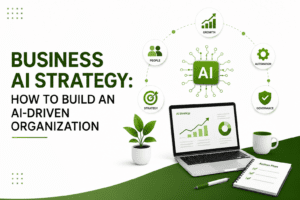
Artificial Intelligence is no longer a futuristic concept reserved for tech giants. Today, organizations of all sizes are leveraging AI to improve efficiency, automate repetitive tasks, enhance customer experiences, and make smarter business decisions.
However, implementing AI tools alone is not enough. Many companies invest in AI technologies without a clear roadmap and fail to achieve meaningful business outcomes. The difference between successful AI adopters and those struggling to see results often comes down to one factor: a well-defined Business AI Strategy.
Organizations that develop a structured AI strategy are better positioned to reduce operational costs, improve productivity, identify growth opportunities, and gain a competitive advantage.
As businesses increasingly seek practical AI implementation frameworks, companies such as DigiTechzo have been helping organizations explore AI-driven transformation strategies, automation solutions, and intelligent marketing systems that align technology with business objectives.
In this guide, you’ll learn exactly how to build a successful Business AI Strategy and create an AI-driven organization capable of thriving in the digital economy.
Quick Answer
A Business AI Strategy is a structured plan that aligns Artificial Intelligence initiatives with business goals. Successful AI-driven organizations focus on leadership alignment, data readiness, process automation, employee adoption, governance, and continuous optimization.
Companies that treat AI as a business transformation initiative—not just a technology project—typically achieve the highest ROI.
What Is a Business AI Strategy?
A Business AI Strategy is a comprehensive plan that defines how an organization will use Artificial Intelligence to achieve specific business objectives.
Rather than adopting AI tools randomly, businesses create a structured roadmap that outlines:
- Business goals
- AI opportunities
- Technology requirements
- Data infrastructure
- Talent needs
- Governance policies
- Success metrics
Business AI Strategy Definition
Business AI Strategy = Business Goals + Data + AI Technology + People + Processes + Governance
When these components work together, organizations can unlock measurable business value from AI investments.
Why Businesses Need an AI Strategy
Many organizations are rushing to adopt AI because competitors are doing so.
However, AI adoption without strategy often results in:
- Wasted budgets
- Disconnected tools
- Poor data quality
- Employee resistance
- Low ROI
Key Reasons Companies Need a Business AI Strategy
Improve Operational Efficiency
AI automates repetitive tasks, reducing manual workloads and increasing productivity.
Examples:
- Customer support automation
- Invoice processing
- Lead qualification
- Document analysis
Enhance Decision-Making
AI systems can analyze massive datasets and uncover insights faster than traditional methods.
Examples:
- Sales forecasting
- Demand prediction
- Market trend analysis
Increase Revenue Growth
Organizations use AI to identify high-value opportunities and personalize customer experiences.
Examples:
- Predictive marketing
- Personalized recommendations
- Dynamic pricing
Gain Competitive Advantage
Businesses that integrate AI into their operations often innovate faster than competitors.
Key Components of a Successful Business AI Strategy
1. Leadership Alignment
AI initiatives must be supported by executive leadership.
Questions leaders should answer:
- Why are we implementing AI?
- What business problem are we solving?
- How will success be measured?
Without executive buy-in, AI projects often fail to scale.
2. Data Readiness
AI systems are only as effective as the data they use.
Organizations should evaluate:
- Data quality
- Data accessibility
- Data governance
- Data security
Data Readiness Checklist
✅ Clean data
✅ Centralized data storage
✅ Data privacy compliance
✅ Real-time accessibility
3. Technology Infrastructure
A strong AI foundation requires:
- Cloud platforms
- Data warehouses
- Automation tools
- Analytics systems
- AI platforms
The technology stack should align with business objectives.
4. Talent and Skills
Successful AI implementation requires collaboration between:
- Leadership teams
- Data analysts
- AI specialists
- Operations managers
- Marketing professionals
Upskilling employees is often more valuable than replacing them.
5. Governance and Ethics
Organizations need clear guidelines regarding:
- Data privacy
- AI transparency
- Compliance
- Risk management
- Human oversight
Responsible AI practices build long-term trust.
Step-by-Step Framework to Build an AI-Driven Organization
Step 1: Define Business Objectives
Start with business goals—not technology.
Examples:
- Reduce customer support costs by 30%
- Increase sales conversion rates by 20%
- Improve operational efficiency by 25%
AI should support measurable outcomes.
Step 2: Identify High-Impact Opportunities
Evaluate business processes and identify bottlenecks.
Look for tasks that are:
- Repetitive
- Time-consuming
- Data-heavy
- Error-prone
High-Value AI Opportunities
| Department | AI Opportunity |
|---|---|
| Marketing | Lead Scoring |
| Sales | Predictive Forecasting |
| HR | Resume Screening |
| Finance | Invoice Automation |
| Customer Service | AI Chatbots |
| Operations | Workflow Automation |
Step 3: Assess Data Availability
Before implementing AI:
Ask:
- Do we have enough data?
- Is our data accurate?
- Is our data accessible?
Many AI projects fail due to poor data quality.
Step 4: Prioritize AI Initiatives
Use an Impact vs Complexity matrix.
Quick Wins
- Customer support chatbots
- Email automation
- Marketing automation
Strategic Projects
- Predictive analytics
- AI-driven personalization
- Demand forecasting
Step 5: Launch Pilot Projects
Avoid enterprise-wide deployment initially.
Start with small-scale pilots.
Benefits:
- Lower risk
- Faster learning
- Easier optimization
Step 6: Measure Performance
Track key performance indicators (KPIs).
Examples:
- Cost savings
- Revenue growth
- Productivity improvements
- Customer satisfaction
- Process efficiency
Step 7: Scale Successful AI Programs
Once proven, expand AI initiatives across departments.
Create repeatable processes and governance frameworks.
AI Use Cases Across Business Functions
Marketing
AI helps marketers:
- Generate content ideas
- Segment audiences
- Optimize campaigns
- Personalize messaging
Example
An AI-powered lead scoring model identifies high-converting prospects and prioritizes sales outreach.
Sales
AI improves:
- Forecast accuracy
- Pipeline visibility
- Lead qualification
Example
Predictive analytics helps sales teams focus on deals most likely to close.
Customer Service
AI chatbots can:
- Handle FAQs
- Provide 24/7 support
- Reduce ticket volume
Example
A chatbot resolves 70% of routine inquiries without human intervention.
Human Resources
AI supports:
- Recruitment
- Employee engagement
- Workforce planning
Example
AI screening tools reduce hiring time significantly.
Finance
AI automates:
- Expense tracking
- Fraud detection
- Invoice processing
Example
Machine learning systems identify unusual transactions in real time.
AI Maturity Model
Organizations typically progress through five stages.
Level 1: Awareness
Exploring AI possibilities.
Level 2: Experimentation
Running pilot projects.
Level 3: Adoption
Implementing AI in multiple departments.
Level 4: Integration
AI becomes part of core operations.
Level 5: Transformation
AI drives business innovation and competitive advantage.
Most organizations are currently between Levels 2 and 3.
Benefits of an AI-Driven Organization
Increased Productivity
Automation reduces repetitive workloads.
Better Decision-Making
AI provides data-driven insights.
Improved Customer Experience
Personalization increases satisfaction.
Lower Operating Costs
Automation reduces manual effort.
Faster Innovation
AI accelerates experimentation and product development.
Stronger Competitive Position
AI-driven businesses adapt faster to market changes.
Common Challenges and Solutions
Challenge: Poor Data Quality
Solution
Invest in data governance and cleansing.
Challenge: Employee Resistance
Solution
Provide training and communicate benefits clearly.
Challenge: Unrealistic Expectations
Solution
Start with measurable goals and pilot projects.
Challenge: Lack of Expertise
Solution
Partner with experienced AI consultants and implementation specialists.
AI Governance and Risk Management
A strong Business AI Strategy includes governance policies.
Organizations should establish:
Data Protection Standards
Protect customer and business data.
Human Oversight
Critical decisions should not rely solely on AI.
Compliance Monitoring
Ensure adherence to industry regulations.
Bias Detection
Regularly audit AI systems for fairness.
Common Mistakes Businesses Make
Implementing AI Without a Business Goal
Technology should solve a business problem.
Ignoring Data Quality
Poor data produces poor outcomes.
Choosing Tools Before Strategy
Strategy should guide technology decisions.
Expecting Immediate Results
AI transformation requires time and continuous improvement.
Neglecting Employee Adoption
People remain a critical component of AI success.
Expert Tips for Building a Successful Business AI Strategy
Focus on Business Outcomes First
Start with objectives, not tools.
Prioritize Quick Wins
Early successes build momentum.
Invest in Data Infrastructure
Data quality drives AI performance.
Create Cross-Functional Teams
AI is not solely an IT initiative.
Build Governance Early
Responsible AI practices reduce future risks.
Measure ROI Continuously
Track outcomes and optimize regularly.
Frequently Asked Questions
What is a Business AI Strategy?
A Business AI Strategy is a structured plan that aligns AI technologies with organizational goals to improve efficiency, decision-making, and growth.
How do companies start implementing AI?
Companies typically begin by identifying business problems, assessing data readiness, launching pilot projects, and measuring results before scaling.
What are the biggest benefits of AI in business?
Key benefits include automation, cost reduction, productivity improvement, better customer experiences, and enhanced decision-making.
Do small businesses need an AI strategy?
Yes. Small businesses can use AI to automate processes, improve marketing performance, and compete more effectively with larger organizations.
What industries benefit most from AI?
Healthcare, finance, manufacturing, retail, logistics, marketing, and professional services are among the industries experiencing significant AI-driven transformation.
Conclusion
Artificial Intelligence is rapidly becoming a fundamental business capability rather than a competitive luxury. Organizations that establish a clear Business AI Strategy can unlock greater efficiency, smarter decision-making, stronger customer experiences, and sustainable growth.
The most successful AI-driven organizations do not simply purchase AI tools. They align AI initiatives with business objectives, build strong data foundations, empower employees, establish governance frameworks, and continuously optimize performance.
Whether you’re exploring automation opportunities, implementing AI-powered marketing systems, improving operational efficiency, or developing a long-term digital transformation roadmap, having the right strategy is essential.
Businesses seeking practical guidance on AI implementation, workflow automation, customer acquisition systems, and AI-powered growth strategies can benefit from working with experienced partners such as DigiTechzo to accelerate their journey toward becoming truly AI-driven organizations.
Ready to build an AI-powered business? Start by assessing your current processes, identifying high-impact opportunities, and creating a roadmap that turns AI from a technology investment into a measurable business advantage.