
AI Lead Generation Automation: How Australian Businesses Are Generating Qualified Leads Automatically
A lead fills out your contact form at 11pm. By the time someone on your sales team sees it the next morning, they’ve already requested quotes from two competitors and half-forgotten why they reached out to you in the first place. This isn’t a sales team problem — it’s a speed problem, and it’s exactly the gap AI lead generation automation was built to close.
Search interest in AI lead generation automation has surged across Australia as businesses realise the old playbook — a sales rep manually qualifying every enquiry, copying details into a spreadsheet, then deciding who to call first — simply can’t compete with software that captures, scores, and responds to a lead within seconds of them showing interest.
At Digitechzo, we’ve worked with Australian businesses to map exactly where leads were leaking out of their funnel — sitting unanswered in inboxes, scored by gut feeling instead of data, or never followed up at all after the first email bounced. This guide breaks down how AI lead generation automation actually works, what it costs to implement properly, the compliance issues most articles skip entirely, and the framework we use to get qualified leads flowing on autopilot.
Quick Answer
“I lead generation automation uses AI-driven chat capture, predictive lead scoring, data enrichment, and personalised nurture sequences to identify and prioritise the prospects most likely to buy, without manual screening. Australian businesses that implement it well typically cut lead response time from hours to minutes and increase qualified pipeline by 20–40%, but only when the system respects the Spam Act 2003 and Privacy Act 1988 — a step most providers gloss over.”
What Is AI Lead Generation Automation?

AI lead generation automation is the use of artificial intelligence to capture, qualify, score, and nurture potential customers with minimal manual effort. It’s not a single tool — it’s a connected system that decides which leads matter most and acts on that decision faster than a person checking a spreadsheet ever could.
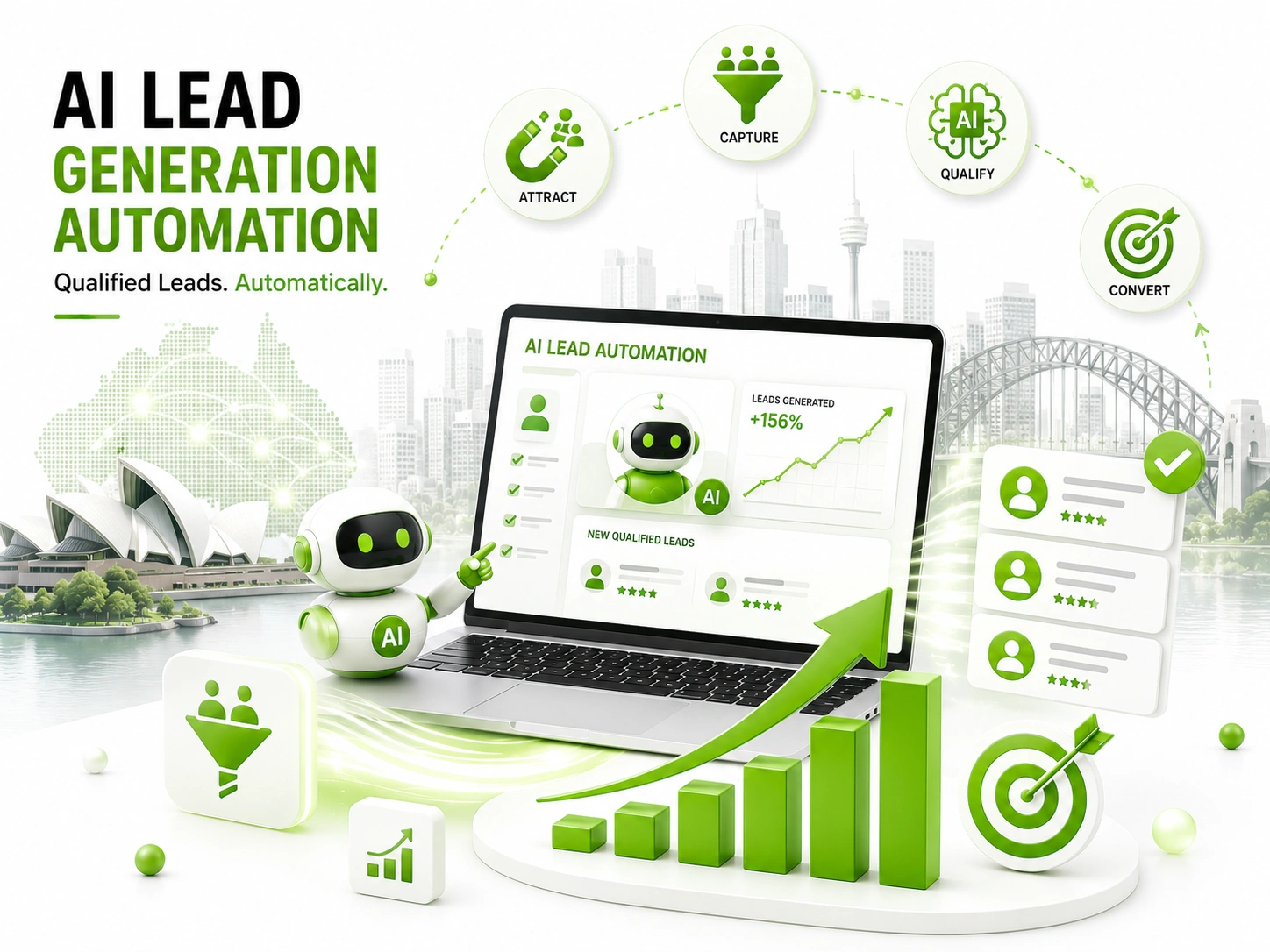
The Four Jobs It Actually Does
- Capture — collecting lead details through AI chat widgets, smart forms, or landing page interactions that ask the right follow-up questions automatically.
- Qualify and score — ranking leads by likelihood to convert based on behaviour, firmographic data, and engagement signals, instead of relying on a rep’s gut feeling.
- Enrich — filling in missing details (company size, industry, role) automatically from public data sources so reps aren’t manually researching every contact.
- Nurture — sending personalised follow-up sequences to leads who aren’t ready to buy yet, so they’re warm by the time a rep does call.
Why Australian Businesses Are Turning to AI Lead Generation Automation
Speed has become the single biggest differentiator in lead conversion, and the data on this is consistent across markets. A widely cited Harvard Business Review analysis of sales response data found that companies contacting a new lead within roughly an hour were dramatically more likely to qualify that lead than those waiting even a few hours longer — and the gap widens further once a day or more passes. For Australian businesses competing across time zones, after-hours enquiries, and increasingly fast-moving digital channels, manually matching that speed around the clock isn’t realistic without automation.
Beyond speed, the cost of unqualified leads reaching a sales rep is real and often invisible. Every hour a rep spends following up with a lead who was never going to buy is an hour not spent on a lead who was. AI scoring doesn’t just generate more leads — its real value is filtering out the ones that were never worth a phone call.
The Hidden Cost of Manual Lead Qualification
Picture a Melbourne-based B2B services firm receiving 80 enquiries a month through its website. If a rep spends just 20 minutes manually researching and qualifying each one before deciding whether to follow up, that’s roughly 27 hours a month — nearly a full working week — spent before a single sales conversation even begins.
The Building Blocks: Core Technologies Behind AI Lead Generation Automation

Understanding each layer of the stack helps you figure out which piece to implement first, rather than buying a platform that does everything poorly.
AI Chat-Based Lead Capture
Conversational widgets that ask qualifying questions in real time — budget, timeline, company size — rather than relying on a static form that tells you almost nothing about whether the lead is worth pursuing.
Predictive Lead Scoring
Machine learning models that rank leads based on patterns from your own historical data — which behaviours and attributes actually correlated with past customers, not generic industry assumptions.
Data Enrichment
Automatically appending firmographic and technographic data (company size, industry, technology stack) to a raw lead record, so reps walk into every call already informed.
AI-Personalised Nurture Sequences
Email and messaging sequences that adapt content and timing based on a lead’s behaviour — what they clicked, what they ignored — rather than sending the same generic sequence to everyone.
Intent Signals and Predictive Analytics
Tracking third-party buying signals (research activity, competitor comparisons, hiring patterns) to flag accounts showing intent before they’ve even filled out a form.
AI-Assisted Outbound Research
Tools that help reps identify and personalise outreach to good-fit prospects faster, though outbound activity in Australia must be built around explicit consent requirements covered later in this guide.
Comparing the Core Tools
| Tool | Primary Job | Typical Cost Range (AUD/mo) | Best Starting Point For |
| AI chat lead capture | Qualify leads on first contact | $100 – $1,200 | High website traffic, low form completion |
| Predictive lead scoring | Prioritise sales follow-up | $300 – $2,500 | Teams drowning in unqualified leads |
| Data enrichment | Fill in missing prospect data | $100 – $1,000 | B2B teams doing manual research |
| AI nurture sequences | Warm up not-ready-yet leads | $50 – $800 | Long sales cycles with high drop-off |
| Intent data platforms | Flag in-market accounts early | $500 – $3,000+ | Account-based B2B sales motions |
How Much Pipeline Can This Actually Generate?
Case Scenario: A Brisbane-Based Professional Services Firm
A 12-person accounting and advisory firm in Brisbane was generating around 60 website enquiries a month, but converting fewer than 15% into booked consultations — partly because follow-up often happened a day or more after the initial enquiry. After introducing an AI chat widget to qualify leads on first contact and an automated scoring model to flag high-value enquiries for immediate phone follow-up, average response time dropped from over 14 hours to under 10 minutes for top-scored leads.
Within three months, booked consultation rates rose from 15% to roughly 24% of total enquiries, without adding a single new staff member to the sales process — the gain came entirely from speed and prioritisation, not from generating more raw leads.
Build vs Buy vs Hire a Partner: Pros and Cons
Off-the-Shelf Marketing Automation Add-Ons
- Pros: fast to activate, often included in tools you already use (HubSpot, Pipedrive, ActiveCampaign)
- Cons: scoring models are generic until trained on your own conversion data, which takes time and volume
In-House Build
- Pros: full control over data and scoring logic tailored exactly to your sales process
- Cons: requires data science and integration capability most sales teams don’t have internally
Hiring a Development or Automation Partner
- Pros: combines proper scoping of your funnel with technical build experience and compliance awareness
- Cons: higher upfront cost than a plug-in tool, and value depends on choosing a partner who audits your actual lead data rather than applying a templated setup
The Digitechzo Framework for AI Lead Generation Automation

- Audit your current funnel — map exactly where leads enter, how long follow-up currently takes, and where they drop off before reaching a sales conversation.
- Define what “qualified” actually means — agree on the specific behaviours and attributes that correlated with your best past customers, rather than guessing.
- Build the capture layer first — deploy AI chat or smart forms before scoring, since scoring is only as good as the data feeding it.
- Train the scoring model on real data — use historical conversion data, not industry templates, to rank new leads accurately.
- Automate the nurture path for not-yet-ready leads — so leads that don’t convert immediately stay warm instead of going cold in an unused spreadsheet.
- Set human follow-up triggers — decide exactly which score thresholds or behaviours should alert a rep instantly versus enter a nurture sequence.
- Review and retrain quarterly — scoring models drift as your market and product change, so revisit the data regularly rather than setting it once.
Industries in Australia Getting the Most Value
- Professional services (accounting, legal, consulting) — qualifying enquiry-based leads instantly instead of waiting for manual triage.
- Real estate — scoring buyer and renter enquiries by intent and budget signals before an agent spends time on a call.
- B2B SaaS and technology — using intent data and enrichment to prioritise outbound efforts toward accounts already showing buying signals.
- Home services and trades — capturing and qualifying quote requests around the clock so the first tradie to respond isn’t just the one who happened to check their phone.
- Financial services and insurance — automating initial qualification while keeping any advice-related conversation with a licensed human, in line with regulatory obligations.
Compliance Considerations Most Lead Gen Guides Skip
This is the part competitor content almost never covers properly, and it’s where automated lead generation in Australia can create real legal exposure if ignored.
The Spam Act 2003 and Consent
Any automated email or SMS outreach to a lead must comply with the Spam Act 2003, which requires consent before sending commercial electronic messages, a clear identification of the sender, and a functional unsubscribe mechanism in every message. AI-personalised nurture sequences are not exempt simply because a human didn’t write each message individually.
The Privacy Act 1988 and Data Handling
Lead enrichment tools that pull additional data about a prospect from third-party sources still trigger obligations under the Australian Privacy Principles regarding collection, storage, and use of personal information — your privacy policy needs to reflect this, not just your marketing tool’s settings.
Questions to Resolve Before Launch
- Does every nurture sequence include a compliant, working unsubscribe option?
- Where is enriched lead data stored, and who has access to it within your business?
- Has your privacy policy been updated to disclose AI-based scoring and enrichment of enquiry data?
- If outbound prospecting tools are used, is there a documented basis for consent or an existing business relationship?
Common Mistakes Businesses Make With AI Lead Generation Automation
- Scoring leads before defining what “qualified” means — a model built on guesses instead of real conversion data produces confident but wrong rankings.
- Automating outreach without consent processes in place — creates Spam Act exposure that’s far more expensive than the leads it generates.
- Treating every lead the same after capture — sending identical nurture content to a high-intent and low-intent lead wastes the entire point of scoring.
- Never closing the loop with sales — if reps don’t report back which leads actually converted, the scoring model can’t improve over time.
- Chasing lead volume over lead quality — a system generating twice as many leads that convert at half the rate hasn’t actually improved anything.
Expert Tips for Getting AI Lead Generation Automation Right
- Set a 5-minute response goal for top-scored leads — speed consistently outperforms perfect personalisation for hot leads.
- Score on behaviour, not just demographics — what a lead does (pages visited, content downloaded) often predicts conversion better than firmographic data alone.
- Keep a human review step on your highest-value segment — full automation makes sense for low-value, high-volume leads; your biggest potential accounts still deserve a tailored human touch.
- Audit your nurture sequences quarterly — messaging that worked six months ago can quietly stop converting as your market shifts.
- Tie automation metrics to revenue, not just lead count — report on qualified pipeline and closed revenue influenced by automation, not just how many leads entered the system.
Frequently Asked Questions
What is AI lead generation automation?
AI lead generation automation uses artificial intelligence to capture, score, enrich, and nurture potential customers automatically, prioritising the prospects most likely to convert without requiring manual qualification of every enquiry.
How much does AI lead generation automation cost in Australia?
Costs typically range from a few hundred dollars a month for an off-the-shelf chat and scoring add-on to several thousand dollars a month for enterprise-grade intent data and custom-built scoring models. Most small-to-medium Australian businesses see meaningful results in the $300–$2,000 monthly range.
Is AI lead generation automation legal in Australia?
Yes, when implemented correctly. Automated outreach must comply with the Spam Act 2003, which requires consent, sender identification, and a working unsubscribe option in commercial messages, while any data enrichment or scoring involving personal information must align with the Australian Privacy Principles under the Privacy Act 1988.
Can small businesses benefit from AI lead generation automation, or is it only for large companies?
Small businesses often see proportionally larger gains because a single improvement — like responding to leads within minutes instead of hours — can noticeably lift conversion rates without requiring an enterprise-scale budget or a dedicated data team.
Does AI lead generation automation replace a sales team?
No. It replaces the manual qualification and prioritisation work that previously consumed sales time, so reps spend their time on conversations with leads most likely to convert, rather than chasing every enquiry equally regardless of fit.
Conclusion: The Leads You’re Losing Are a Speed and Scoring Problem

Most Australian businesses don’t have a lead generation problem — they have a response time and prioritisation problem. The leads are already arriving; they’re just sitting unanswered overnight, getting equal attention regardless of fit, or going cold in a nurture sequence nobody reviewed in months. AI lead generation automation fixes exactly that gap, without requiring a bigger sales team.
If your business is generating enquiries but struggling to convert them at the rate it should, Digitechzo can audit your current funnel, show you exactly where leads are leaking out, and map what a properly scoped, compliant automation setup would look like before you commit to any tool. Get in touch to start with a clear plan built on your own data, not a generic template.