
You launched a Web3 exchange. The smart contracts are audited, the wallet integrations work, and the UI is clean — but three months in, your user growth chart still looks like a flat line. Meanwhile, three newer competitors with objectively worse products are showing up in every “top Web3 exchanges” list and pulling in trading volume you can’t compete with. The problem usually isn’t the product. It’s the absence of a marketing engine built specifically for how Web3 platforms actually acquire users.
That’s where specialized Web3 exchange marketing services come in. Marketing a Web3 exchange sits at the intersection of crypto-native growth tactics (token incentives, community trust, on-chain reputation) and traditional demand generation (SEO, paid acquisition, PR) — and very few agencies genuinely operate across both. At Digitechzo, our work with early-stage exchanges and trading platforms has shown a consistent pattern: platforms that treat marketing as a launch-day checkbox stall out, while those that build a compounding acquisition system — organic search, community, and strategic partnerships working together — keep growing well past the initial hype cycle.
This guide covers exactly what Web3 exchange marketing involves in 2026, what separates platforms that scale from ones that plateau, and how to evaluate a marketing partner before you commit budget.
Quick Answer
Web3 exchange marketing services combine SEO, community growth, token/incentive-driven acquisition, and digital PR to help new trading platforms attract users and liquidity in a highly competitive, trust-sensitive market. Because Web3 users are more skeptical and more technically informed than average consumers, the strategies that work rely on transparency, on-chain proof points, and genuine utility — not hype-driven promotion.
Why Web3 Exchange Marketing Requires a Different Playbook
Traditional fintech marketing leans on brand awareness, paid acquisition, and conversion funnels optimized through A/B testing. Web3 exchange marketing overlaps with that world but adds several layers traditional playbooks don’t account for:
- Users verify before they trust. Before connecting a wallet, most Web3 users check contract audits, look up the team on-chain, and read community sentiment on Discord or X — not just landing page copy.
- Token incentives change acquisition math. Liquidity mining, referral rewards, and airdrop campaigns can drive rapid growth, but poorly structured incentives attract mercenary capital that disappears the moment rewards dry up.
- Regulatory exposure shapes what you can say. Claims implying guaranteed returns, custodial safety, or investment advice create real legal risk — and increasingly, Google penalizes exactly this kind of language in financial YMYL content.
- Community is a distribution channel, not just support. A well-run Discord or Telegram doesn’t just answer questions — it actively drives referrals, feedback loops, and word-of-mouth growth that paid ads can’t replicate.
A generic digital marketing agency applying a SaaS or e-commerce framework to a Web3 exchange will typically optimize for the wrong signals — vanity traffic instead of wallet connections, follower counts instead of active liquidity providers.
Core Web3 Exchange Marketing Services Explained
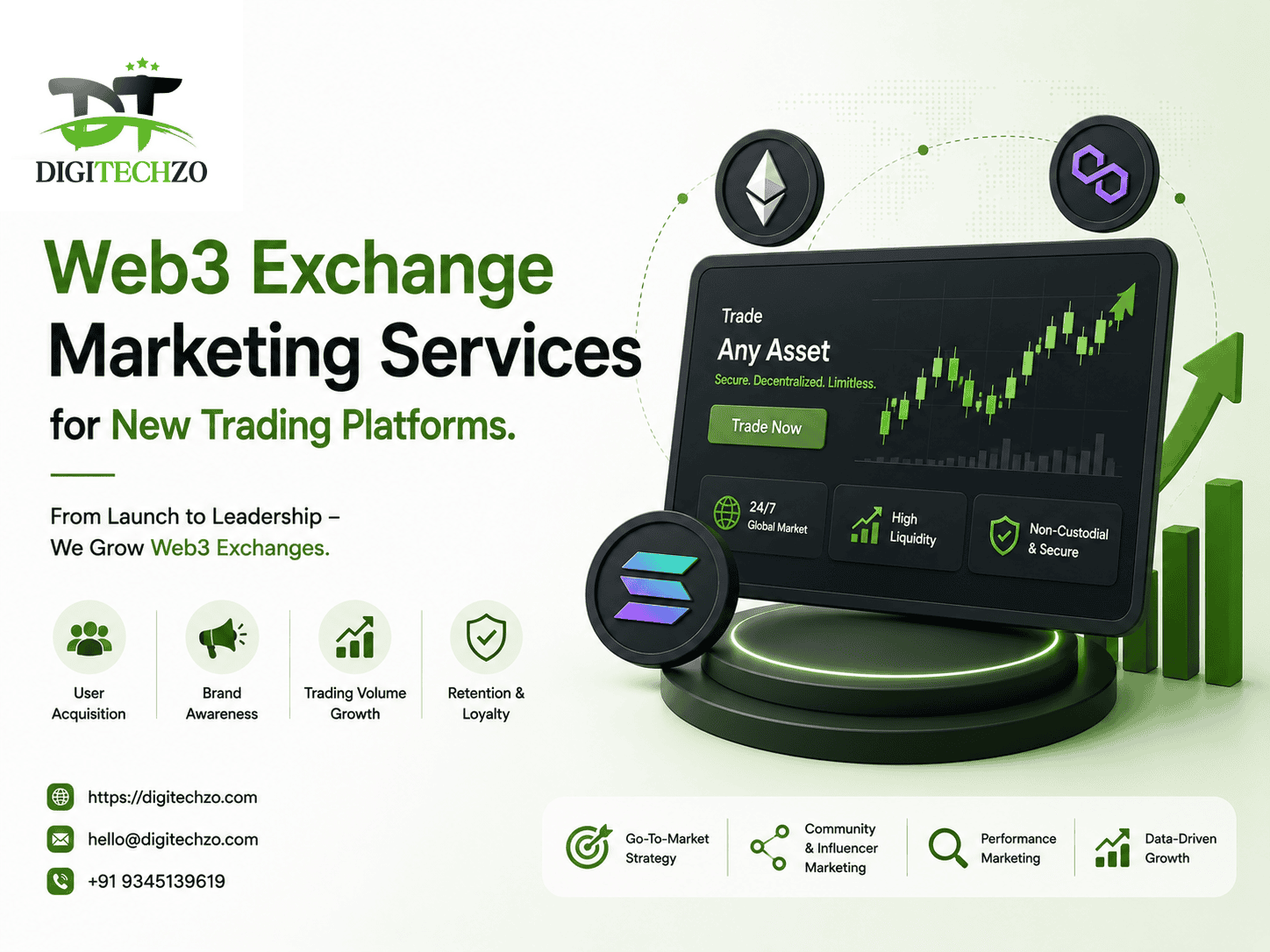
A complete Web3 exchange marketing engagement typically includes these interlocking services:
1. Search Engine Optimization (SEO)
Ranking for high-intent terms like “[chain] Web3 wallet exchange” or “trade [asset] on Web3,” plus building topical authority through educational content.
2. Community Management & Growth
Building and moderating Discord/Telegram communities, running governance or engagement campaigns, and converting community members into active traders.
3. Token & Incentive Campaign Design
Structuring airdrops, referral programs, and liquidity incentives that attract genuine long-term users rather than short-term farmers.
4. Digital PR & Media Relations
Securing coverage on crypto-native publications (Decrypt, The Block, CoinDesk) and mainstream fintech press to build third-party credibility.
5. Paid User Acquisition
Running compliant paid campaigns across crypto-friendly ad networks and platforms, since major ad networks heavily restrict crypto advertising.
6. Conversion & Onboarding Optimization
Reducing friction between “landed on site” and “connected wallet, made first trade” — often the single biggest lever for improving marketing ROI.
Building Trust Before Driving Traffic
Here’s a mistake seen constantly with new Web3 exchanges: aggressive marketing spend before trust infrastructure is in place. Traffic without trust converts poorly, and worse, it can generate negative community sentiment that follows the project for months.
What Trust Infrastructure Actually Looks Like
- Visible, verifiable audits. Not just “audited” as a badge — link directly to the audit report, name the auditing firm, and disclose any findings and remediations.
- Transparent team information. Fully anonymous teams face a steep credibility disadvantage. Where full doxxing isn’t possible, verifiable track records (previous projects, LinkedIn presence, KYC’d with a reputable launch platform) help.
- Clear, jargon-free risk disclosures. Explaining impermanent loss, smart contract risk, and custody model in plain language builds more trust than burying it in a whitepaper.
- Real-time transparency tools. Live dashboards showing TVL, treasury holdings, or reserve proof (where applicable) give users something more convincing than marketing copy.
Example scenario: Two competing Web3 exchanges launch in the same month with similar features. Exchange A leads its homepage with slick visuals and bold claims about “the future of trading.” Exchange B leads with a security-first message, links its audit report above the fold, and shows a live TVL counter. In nearly every case we’ve observed, Exchange B converts skeptical Web3 users at a meaningfully higher rate — because the audience actively looks for proof, not promises.
SEO Strategy for New Trading Platforms
Organic search is one of the most underused growth channels for Web3 exchanges — most teams pour budget into paid social and influencer deals while ignoring search traffic that converts at a much lower acquisition cost.
Keyword Opportunities by Funnel Stage
| Funnel Stage | Example Keywords | Content Type |
|---|---|---|
| Awareness | “what is a Web3 exchange” | Educational blog content |
| Consideration | “Web3 exchange vs CEX,” “best Web3 wallets for trading” | Comparison pages |
| Decision | “trade on [chain] Web3 exchange,” “[token] Web3 swap” | Landing/product pages |
Technical SEO Considerations Specific to Web3 Platforms
- Wallet-gated pages aren’t indexable. Keep core marketing, educational, and landing pages publicly accessible; gate only the actual trading interface behind wallet connection.
- Multi-chain deployments need distinct pages. A platform live on Ethereum, Arbitrum, and Base needs unique, non-duplicated content per chain rather than one page trying to rank for all three.
- Page speed matters more than most teams assume. Web3 sites often load heavy wallet-connect libraries and RPC calls on the homepage itself — deferring these until after user interaction improves both Core Web Vitals and bounce rate.
Featured Snippet Opportunity
Structuring FAQ content with schema markup around common questions (“What is a Web3 exchange,” “Is a Web3 exchange safe”) gives smaller platforms a real shot at snippet visibility — a spot usually monopolized by large aggregator or definition sites.
Community-Led Growth for Web3 Exchanges
Community isn’t a marketing channel in Web3 — it’s closer to the product itself. Active, engaged communities directly influence trading volume, liquidity provision, and governance participation.
What effective community growth looks like:
- Weekly AMAs with founders addressing real questions, including hard ones about security and roadmap delays
- Referral programs tied to actual trading activity, not just sign-ups
- Governance participation incentives that reward thoughtful proposals and voting, not just presence
What undermines it:
- Purchased followers or bot-driven Discord activity (engagement ratio red flags are easy for experienced users to spot)
- Generic engagement farming with no substance
- Influencer partnerships chosen purely on follower count rather than audience relevance and credibility
Paid Acquisition vs. Organic Growth: What to Prioritize First
Pros of paid acquisition (early stage):
- Immediate visibility and traffic
- Useful for testing messaging and conversion before scaling SEO
- Can jumpstart liquidity around launch
Cons of paid acquisition:
- Major platforms (Google, Meta) heavily restrict crypto ads, limiting reach and inflating costs
- Traffic disappears the moment spend stops — no compounding value
- Attracts lower-intent users if targeting isn’t tightly scoped
Pros of organic growth (SEO, content, community):
- Compounds over time — content published today keeps driving traffic a year later
- Attracts higher-intent users actively researching before trading
- Builds durable brand authority that paid traffic doesn’t
Cons of organic growth:
- Slower to show results (typically 4–8+ months for meaningful traction)
- Requires consistent investment even when short-term ROI isn’t visible
Practical framework: Use paid acquisition tactically around launch and major campaigns, while building SEO and community as the long-term engine that reduces dependency on paid spend over time.
Common Mistakes New Web3 Exchanges Make
- Leading with hype instead of proof. Bold claims without verifiable backing get dismissed instantly by a skeptical, technically literate audience.
- Neglecting SEO in favor of paid social entirely. This leaves a lower-cost, higher-intent traffic channel completely untapped.
- Running incentive campaigns without retention mechanics. Airdrops and liquidity mining that don’t reward continued engagement attract users who leave the moment rewards end.
- Treating community management as customer support. A community manager who only answers tickets misses the growth potential of an engaged community.
- Ignoring mobile and wallet-app SEO. As more trading happens through mobile wallets and Web3 browsers, platforms optimizing only for desktop search miss significant traffic.
- Overlooking compliance in marketing copy. Language implying guaranteed returns or custodial safety creates both regulatory and platform-policy risk.
Expert Tips for Scaling Sustainably
- Publish your security and audit information before you publish your first ad. Trust infrastructure should exist before traffic arrives, not after.
- Design incentive campaigns around retention metrics, not just sign-up volume. Track 30/60/90-day active wallet retention, not just total wallets connected.
- Build a content calendar around your platform’s unique mechanics. If your exchange offers something genuinely different (novel fee model, unique chain support, hybrid custody), that differentiation is your strongest organic content angle.
- Treat your Discord/Telegram as a research channel, not just a support channel. The questions your community asks repeatedly are exactly what your SEO content should answer.
- Measure marketing performance against wallet connections and trade volume, not just traffic. A blog post with high traffic and no conversions signals a funnel problem, not a content success.
FAQ
What are Web3 exchange marketing services?
Web3 exchange marketing services combine SEO, community growth, token/incentive campaign design, digital PR, and paid acquisition to help decentralized and Web3-native trading platforms attract users and liquidity in a competitive, trust-sensitive market.
How is Web3 exchange marketing different from traditional fintech marketing?
Web3 users typically verify claims through on-chain data, audits, and community sentiment before trusting a platform, which means marketing needs to prioritize transparency and proof over traditional brand messaging and paid conversion funnels.
How long does it take to see results from Web3 exchange marketing?
Paid acquisition can show results within weeks, while organic growth channels like SEO and community typically take 4–8 months to build meaningful, compounding traction.
Is paid advertising effective for Web3 exchanges?
It can be, but major ad platforms restrict crypto advertising, which limits reach and increases cost. Paid acquisition works best as a launch-phase tactic alongside a longer-term organic growth strategy.
What’s the biggest factor in converting visitors to active traders on a Web3 exchange?
Visible trust infrastructure — verifiable audits, transparent team information, and clear risk disclosures — consistently has a greater impact on conversion than visual design or marketing copy alone.
Final Thoughts
Marketing a Web3 exchange successfully isn’t about chasing hype cycles or matching competitors’ ad spend. It’s about building a system where trust, organic discoverability, and community growth compound together over time — so your platform keeps attracting users long after the launch buzz fades.
If you’re evaluating Web3 exchange marketing services and want a partner that understands both crypto-native growth mechanics and durable organic strategy, Digitechzo works specifically with new and early-stage trading platforms — from trust-first positioning to SEO and community growth. Reach out for a free marketing audit to see exactly where your platform’s growth opportunities are being left untapped.
About The Author