
If you’ve ever tried to get a straight answer on “how long will it take to build a prediction market platform,” you’ve probably run into the same problem we did when we first scoped one of these projects: everyone gives you a range, nobody explains why.
Six weeks. Six months. A year. Which one is true?
The honest answer is: it depends on what you’re actually building — a simple polling-style app, a fully on-chain platform with smart contract settlement, or a regulated exchange-grade product like Polymarket or Kalshi. Each of these has a completely different timeline, cost structure, and risk profile, and most guides online lump them together, which is why founders end up with wildly inaccurate expectations and blown budgets.
At Digitechzo, we’ve worked with founders building everything from lightweight Web2 prediction apps to blockchain-based markets with on-chain oracles and multi-sig treasuries. This guide breaks the process down stage by stage, with realistic timeframes, cost drivers, common pitfalls, and the questions you should be asking your development partner before you sign a contract.
Quick Answer
Building a prediction market platform typically takes 8 to 20 weeks for an MVP and 4 to 9 months for a full-featured, production-grade product. The biggest timeline variables are blockchain integration complexity, regulatory/compliance work, oracle design, and liquidity mechanism (AMM vs. order book). Skipping legal review or oracle testing to “save time” is the #1 cause of post-launch delays.
What Actually Determines a Prediction Market Development Timeline
Before jumping into stages, understand the four levers that move your timeline more than anything else:
- Settlement mechanism — Order book, AMM (automated market maker), or hybrid. AMMs are faster to build; order books need matching engine work.
- Oracle strategy — Manual resolution, decentralized oracle (like UMA or Chainlink), or a hybrid dispute system. Oracle design alone can add 2–4 weeks.
- Regulatory posture — Are you launching as a real-money exchange, a “play-money” prediction app, or an offshore crypto-native platform? Each carries different legal review timelines.
- Chain choice — Deploying on Polygon or an EVM L2 is faster and cheaper to audit than building a custom chain or novel settlement layer.
Get these four decisions locked in early. Most timeline blowouts happen because a founder tries to make these calls during development instead of before it.
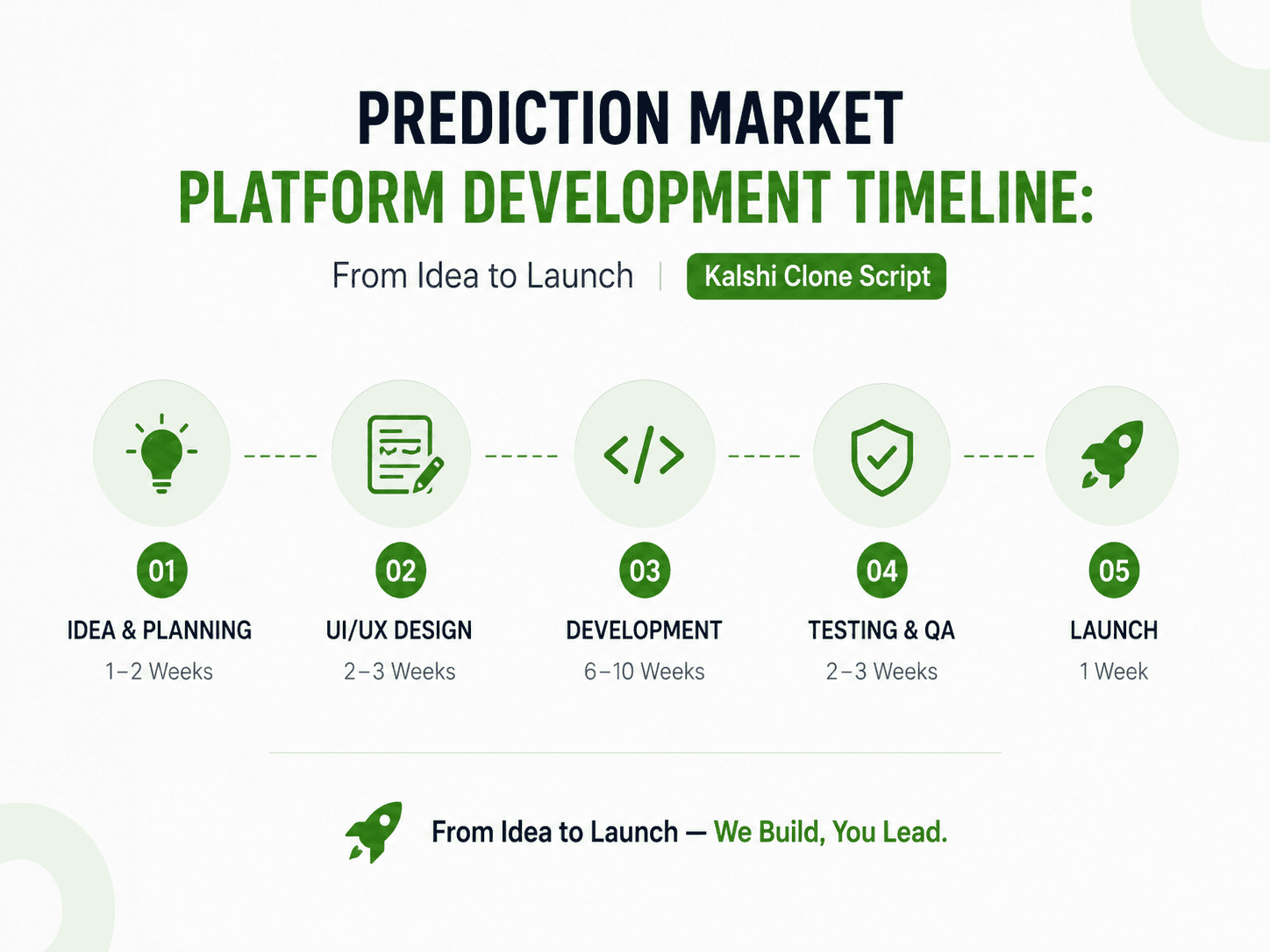
Stage 1: Discovery & Market Research (1–3 Weeks)
This is the stage most teams rush — and it’s the one that saves the most time later.
A proper discovery phase includes:
- Competitor teardown (Polymarket, Kalshi, Manifold, Metaculus — what works, what doesn’t)
- Target market definition (sports bettors, political forecasters, crypto-native traders, corporate forecasting teams)
- Revenue model decision (trading fees, spread capture, listing fees, subscription)
- Jurisdiction scoping (which countries/states you can legally serve)
Example: A fintech client of ours initially wanted a real-money sports prediction market for the U.S. market. During discovery, we flagged that this would require CFTC-adjacent compliance work similar to Kalshi’s — a multi-month legal process. They pivoted to a play-money model with a crypto-rewards layer instead, cutting their go-to-market timeline by roughly four months.
Stage 2: Architecture & Compliance Planning (2–4 Weeks)
This is where your technical architecture and legal strategy get locked in.
Deliverables at this stage:
- System architecture diagram (frontend, backend, smart contracts, oracle layer)
- Tech stack finalization (Solidity/Rust for contracts, Node/Go for backend, React/Next.js for frontend)
- Compliance framework (KYC/AML provider selection if handling real money)
- Tokenomics or fee-structure model, if applicable
If you’re building on-chain, this is also when you decide between a custom smart contract suite versus forking an audited, open-source prediction market protocol. Forking a proven codebase (with proper licensing and modification) can cut development time by 30–40%, but it also limits customization — a genuine trade-off worth discussing with your dev partner rather than glossing over.
Stage 3: UI/UX Design (2–3 Weeks)
Prediction markets live or die on how clearly they present probability and risk. This isn’t a generic app design job.
Key screens that need dedicated design attention:
- Market listing/discovery page (categories, trending markets, search)
- Individual market page (price chart, order book/AMM curve, position entry)
- Portfolio/positions dashboard
- Resolution and dispute interface
- Wallet connection and funding flow (for crypto platforms)
Pro tip from experience: Users abandon prediction markets most often at the “how do I actually place a trade” moment. Investing extra design time in the trade-entry flow — with clear cost, potential payout, and slippage indicators — pays for itself in retention.
Stage 4: Core Development (6–14 Weeks)
This is the largest chunk of the timeline and where estimates diverge the most.
Backend & Smart Contract Development
- Market creation and resolution logic
- Order matching engine or AMM pricing curve
- Wallet integration (MetaMask, WalletConnect, or custodial wallets)
- Fee collection and treasury management
- Admin panel for market moderation
Frontend Development
- Real-time price/probability updates (WebSocket or subgraph-based)
- Responsive trading interface
- Notifications for market resolution and price movement
Realistic benchmarks:
| Platform Type | Core Dev Time |
|---|---|
| Simple play-money prediction app | 5–7 weeks |
| Crypto-native AMM-based market | 8–12 weeks |
| Order-book based real-money exchange | 12–16+ weeks |
Stage 5: Oracle Integration & Testing (2–5 Weeks)
The oracle — the mechanism that determines who won — is the single most underestimated piece of prediction market development.
Three common oracle approaches:
- Centralized/manual resolution — Fastest to build, but introduces trust and censorship concerns.
- Decentralized oracle (UMA-style optimistic oracle) — More trustworthy, but requires dispute-window logic and bonded resolvers.
- Hybrid — Manual resolution with an on-chain dispute escalation path. This is what most serious platforms end up using.
Testing must cover edge cases: ambiguous outcomes, split resolutions, late-breaking news that changes an outcome after a market closes, and malicious dispute attempts. Skipping edge-case testing here is how platforms end up with a resolution controversy in week one of launch — which is far more damaging to trust than a delayed launch date.
Stage 6: Security Audit (1–4 Weeks)
If any part of your platform touches real money or crypto assets, a third-party smart contract audit is non-negotiable.
- Simple contract suites: 1–2 weeks
- Complex AMM/order-book contracts with custom oracle logic: 3–4 weeks, sometimes with a second audit round after fixes
Budget for this explicitly. Founders who treat the audit as an afterthought often discover critical issues that send them back to Stage 4, adding weeks they hadn’t planned for.
Stage 7: Beta Launch & QA (2–3 Weeks)
Run a closed beta with real users placing real (or test) trades before a public launch. This surfaces:
- Load and latency issues under concurrent trading
- UX friction points in the trade flow
- Oracle resolution accuracy in live conditions
Stage 8: Public Launch & Post-Launch Support
Launch isn’t the finish line. Budget ongoing time for:
- Monitoring market liquidity and adding market-maker incentives if volume is thin
- Regular smart contract monitoring and incident response
- Iterating on new market categories based on user demand
On-Chain vs. Off-Chain: How Architecture Changes the Timeline
| Factor | Off-Chain (Web2) | On-Chain (Web3) |
|---|---|---|
| Development time | Faster (8–12 weeks MVP) | Slower (12–20 weeks MVP) |
| Trust/transparency | Lower — relies on platform integrity | Higher — verifiable on-chain settlement |
| Audit requirement | Optional | Essential |
| Regulatory exposure | Depends on real-money handling | Often higher, especially in the U.S. |
| Best for | Fast market validation, play-money apps | Crypto-native audiences, transparency-focused products |
Pros of starting off-chain: faster time to market, lower audit costs, easier iteration. Cons: harder to migrate to on-chain later without rearchitecting core logic; less appealing to crypto-native users who want verifiable settlement.
Common Mistakes That Delay Launch
- Designing the oracle last. Teams build the entire trading engine, then realize resolution logic doesn’t fit their market types.
- Underestimating compliance for “play-money” platforms. Even non-monetary prediction markets can trigger gambling-adjacent regulation depending on jurisdiction and reward structure.
- Skipping load testing before high-attention events. Prediction markets see massive traffic spikes around elections, sports finals, or major news — untested infrastructure buckles exactly when you need it most.
- Choosing an unaudited fork without understanding its assumptions. Forked code built for a different oracle model or chain can introduce subtle bugs.
- No dispute resolution UX. Users need a visible, trustworthy way to contest a resolution — its absence is a fast track to reputational damage.
Expert Tips to Compress the Timeline Without Cutting Corners
- Start with one market category, not ten. Launch focused (e.g., only sports or only crypto prices), then expand. This shrinks oracle complexity dramatically.
- Use an audited base protocol where legally permissible. It shortens Stage 4 and Stage 6 simultaneously.
- Run compliance and smart contract development in parallel, not sequentially — most timeline waste comes from treating these as a relay race instead of parallel tracks.
- Build the dispute/resolution UI before the trading UI polish. It’s less glamorous but prevents the most damaging failure mode.
- Lock your tokenomics/fee model before development starts. Changing fee logic mid-build routinely adds 1–2 weeks of contract rework.
FAQs
How long does it take to build a prediction market platform?
A basic MVP typically takes 8–20 weeks depending on whether it’s off-chain or on-chain. A full production-grade platform with audits, compliance, and a mature oracle system usually takes 4–9 months.
How much does prediction market platform development cost?
Costs generally range from $30,000–$60,000 for a lean MVP to $150,000+ for a fully audited, on-chain platform with a custom oracle and compliance layer. The exact figure depends heavily on chain choice, oracle design, and regulatory scope.
Do I need a smart contract audit for a prediction market app?
Yes, if any real value (crypto or fiat) settles through your platform. Skipping an audit is one of the highest-risk shortcuts in this space and can lead to exploits that end a platform’s reputation overnight.
Can I launch without blockchain and add it later?
Yes, and many teams do this to validate demand faster. However, migrating an off-chain platform to on-chain settlement later usually requires significant rearchitecture, so it’s worth deciding your long-term direction early, even if you launch off-chain first.
What’s the biggest factor that delays prediction market launches?
Oracle and dispute resolution design. Teams consistently underestimate how much testing and edge-case planning this requires compared to the trading interface itself.
Final Thoughts
A prediction market platform isn’t just another trading app — it’s a system that has to be fast, transparent, and provably fair the moment real users start placing real stakes on real outcomes. The timeline you should plan for depends far less on “how fancy” your platform looks and far more on how disciplined you are about oracle design, compliance scoping, and security review from day one.
If you’re currently scoping a prediction market build and want a realistic timeline and cost estimate specific to your market category and jurisdiction, Digitechzo works with founders through exactly this process — from architecture decisions through audit and launch. Reach out for a free scoping call to see what your specific timeline would actually look like.
About The Author